
Maintaining an impeccable professional appearance during travel is not a matter of luck, but of strategic risk management.
- Most hotel dry cleaning services are outsourced, creating inherent quality and timeline risks you must proactively vet.
- Building a travel-ready capsule wardrobe with specific performance fabrics is your most reliable long-term strategy and contingency plan.
Recommendation: Treat garment care as a key part of your travel logistics, auditing hotel services and having a robust, fabric-based contingency plan.
For the senior business executive, arriving at a critical meeting with a creased shirt or a damaged suit is more than a minor inconvenience; it’s a dilution of professional brand equity. Your presentation is an asset, meticulously cultivated and essential for projecting authority and competence. Yet, on the road, this asset is placed at the mercy of logistical chains you don’t control. The common advice—to simply « use the hotel’s laundry service » or « pack an iron »—fails to acknowledge the high stakes and the significant operational risks involved.
The reality is that garment care during intensive business travel is an exercise in supply chain management. The crispness of your collar and the sharp line of your trousers depend on a complex, often outsourced, service ecosystem fraught with potential failure points. This guide moves beyond simplistic travel hacks. We will not be discussing how to roll a t-shirt. Instead, we will deconstruct the operational realities of hotel garment services, treating your wardrobe not as mere clothing, but as a portfolio of valuable assets that requires strategic preservation.
This is a framework for managing the risk to your professional image. We will explore the structural weaknesses in hotel dry cleaning, provide a methodology for auditing service quality, compare the value propositions of different providers, and ultimately, arm you with a robust contingency plan to eliminate dependency on these often-unreliable systems. It’s time to take control of your presentation, from check-in to checkout.
To navigate this complex topic, this guide is structured to move from identifying the core problems with hotel services to providing actionable strategies for mitigation and independence. Below is a summary of the key areas we will cover.
Summary: A Strategic Framework for Executive Garment Care on the Road
- Why Same-Day Dry Cleaning Is Impossible at 70% of British Hotels
- How to Verify Hotel Dry Cleaning Meets Professional Quality Standards
- Hotel Dry Cleaning or Local Service: Which Delivers Better Value and Quality?
- The Dry Cleaning Error That Ruins One in Twenty Hotel-Processed Garments
- How to Pack Wrinkle-Resistant Business Attire Eliminating Dry Cleaning Dependency
- Express Facial or Deep Treatment: Which Before an Important Client Meeting?
- Why Laundry Services Become Critical for Hotel Stays Exceeding Five Nights
- Securing Operational Services Enabling Productive Long-Term Hotel Living
Why Same-Day Dry Cleaning Is Impossible at 70% of British Hotels
The promise of « same-day » dry cleaning, often advertised in hotel guest directories, creates a dangerous illusion of reliability for the business traveller. The fundamental flaw in this assumption lies in the operational model of most modern hotels, especially outside of major metropolitan hubs like London. The vast majority of UK hotels do not operate their own on-site laundry or dry-cleaning facilities. Instead, they act as a mere collection point, outsourcing the entire process to a third-party industrial cleaning service.
This « hub-and-spoke » model introduces significant logistical friction. Your garments are bundled with hundreds of others, transported to an off-site facility, processed in large batches, and then transported back. This journey is governed by strict cut-off times for collection (often as early as 8 or 9 a.m.) and delivery schedules optimized for the provider’s efficiency, not your urgent need. A delay at any point in this chain—traffic, equipment malfunction at the plant, or simply high volume—can cascade, making a 24-hour turnaround challenging, let alone a same-day service.
Even premium hotel brands are susceptible to these vulnerabilities. The Dorchester Collection luxury group, for instance, embarked on a major overhaul after discovering that rising complaints about laundry quality and damage were directly linked to failures in their outsourced service model. A data-driven analysis of their outsourced service model identified that the pressure of the logistics system led to rushed processing and critical quality control failures. For the executive, this means understanding that the hotel’s five-star rating does not automatically extend to the industrial laundry partner they’ve chosen, making blind trust a significant professional risk.
Therefore, the « same-day » offering should be viewed as a high-risk marketing promise rather than a guaranteed operational capability. Relying on it for a critical meeting is a gamble on a logistical chain with numerous potential points of failure.
How to Verify Hotel Dry Cleaning Meets Professional Quality Standards
Given that most hotels outsource this critical service, you cannot rely on the hotel’s brand as a proxy for quality. As an executive managing your professional image, you must adopt the mindset of a procurement manager and conduct a quick, effective audit of the service. This doesn’t mean visiting the laundry plant, but asking a few targeted questions to the concierge or front desk manager can reveal the robustness of their operation. Your goal is to assess their process and mitigate the risk to your wardrobe investments.
The first line of inquiry should concern logistical transparency. Ask about the location of their cleaning partner and their standard turnaround time, not the « express » option. A vague answer or an unusually long standard time (over 24 hours) is a red flag, indicating a potentially distant or inefficient partner. Secondly, inquire about their policy for damaged garments. A professional operation will have a clear, documented procedure and liability policy, not an ad-hoc « we’ll talk to the manager » response. A confident, direct answer signals a well-established, professional relationship with their vendor.
This proactive vetting transforms you from a passive customer into an informed client. It signals that you are discerning and have professional standards, which can often lead to more careful handling of your items. The small investment of time in this initial diligence pays significant dividends in risk reduction.
Ultimately, verifying quality is about assessing the professionalism of the entire service chain. The questions you ask are less about the answers themselves and more about observing the confidence and clarity with which they are answered. A robust system is a transparent one.
Your 5-Point Audit for Hotel Garment Care Services
- Assess Proximity: Ask the concierge, « How far away is your dry cleaning partner? » Every ten minutes of travel represents an increased risk of delay during peak times. A local partner (under 30 minutes) is a sign of a more resilient service.
- Confirm Equipment Grade: Inquire if their partner uses commercial-grade equipment calibrated for varied fabrics. This helps you avoid services that might use less sophisticated, potentially damaging machinery.
- Probe on Process Integrity: Ask, « Does your service have a clear policy for handling and compensating for damaged items? » A firm ‘yes’ with a clear explanation is a strong positive indicator of accountability.
- Check for Automation: A more advanced question is to ask if their vendor uses automated chemical dispensing. This indicates a modern facility focused on reducing the human error that can damage delicate fabrics.
- Review Service Level Agreements (SLAs): Ask, « What is your standard, non-express turnaround commitment? » This reveals their actual operational baseline, not the expensive premium offering, and helps you assess their standard level of performance.
By performing this quick due diligence, you can make an informed decision about whether to use the hotel’s service or seek a more reliable local alternative, effectively managing the risk to your professional wardrobe.
Hotel Dry Cleaning or Local Service: Which Delivers Better Value and Quality?
Once you understand that the hotel is often just a middleman, a critical strategic question arises: should you use the convenient-but-opaque hotel service or invest a small amount of effort to engage a local specialist dry cleaner directly? The decision hinges on a trade-off between convenience, cost, quality, and accountability. For a business executive, where the cost of a ruined garment far exceeds the cleaning fee, quality and accountability are paramount.
The hotel’s primary value proposition is convenience. You place your items in a bag, and they reappear in your closet. However, this convenience comes at a steep price, both in monetary terms (with markups often exceeding 100%) and in a complete loss of control. You have no direct relationship with the person cleaning your garments, and in case of an issue, the hotel can act as a bureaucratic shield for their contractor. The communication is indirect, and your specific instructions or concerns can be lost in translation.
Conversely, engaging a local, reputable dry cleaner establishes a direct-to-specialist relationship. You can communicate your needs directly, discuss the specific nature of a stain, and benefit from their focused expertise. This is particularly crucial for delicate or high-value items. While it requires a minor logistical effort—a short walk or a quick taxi ride—the benefits in terms of cost savings, superior quality control, and direct accountability are substantial. For stays longer than two days, the argument for sourcing a local specialist becomes overwhelmingly compelling.
The following table breaks down the key differences, making it clear that the hotel’s « convenience » often masks a sub-optimal value and quality proposition.
| Service Type | Pricing Model | Turnaround Time | Quality Control | Cost Savings Potential |
|---|---|---|---|---|
| Hotel In-Room Service | Per-piece pricing (high markup) | 24 hours standard; 3-6 hours express (50-100% premium) | Variable – depends on outsourced partner | Baseline (most expensive) |
| Hotel Shop Drop-off | Per-piece or per-kilo | 24-48 hours | Same as in-room but direct communication | 30-50% savings vs in-room |
| Local Specialist Cleaner | £1.50-£2.50 per kilogram for wash-and-fold; higher for dry cleaning | 24-48 hours; same-day available with premium | Higher – direct relationship and specialist expertise | 40-60% savings for basics vs hotel in-room |
For the discerning executive, the slight inconvenience of using a local service is a small price to pay for the peace of mind that comes with direct control and specialist care, treating garment care as a professional service, not a hotel amenity.
The Dry Cleaning Error That Ruins One in Twenty Hotel-Processed Garments
While the statistic « one in twenty » may sound alarming, it reflects the accumulated risk over a career of frequent travel when relying on non-vetted services. The true risk isn’t a single catastrophic failure, but a series of minor errors that degrade your garments over time, or a single significant mistake that can ruin a key piece of your professional wardrobe. The core issue is a lack of accountability in the outsourced chain, where a 0.5-1% quality-issue tolerance rate is considered an acceptable industry benchmark. For the owner of a £2,000 suit, that 1% chance is an unacceptable risk.
The most common and damaging error is not a dramatic chemical spill, but the misapplication of heat and pressure. Industrial facilities are optimized for volume and speed, processing cotton sheets and towels. A delicate wool suit or a silk blouse accidentally routed through a high-heat press designed for bedding can be irreparably damaged—seams can pucker, fabrics can shrink, and the garment’s structure can be permanently compromised. This is not malicious, but a predictable failure in a system that de-emphasizes individual garment care in favour of bulk processing.
Another critical failure point is stain treatment. An on-site specialist can examine a stain and select a precise solvent. In a high-volume outsourced model, a garment may be subjected to a generic, aggressive pre-treatment process that can damage the fabric’s dye or finish. The absence of a direct feedback loop means the operator has no specific knowledge of your garment’s value or material, treating it as just another unit in the batch. This operational anonymity is the single greatest threat to your clothing.
The potential for damage is not merely theoretical. Consider this real-world account from a business traveller:
A guest at a luxury 5-star hotel in Dublin had an expensive blazer dry cleaned by the hotel to remove a stain caused by the hotel’s faulty soap dispenser. While the stains were successfully removed, the jacket had shrunk considerably and no longer fit. The issue was only discovered four weeks later when the guest removed it from the wardrobe. Despite the manager acknowledging the fit issue, the hotel sided with their cleaning contractor, leaving the guest without compensation for the ruined garment.
The key takeaway is that the risk of a « dry cleaning error » is not random. It is a systemic feature of an outsourced, high-volume model that is fundamentally misaligned with the care required for high-quality executive attire.
How to Pack Wrinkle-Resistant Business Attire Eliminating Dry Cleaning Dependency
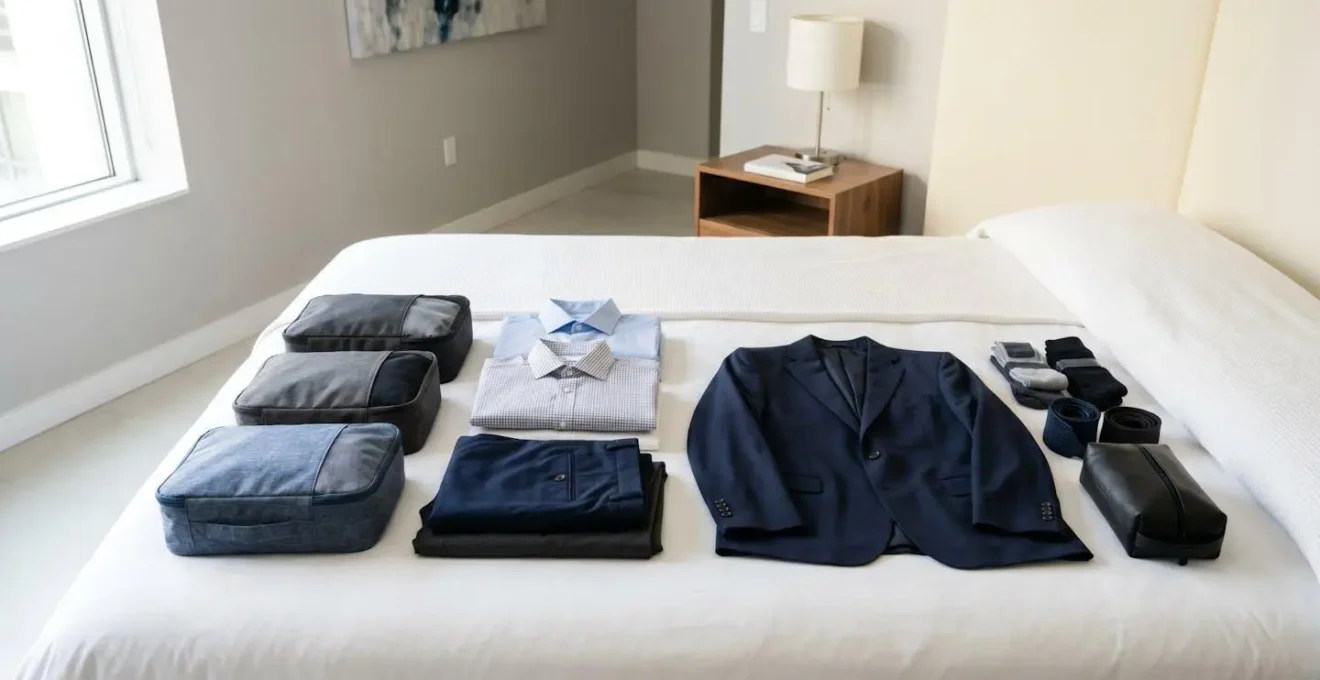
The most effective strategy for preserving your professional image on the road is to reduce or eliminate your dependency on external garment care services altogether. This is not about compromising on style, but about making strategic investments in a travel-specific capsule wardrobe built from modern, high-performance fabrics. This approach serves as your ultimate contingency plan, ensuring you have a crisp, professional option ready regardless of hotel service quality or logistical delays.
The foundation of this wardrobe is material science. Brands like Ministry of Supply, Bluffworks, and Everlane have engineered fabrics that merge the classic aesthetics of business wear with the wrinkle-resistance and durability of performance apparel. A blazer made from a technical, wrinkle-resistant fabric can be packed in a suitcase and emerge ready to wear, while a shirt made from a polyester blend like AeroZero can be washed in a hotel sink, hung to dry overnight, and be perfectly presentable the next morning. Natural fibers like merino wool and heavyweight cotton also offer excellent wrinkle-resistance and breathability.
Building this travel capsule wardrobe requires a shift in mindset from buying individual pieces to investing in a compatible, high-performance system. The goal is to have 3-4 core outfits that can be mixed and matched, all of which are resilient to the rigors of travel. This includes not just suits and shirts, but also foundational layers. Opting for merino wool t-shirts or base layers, for example, provides temperature regulation and can be worn multiple times without retaining odour, further reducing laundry needs.
The initial investment in these specialized garments is higher than standard business attire, but it should be viewed as a capital expenditure that yields significant returns. It saves money on exorbitant hotel dry cleaning fees, but more importantly, it buys you certainty and peace of mind. You are no longer gambling on the quality of a third-party service; you are in complete control of your professional presentation. Here are some specific, travel-tested examples to build your wardrobe around:
- Performance Business Shirts: Invest in brands like Ministry of Supply, whose AeroZero Dress Shirts are made from 100% recycled polyester that is both wrinkle-resistant and machine washable.
- Travel-Specific Blazers: Choose blazers designed for travel, such as the Bluffworks Gramercy Blazer, which is engineered with wrinkle-free properties for business wear.
- Heavyweight Cotton Alternatives: For more casual elements, select items like Everlane’s Heavyweight Tee. Its two-ply cotton construction naturally resists creasing while remaining comfortable.
- Merino Wool Layers: The natural elasticity of merino wool makes it incredibly wrinkle-resistant. It’s an ideal choice for layers as it also provides superior temperature regulation.
- Wrinkle-Free Cotton Shirts: For a traditional look, options like the Orvis Wrinkle-Free Cotton Twill Shirt use a 100% cotton fabric with a special soil-release finish that stays crisp through long flights.
This strategic approach to packing transforms your luggage from a collection of clothes into a reliable, self-sufficient toolkit for maintaining your executive presence anywhere in the world.
Express Facial or Deep Treatment: Which Before an Important Client Meeting?
Just as with garment care, maintaining your personal presentation through grooming requires a strategic, risk-managed approach, especially before a high-stakes meeting. The hotel spa may seem like a convenient oasis, but choosing the wrong treatment at the wrong time can be counterproductive, leading to redness, irritation, or breakouts—the very opposite of a polished, confident appearance. The decision between a quick « express » facial and a more intensive « deep » treatment is a classic risk-versus-reward calculation.
An express facial is the low-risk, immediate-reward option. Typically lasting 30-45 minutes, it focuses on hydration, gentle cleansing, and massage. The goal is to produce an immediate, visible « glow » and reduce signs of travel fatigue. Because it avoids aggressive techniques like deep extractions or chemical peels, the risk of an adverse reaction (redness, sensitivity) is minimal. This makes it the ideal choice if your important meeting is within the next 24 to 48 hours. It’s a reliable tool for a quick refresh and confidence boost.
A deep treatment, conversely, is a high-risk, long-term investment. While treatments involving peels, microdermabrasion, or extensive extractions can yield significant long-term benefits for skin health, they almost always cause short-term inflammation. The skin needs a recovery period of at least 72 hours for redness to subside and for the true benefits to emerge. Scheduling such a treatment the day before a major presentation is a strategic error, gambling on your skin’s unpredictable healing process. The safest approach, if you’ve never used the hotel’s spa before, is to opt for an in-room DIY protocol with products you’ve already tested, such as a trusted sheet mask and serum. This gives you full control and near-zero risk.
This comparative table clearly outlines the risk profile of each option, allowing you to make a decision that aligns with your schedule and presentation needs.
| Treatment Type | Time Required | Risk Level (48hr window) | Benefit Timeline | Best Use Case |
|---|---|---|---|---|
| Express Facial | 30-45 minutes | Low – minimal risk of adverse reaction | Immediate (hydration and glow visible within hours) | Meeting within 24-48 hours; first-time spa use at hotel |
| Deep Treatment (with extractions/peels) | 60-90 minutes | High – potential for redness, breakout, or sensitivity | Long-term (benefits appear 3-7 days post-treatment) | No important meetings for 72+ hours; established relationship with esthetician |
| In-Room DIY Protocol (sheet mask + serum) | 15-20 minutes | Very low – controlled products you’ve tested | Immediate (hydration and refresh within 1-2 hours) | Ultimate risk mitigation; full control over products and timing |
Ultimately, when a critical meeting looms, the governing principle should be risk mitigation. Opt for the predictable, immediate benefits of a simple treatment or a trusted self-care routine over the uncertain outcome of a more invasive procedure.
Why Laundry Services Become Critical for Hotel Stays Exceeding Five Nights
For a short business trip of two or three days, an executive can typically pack enough to avoid laundry services entirely. However, as a stay extends beyond the five-night mark, the dynamic fundamentally changes. The hotel transitions from a temporary stopover to a temporary residence, and access to reliable operational services like laundry becomes not a luxury, but a critical enabler of sustained productivity and professional presentation. Attempting to manage a ten-day trip with only the contents of a suitcase is inefficient and stressful.
The primary driver is logistical necessity. It is simply impractical to pack ten different professional outfits. The ability to cycle through a smaller, curated collection of clothing—washing and pressing shirts, blouses, and other essentials—is vital for maintaining a consistently polished appearance throughout the engagement. Relying on a hotel’s laundry or a local service allows for a much lighter, more manageable packing list, which is a significant benefit in itself during complex, multi-leg journeys.
Moreover, for extended stays, the cost-benefit analysis of using laundry services shifts. While hotel per-piece pricing is exorbitant for a single shirt, it can become more palatable when viewed as part of the overall cost of a long-term project. Many extended-stay properties, recognizing this need, offer more cost-effective solutions like per-kilo pricing or on-site, self-service laundry facilities. These amenities are a key reason why dedicated extended-stay hotels are a rapidly growing market segment. As research from Extended Stay America shows, guest satisfaction is directly tied to these practical amenities, with 85% of guests reporting they would choose an extended-stay hotel for future lodging needs precisely because these services provide a more convenient and cost-effective alternative to traditional hotels.
On a long-term assignment, outsourcing garment care is not an indulgence; it is a strategic delegation of a non-core task. It frees up valuable time and mental energy that can be better invested in the business objectives of the trip. The professional who plans for this necessity from the outset will be better equipped to maintain peak performance and presentation over the long haul.
Key takeaways
- The « same-day » dry cleaning promise from most hotels is a logistical gamble due to widespread outsourcing; do not rely on it for critical needs.
- Adopt a procurement mindset: quickly audit a hotel’s garment care service by asking about their partner, damage policies, and standard turnaround times.
- For stays exceeding two days, a local specialist dry cleaner almost always offers superior quality, accountability, and value compared to the high-markup hotel service.
Securing Operational Services Enabling Productive Long-Term Hotel Living
Successful long-term hotel living for a business engagement is not about enduring a temporary situation; it’s about rapidly establishing a fully functional, productive home base. This requires a proactive, systematic approach to securing and optimizing the key operational services—laundry, food, and logistics—that underpin daily performance. Waiting until a need becomes critical is a reactive posture that leads to stress and inefficiency. The goal is to build a personalized, reliable support ecosystem within and around the hotel from week one.
This is becoming increasingly critical as the nature of business travel evolves. With the extended stay hotel market projected to grow from USD 62.8 billion in 2025 to over USD 143 billion by 2035, the industry is rapidly adapting to the needs of the long-term resident. Modern properties are designed as hybrid living-working spaces, and the savvy executive must learn to leverage this new infrastructure. This means going beyond the guest directory and treating the hotel as a platform of services to be customized.

The process of establishing this ecosystem should be methodical. Your first week should be dedicated to establishing routines and negotiating preferences with hotel management, such as a fixed weekly laundry pickup time. By the second week, you should be expanding your network to include external services, identifying a trusted local dry cleaner or a preferred healthy food delivery service to supplement hotel offerings. The following structured plan provides a roadmap for optimizing your long-term stay, transforming a generic hotel room into a high-performance operational headquarters.
- Weeks 1-2: Establish Core Routines. Negotiate recurring service schedules directly with the hotel manager. This includes preferential laundry pickup times and housekeeping frequencies adjusted for your residential needs, not a transient guest’s.
- Week 2: Build Your Local Service Network. Register with food delivery apps using the hotel address to access healthier options beyond room service. Identify and test local courier services for sending and receiving business documents.
- Week 3: Leverage Hybrid Hotel Features. Fully utilize the hotel’s evolving amenities. Integrate into the on-site coworking zones, which are now available in over 60% of new extended-stay properties. Master the hotel’s app for efficient, mobile-based service ordering.
- Week 4+: Cultivate a Key External Partner. Identify and build a relationship with one critical off-property service provider. This could be a trusted car service, a mobile barber, or a specialist dry cleaner who understands your specific needs, providing flexibility and a backup to the hotel’s ecosystem.
- Ongoing: Monitor and Optimize. Actively track your expenses to identify optimization opportunities. For example, determine the point (typically around day 5-7) at which using a per-pound wash-and-fold service becomes more economical than the hotel’s per-piece charges for basic items.
By proactively managing these logistical elements, you transform the challenges of an extended stay into a strategic advantage, ensuring you can maintain maximum productivity and a polished, professional presence for the entire duration of your assignment.