
Contrary to popular belief, the key to a joyful family holiday isn’t a perfect itinerary; it’s actively protecting your shared time from the ‘satisfaction destroyers’ of over-scheduling, digital distraction, and performative pressure.
- Overly rigid plans can reduce family enjoyment by creating pressure and eliminating space for spontaneous connection.
- Genuine quality time comes from novel shared experiences and balanced activities, not just luxury or kid-centric entertainment.
Recommendation: Shift your focus from controlling every moment to intentionally designing a framework that allows authentic family connection to emerge naturally.
For many UK parents, the anticipation of a family holiday is a mix of excitement and a low-level hum of anxiety. You invest significant time, money, and emotional energy into planning the perfect getaway, envisioning shared laughter and lifelong memories. Yet, the reality can often fall short, dissolving into a landscape of scheduling conflicts, teenage screen-time battles, and the quiet pressure to look like you’re having the time of your lives. The common advice is to plan more, to schedule activities to keep everyone busy, and to book that all-inclusive « family-friendly » resort.
But what if this approach is the very source of the problem? What if meticulous control is the enemy of genuine connection? The constant rush from one pre-booked activity to another leaves no room for the quiet, unpredictable moments where real bonding happens. The focus on capturing ‘perfect’ photos for social media pulls everyone out of the present, replacing authentic joy with a performance of happiness. These are the hidden ‘satisfaction destroyers’ that silently sabotage our most precious shared time.
This guide offers a different perspective. It’s not about finding the perfect destination, but about building a better ‘connection architecture’ for your holiday, regardless of where you are. We will explore how to protect your family’s joy by identifying and neutralizing these common points of friction. By shifting from a mindset of control to one of intentional design, you can create the space for the deep, restorative connection you and your family truly crave.
This article provides a complete framework for rethinking your approach to family holidays. You will find actionable strategies to balance everyone’s needs, decode marketing jargon, manage technology, and foster authentic moments that strengthen your family bonds.
Summary: A Guide to Creating Genuinely Connected Family Holidays
- Why Over-Scheduled Holidays Reduce Family Enjoyment by 70% Compared to Flexible Plans
- How to Balance Adult Interests With Children’s Needs in Shared Holiday Activities
- What « Family-Friendly » Actually Means in Destination Marketing Language
- The Technology Pattern That Ruins Present-Moment Family Connection on Holidays
- How to Capture Authentic Family Joy Without Staging Performative Happiness
- Why Novel Shared Experiences Bond Couples 3× Stronger Than Luxury Settings
- The Group Planning Burden That Falls Unfairly on One Organizer
- Designing Deliberate Romantic Experiences That Strengthen Couple Connection
Why Over-Scheduled Holidays Reduce Family Enjoyment by 70% Compared to Flexible Plans
The impulse to plan a family holiday down to the minute is understandable; it feels like a defence against chaos and wasted time. We create detailed spreadsheets and back-to-back bookings in pursuit of maximum value. However, this strategy often backfires, becoming the primary ‘satisfaction destroyer’. When every hour is accounted for, there is no room for the organic moments of discovery that often become the most cherished memories—the spontaneous decision to explore a side street, linger over an ice cream, or simply watch the waves. The pressure to stick to the schedule can create tension and turn the holiday into a series of logistical challenges rather than a relaxing experience.
This isn’t just a feeling; it’s a preference rooted in how we desire to travel. While 90% of families enjoy the planning phase, comprehensive family travel research shows that 59% prefer to plan only the basics, leaving the rest to spontaneity. This reveals a fundamental disconnect: our planning methods often contradict our intrinsic desire for freedom and flexibility. An over-scheduled holiday forces a rigid structure onto an experience that we instinctively want to be fluid. The result is a subtle but pervasive sense of being rushed and managed, which directly erodes enjoyment.
Case Study: The Rise of Flexible ‘Stay-and-Play’ Packages
Recent hospitality research highlights a significant shift in family travel trends. An analysis from 2024 shows that families are increasingly opting for shorter, more frequent trips that fit into busy schedules without the pressure to maximise every second. In response, hotels have found success with ‘stay-and-play’ packages that offer a menu of optional activities rather than a mandatory itinerary. The data is clear: properties report that families who book these flexible packages show significantly higher satisfaction scores and return rates. This supports the core principle that the perceived abundance of choice and the absence of obligation are critical for reducing vacation stress and enhancing family enjoyment.
The solution lies in building a ‘connection architecture’ that is a framework, not a cage. Plan the non-negotiables: flights, accommodation, and one or two anchor activities. But for the rest, create a ‘menu of possibilities’ that the family can choose from each day. This approach respects the need for structure while empowering the family with a sense of autonomy and encouraging the kind of spontaneous adventures that build lasting bonds.
How to Balance Adult Interests With Children’s Needs in Shared Holiday Activities
One of the classic holiday friction points is the tug-of-war between adult-centric activities (art galleries, historical sites, long dinners) and child-focused fun (playgrounds, water parks). The generic advice to « involve the kids » is a starting point, but often not enough to prevent meltdowns or parental resentment. Data shows children have significant sway, with 81% of families consulting their children on holiday plans. The challenge isn’t about abdication to a « tyranny of the toddler » but about creating a balanced and intentional activity ecosystem where everyone feels seen and catered to.
A successful approach moves beyond simple compromise to a more strategic ‘activity stacking’. This involves pairing an adult-interest activity with an immediate and guaranteed child-focused reward. For example, a 30-minute visit to a historic church can be followed directly by a trip to a famous local ice cream shop. This technique acknowledges the limited attention spans of children and reframes the ‘boring’ part as a short step towards something exciting. It’s not bribery; it’s intelligent emotional and logistical planning.
The goal is to find ‘Low-Floor, High-Ceiling’ activities. These are experiences accessible to the youngest family member (low floor) but which offer deeper layers of engagement for older children and adults (high ceiling). A walk on the beach is a perfect example: a toddler can splash in the shallows, an older child can hunt for crabs in rock pools, and adults can enjoy the scenery and conversation. This ensures shared time is genuinely shared, rather than a scenario where one part of the family is simply enduring an activity for the sake of the other.
Your Action Plan for Balanced Family Fun
- Identify ‘Low-Floor, High-Ceiling’ Activities: Brainstorm options accessible to all ages but offering varied engagement (e.g., a boat trip, a food market, a nature trail).
- Implement Daily Rotation: Structure each day with one child-focused activity, one adult-interest experience, and one genuinely shared family moment to ensure everyone’s needs are met.
- Use ‘Activity Stacking’: Pair adult cultural experiences (e.g., a museum visit) with immediate child-focused rewards located nearby (e.g., a unique playground).
- Pre-research Family-Friendly Versions: Look for interactive exhibits, audio guides for kids, or scavenger hunts at adult attractions to enhance engagement for younger members.
- Build in Buffer Time: Schedule downtime between activities to prevent overstimulation, manage transitions, and allow for those crucial organic discovery moments.
By consciously designing this balance, you transform the holiday from a series of compromises into a rich tapestry of experiences that cater to the entire family unit. It’s a key part of building a resilient and joyful ‘connection architecture’.
What « Family-Friendly » Actually Means in Destination Marketing Language
The term « family-friendly » is one of the most overused and ambiguous phrases in the travel industry. For exhausted parents, it promises a haven of convenience and entertainment. In reality, it can mean anything from a hotel that simply doesn’t prohibit children to one with a full-blown water park and round-the-clock childcare. This vagueness is a trap. Arriving at a hotel that advertised a « family suite » only to find it’s a standard room with a sofa bed can be a major ‘satisfaction destroyer’, setting a tone of disappointment for the entire trip.
To protect your holiday joy, you must become a savvy decoder of this marketing language. True family-friendliness is not just about amenities; it’s about space, safety, and services. A genuinely family-friendly hotel understands that parents need physical separation from sleeping children to have a relaxing evening. They understand that access to a kitchenette can be a lifesaver for managing picky eaters or early morning milk. They understand that guaranteed connecting rooms are infinitely more valuable than a ‘request’ for them.
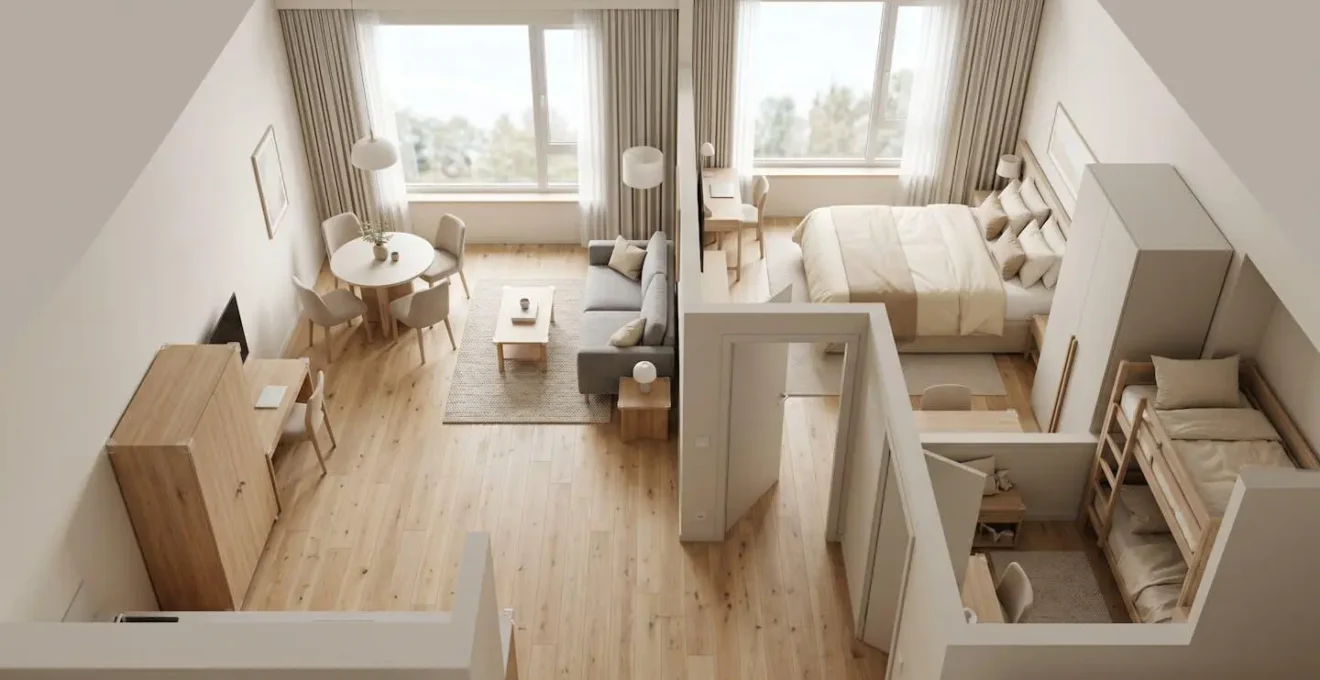
As the image above illustrates, a truly thoughtful family suite is designed around spatial intelligence—providing separate zones for sleep and relaxation. The key is to look beyond the marketing headline and ask specific, probing questions before you book. Instead of asking « Are you family-friendly? », ask « What is the exact square footage of the family suite? » or « Can you guarantee connecting rooms in writing? ». This shifts the power back to you and ensures your expectations align with reality.
The following table breaks down common marketing terms and provides the critical questions you should be asking to understand what is truly being offered. Consulting a resource like this before booking is a crucial step in building a frustration-free holiday foundation.
| Marketing Term | What It Actually Means | Questions to Ask Before Booking |
|---|---|---|
| Kids Club | Supervised area for children’s activities; quality varies widely by age grouping and staff training | What are the age ranges? What is the staff-to-child ratio? Are staff trained in first aid? |
| Family Suite | Multi-room layout with separate sleeping space for kids, often includes kitchenette | Is it a true separate room or just a sofa bed in the same space? What are the square footage and bed configurations? |
| Connecting Rooms | Two rooms with an internal connecting door; may not always be guaranteed | Is this a request or guarantee? Can it be confirmed at booking? Is there an extra charge? |
| Baby Gear Rental | On-site availability of cribs, high chairs, strollers; may or may not be complimentary | Are items complimentary or paid? How far in advance must you reserve? Are items sanitized between uses? |
| Childcare Services | May range from certified babysitters to informal referrals | Are providers hotel employees or third-party? What certifications do they hold? What is the cancellation policy? |
The Technology Pattern That Ruins Present-Moment Family Connection on Holidays
Perhaps no ‘satisfaction destroyer’ is more pervasive in the modern family holiday than technology. It’s the teenager glued to their phone at a scenic viewpoint, the parent buried in Google Maps while navigating a new city, and the collective pull to check notifications during what should be shared downtime. While technology is a useful tool for travel, its unchecked use fragments attention and erects invisible walls between family members, preventing present-moment presence. This isn’t just an annoyance; it has tangible impacts on well-being.
The statistics are concerning. According to data from the National Health Interview Survey, a staggering 50.4% of teenagers report four or more hours of daily screen time. The survey highlights a strong correlation with mental health challenges, with about 1 in 4 of these high-use teenagers experiencing symptoms of anxiety or depression. A holiday is meant to be a restorative escape, but importing these high-screen-time habits can inadvertently import the associated stress and disconnection, defeating the purpose of the trip.
The solution isn’t a draconian, trip-long ban, which is likely to cause more conflict than it solves. Instead, the answer lies in creating a pre-agreed ‘Family Tech Charter’ for the holiday. This is a collaborative agreement, discussed and set before you leave, that establishes clear and reasonable boundaries. It’s a core part of your ‘connection architecture’ that protects shared moments without sparking a rebellion. The charter should be simple and focus on creating tech-free zones and times.
Effective strategies include:
- Establishing ‘Phone-Free Zones’: Agree that mealtimes (at the table or on a picnic blanket) and the first and last hour of each day are completely screen-free to encourage conversation and reflection.
- Designating a rotating ‘Family Photographer’: Assign one person per day to be the official photographer. This frees everyone else from the impulse to constantly document the trip and allows them to simply experience it.
- Scheduling a daily ‘Tech Check-In Hour’: Set aside a specific time, perhaps in the late afternoon, where everyone is free to use their devices without guilt. This contains tech use to a specific window and makes it easier to collectively put devices away afterwards.
- Implementing ‘Navigator Rotation’: So one parent isn’t constantly missing the scenery because they are focused on a map app, rotate the role of navigator between adults or even responsible older teens.
How to Capture Authentic Family Joy Without Staging Performative Happiness
In an age of social media, there is immense pressure to ‘prove’ you are having a wonderful holiday. This leads to what can be called ‘performative happiness’—staging photos and videos that look joyful, even if the moment itself is filled with stress. We direct our kids to « smile for the camera! » so many times that we interrupt the very authentic joy we are trying to capture. This constant need to document and curate can become a significant ‘satisfaction destroyer’, pulling the entire family out of the present moment and into the role of actors in their own lives.
The goal should be to capture memories, not to manufacture them. This requires a shift in mindset from director to observer. Instead of orchestrating the perfect shot, look for the small, unposed, organic moments of connection: your children laughing together over a private joke, your partner’s relaxed expression as they look out at the sea, or the quiet concentration on your child’s face as they examine a seashell. These are the images that will hold the most emotional resonance for years to come, far more than a forced group photo where everyone is wearing a strained smile.

As author and filmmaker Steve Stockman advises, the key is to engage with your children’s world rather than imposing your own narrative on it. His insight is a powerful reminder of where true value lies:
Your five-year-old will never be 5 again. Ask her open-ended questions about what’s going on. Let her show you, explain to you, sing to you.
– Steve Stockman, How to Shoot Vacation Video that Won’t Bore People to Death
One practical strategy is to use the ‘Family Photographer’ role mentioned earlier. This person’s job is not just to take photos, but to be the designated memory-keeper for the day, focusing on candid moments. Another powerful tool is to switch your phone or camera to video and simply let it run for a minute or two during an activity, capturing the natural sounds and interactions without any direction. These unscripted snippets often become the most treasured souvenirs of your time together.
Why Novel Shared Experiences Bond Couples 3× Stronger Than Luxury Settings
When planning a family holiday, the focus is naturally on the children. But these trips are also a crucial opportunity for couples to reconnect away from the daily grind. Often, the assumption is that romantic connection is best fostered in luxurious settings—a fancy dinner, a five-star hotel. While pleasant, these passive experiences often lack the ingredients for deep bonding. The surprising truth is that novel shared experiences, even simple or challenging ones, are far more powerful for strengthening a relationship.
The reason for this lies in our brain chemistry. Groundbreaking research published in Biology demonstrates that novel stimuli trigger a significantly stronger dopamine response than familiar ones. Dopamine is a key neurotransmitter in the brain’s reward system. When this is combined with oxytocin—the ‘bonding hormone’—our brains create a powerful and lasting link between our partner and the feeling of social reward. Trying something new together—whether it’s a cooking class, learning to paddleboard, or navigating a foreign city’s public transport—floods our system with these bonding chemicals.
Case Study: The ‘Self-Expansion Model’ in Long-Term Love
Neural imaging studies on couples in long-term romantic partnerships provide compelling evidence for the power of novelty. Research shows that couples who regularly engage in new and challenging activities together maintain patterns of brain activation in dopamine-rich reward systems that are similar to those seen in the early stages of romantic love. This is explained by the ‘self-expansion model,’ which suggests that by overcoming shared challenges, couples create a powerful ‘team’ narrative. The simple act of learning a new skill together or navigating an unfamiliar environment builds a sense of shared competence and mutual reliance that passive luxury experiences simply cannot replicate. This process is critical for long-term pair-bond maintenance through sustained neurochemical reward.
This provides a high ‘Relational ROI’ (Return on Investment). A simple, shared challenge can build more connection than an expensive but passive luxury experience. The key for couples on a family holiday is to deliberately carve out time for one or two such novel activities, leveraging childcare or kids’ clubs to make it happen. It doesn’t have to be extreme; it just has to be new *for both of you*. This shared growth is the secret engine of sustained romantic connection.
The Group Planning Burden That Falls Unfairly on One Organizer
In most families, the immense mental and emotional labour of planning a holiday falls disproportionately on one person—often, but not always, the mother. This individual becomes the de facto project manager, travel agent, and logistics coordinator. They research destinations, find flights, book accommodation, plan activities, and create packing lists. This is a huge ‘satisfaction destroyer’ that can lead to burnout and resentment before the holiday has even begun. The sheer scale of this investment is often underestimated.
Consider the financial and logistical weight of the task. According to the 2025 Family Travel Survey, the average family spent around $8,052 on travel in 2024, a significant financial outlay that adds to the pressure of ‘getting it right’. With 92% of parents planning to travel with their children in the next year, this burden is a widespread and repeating pattern. When one person carries this entire load, they often arrive on holiday already exhausted, making it difficult for them to relax and enjoy the trip they worked so hard to create.
The solution is to make this invisible labour visible and to distribute it consciously across the family. This requires a structured approach, not just a casual « can someone help me? ». A ‘Pre-Trip Delegation Meeting’, held 4-6 weeks before departure, can be transformative. In this meeting, the primary planner presents the draft itinerary and the family collectively decides how to share the remaining responsibilities. The key is to formalise these roles to create accountability and a sense of shared ownership.
A fun and effective framework involves assigning official-sounding roles:
- Assign visible and fun roles: ‘Director of Snacks and Hydration,’ ‘Minister of Music and Entertainment’ (in charge of playlists), ‘Head of Navigation,’ or ‘Chief of Photography.’
- Create a shared digital document: Use a tool like Google Docs or a shared note where each person manages their domain (e.g., adding links to restaurant suggestions, curating their packing list).
- Establish a ‘decision-making deputy’: Designate another adult or older teen who takes over all planning and decision-making for specific 24-hour periods during the trip, giving the primary organizer true ‘off-duty’ time.
- Conduct a mid-trip check-in: A quick 15-minute chat halfway through the holiday to see if any tasks need to be redistributed, modelling flexibility and teamwork.
Key Takeaways
- True holiday joy comes from flexibility and spontaneity, not rigid, over-scheduled itineraries.
- Balancing adult and child needs through strategic ‘activity stacking’ and finding ‘low-floor, high-ceiling’ experiences prevents conflict.
- Protecting ‘present-moment presence’ by setting clear, pre-agreed technology boundaries is crucial for genuine connection.
- Novel shared experiences, even simple ones, are more powerful for couple bonding than passive luxury due to their neurochemical impact.
Designing Deliberate Romantic Experiences That Strengthen Couple Connection
In the whirlwind of a family holiday, where the logistics of children’s needs dominate, the couple’s connection can easily become an afterthought. Yet, the strength of the parental partnership is the very foundation upon which a happy family is built. The trend towards multi-generational travel, while wonderful for family bonding, can exacerbate this issue. Recent family travel trend analysis shows that in 2025, 47% of travellers are choosing these trips, with ‘quality time’ cited as the primary motivator. The irony is that in the pursuit of more *family* quality time, *couple* quality time is often the first casualty.
Protecting and nurturing the couple’s bond requires a deliberate, strategic approach. It won’t happen by accident. You have to design it into the holiday’s ‘connection architecture’. As research on long-term relationships notes, sustained reward is key:
romantic love—associated with engagement, sexual interest and lower attention to alternative partners—may promote pair-bond maintenance through sustained reward
– Bianca Acevedo et al., Neural correlates of long-term intense romantic love
This means proactively using the infrastructure available to you. If there are grandparents on the trip, schedule a ‘date night’ in advance. If the hotel has a kids’ club or offers certified childcare, book a two-hour slot and use that time for a simple, connecting activity—a walk on the beach, a quiet coffee, or a shared novel experience.
Case Study: The Power of ‘Permission and Structure’
Hotels targeting multi-generational travellers have started to recognise this gap. Innovative properties are now implementing ‘couple connection programming’. This involves pairing pre-scheduled kids’ club activities with curated experiences for two, such as private sunset wine tastings or dedicated spa slots. The results are striking, with these hotels reporting 34% higher guest satisfaction scores. A case study from one Caribbean resort found that simply prompting couples at check-in to book one ‘mini-date’ using the complimentary childcare significantly increased their likelihood of returning. The insight is profound: couples often need explicit permission and a clear structure to prioritize their relationship amidst family time, transforming potential guilt into powerful intentionality.
Investing in your connection is not selfish; it is the most important investment you can make in your family’s overall happiness. By designing these small, deliberate moments into your holiday, you refuel your partnership, which in turn creates a more stable, loving, and joyful environment for everyone.
The first step towards a more connected and joyful family holiday is to have an open conversation before your next trip. Use the ideas in this guide to discuss what a truly relaxing and bonding experience would look like for everyone, and collaboratively design a flexible framework that protects your precious time together.