Hotels & Accommodations
Choosing the right hotel accommodation involves far more than simply comparing prices and locations. The modern hospitality landscape presents travelers with an overwhelming array of options, terminology, and promises—from star ratings that vary by country to service descriptions that can mean entirely different things depending on the establishment. Understanding what you’re actually paying for, what legal protections cover your booking, and which amenities genuinely meet your needs requires navigating a complex industry with inconsistent standards and varying levels of transparency.
This comprehensive resource demystifies the hotel and accommodation sector by examining the practical realities behind industry terminology, classification systems, and service promises. Whether you’re booking a budget room for a quick overnight stay or reserving a luxury suite for an extended business trip, the knowledge contained in these sections will help you assess genuine quality, verify actual room dimensions, understand your consumer rights, and identify which services justify their premium pricing. The goal is to transform you from a passive booker into an informed decision-maker who can confidently select accommodations that truly match your requirements.
Understanding Hotel Classifications and Star Ratings
Hotel star ratings represent one of the most misunderstood aspects of accommodation booking. Many travelers assume that a five-star hotel delivers consistent quality worldwide, but the reality is far more nuanced. Star rating systems vary dramatically between countries, with some nations employing rigorous government-regulated assessments while others rely on voluntary industry schemes or even self-certification by hotel owners.
What Star Ratings Actually Measure
Official star ratings typically assess tangible factors: room size, availability of ensuite facilities, reception desk operating hours, and the presence of specific amenities like air conditioning or room service. A three-star property in one country might offer substantially different facilities compared to a three-star hotel elsewhere. The rating focuses primarily on what exists rather than the quality of execution—a hotel can technically qualify for four stars based on having a gym and restaurant, regardless of whether the gym contains functional equipment or the restaurant serves appealing food.
International Rating Variations and Traveler Expectations
When booking abroad, the classification assumption disappoints a significant proportion of international travelers who expect universal standards. A British four-star hotel typically emphasizes service quality and heritage charm, often in buildings with smaller rooms due to historic architecture. Continental European equivalents might prioritize room size and modern amenities. Asian five-star properties frequently include extensive facilities like multiple restaurants and spa complexes that would be exceptional elsewhere but represent baseline expectations in major cities like Singapore or Hong Kong.
Balancing Official Ratings With Guest Reviews
Neither official star ratings nor guest reviews alone provide complete insight. Star ratings confirm the presence of facilities but cannot measure staff attitude, cleanliness consistency, or maintenance quality. Guest reviews capture experiential elements but can be skewed by unrealistic expectations, personal preferences, or isolated incidents. The most reliable assessment method combines three rating sources simultaneously: official classification for facility baseline, aggregate review scores for experiential quality, and recent individual reviews for current operational standards. Pay particular attention to reviews from travelers with similar priorities to your own—business travelers and leisure families rarely value the same attributes.
Room Categories and Spatial Requirements
Room category terminology causes considerable confusion, with terms like « standard, » « economy, » « superior, » and « deluxe » lacking universal definitions across the industry. Understanding actual space requirements and how to verify them before arrival prevents the disappointment that affects many guests who find their room physically unusable for their intended stay duration.
Standard Room Versus Economy Room Distinctions
The difference between standard and economy rooms varies by property. In some hotels, « economy » simply means a less desirable location within the building—perhaps facing a car park rather than gardens, or situated near service areas. In others, economy rooms are measurably smaller or lack certain amenities present in standard accommodations. A critical question to ask during booking: does the room category affect the physical dimensions or merely the view and floor location? Many hotels now use « standard » as their baseline category, with « economy » or « compact » rooms introduced as budget alternatives in space-constrained urban properties.
Minimum Space Requirements for Comfortable Stays
Room size dramatically impacts comfort, particularly for stays exceeding three nights or for couples sharing the space. British hotel rooms average approximately 30% smaller than Continental European equivalents, with many urban properties offering rooms as compact as 12-15 m². While adequate for solo business travelers sleeping only, such dimensions become claustrophobic during week-long stays when you need space for open luggage, work materials, or simply movement that doesn’t require constant negotiation with your travel companion.
For a couple’s seven-night stay, minimum comfortable dimensions start around 20-22 m², allowing space for a proper desk, seating area, and luggage access without constant reorganization. Extended stays or those involving remote work benefit from 25 m² or larger. Hotels frequently disguise compact dimensions through clever photography—wide-angle lenses make spaces appear 40% larger than reality. Request specific room dimensions in square meters rather than relying on photographs, and note that « room size » sometimes includes bathroom area in quoted figures.
Connecting Rooms and Special Configurations
« Connecting rooms » in British hotel terminology legally refers to adjacent rooms with an internal door allowing passage between them without entering the corridor. This differs from « adjoining rooms » (simply next to each other) or « communicating rooms » (terminology varies by region). When booking connecting rooms for family stays, confirm whether the internal door can be locked from both sides for privacy, and verify that both rooms meet your individual space requirements—hotels sometimes pair a standard room with a noticeably smaller second room.
Essential Hotel Services and Their Real Meanings
Service descriptions in hotel marketing materials often promise more than operational reality delivers. Understanding what services actually include—and which questions to ask before arrival—prevents disappointment and helps you assess genuine value.
Concierge and Reception Services
« 24-hour concierge » and « round-the-clock reception » describe different service levels. A 24-hour reception simply means someone staffs the front desk continuously—they can check you in at 3 AM and handle basic queries, but may not provide the specialist local knowledge, restaurant booking capabilities, or problem-solving expertise that defines genuine concierge service. True concierge teams maintain relationships with local venues, can secure reservations at sought-after restaurants, and proactively solve complex travel problems. Budget and mid-range properties rarely employ dedicated concierges despite marketing language suggesting otherwise.
To test service standards before arrival, contact the hotel with a specific request that requires local expertise or relationship access—perhaps asking them to recommend and book a table at a popular restaurant for an upcoming weekend. The quality, speed, and helpfulness of their response provides reliable insight into actual service capabilities.
Turndown Service and Housekeeping Standards
Turndown service in British four and five-star hotels traditionally includes evening room preparation: closing curtains, turning down bedcovers, refreshing towels, emptying bins, and leaving bedside water or chocolates. However, standards vary considerably. Some properties offer full turndown only on request or limit it to suite categories. Budget hotels rarely provide any evening service beyond basic housekeeping during your absence.
The comfort feature hotels most frequently skimp on—affecting a substantial majority of guests’ health and sleep quality—is adequate pillow variety and quality bedding. Many properties provide only two standard pillows per bed regardless of firmness preferences, and use synthetic bedding that doesn’t regulate temperature effectively. Upon booking, ask whether additional pillows (firm, soft, hypoallergenic) can be provided, and whether natural-fiber bedding is available for guests sensitive to overheating.
Room Service Specifications
« 24-hour room service » in budget hotels often means limited menu availability outside main meal times—perhaps only sandwiches and drinks after 10 PM rather than full kitchen service. Luxury properties typically offer extensive menus around the clock, though quality and pricing vary. Delivery times also differ dramatically: genuine five-star service targets 20-30 minutes for most items, while budget properties might require 45-60 minutes even for simple orders. Clarify both menu scope and typical delivery times when room service matters to your stay comfort.
Booking Policies and Consumer Protection
The gap between hotel marketing promises and legal obligations creates confusion around cancellation policies, price guarantees, and your actual rights when things go wrong. Understanding these protections helps you book confidently and address problems effectively.
Free Cancellation Terms and Hidden Conditions
« Free cancellation » policies still result in unexpected charges for approximately one-fifth of guests who misunderstand the specific terms. Most free cancellation offers require cancellation by a specific time—often 48 or 72 hours before arrival, sometimes calculated in the hotel’s local time zone rather than yours. Cancel even minutes after this deadline and full charges typically apply. Some rates advertise free cancellation but impose it only on the room rate, with additional charges for breakfast, parking, or resort fees remaining non-refundable regardless of cancellation timing.
Always verify the exact cancellation deadline in your booking confirmation, note which time zone applies, and confirm whether any ancillary charges remain payable if you cancel. Booking through third-party sites sometimes involves two separate cancellation policies—the site’s terms and the hotel’s terms—creating additional complexity.
Best Rate Guarantee Programs and Their Limitations
Best rate guarantees legally require UK hotels to match lower rates found elsewhere for identical room categories, dates, and terms. However, guarantee loopholes void approximately half of price match claims. Common exclusions include: rates available only to loyalty program members, prices on foreign-language versions of booking sites, rates requiring full prepayment when you booked a flexible rate, and member-only deals from warehouse clubs or professional associations.
The guarantee also typically requires identical cancellation terms—you cannot claim a match between your flexible-rate booking and a cheaper non-refundable rate. To successfully claim a best rate guarantee, document the lower rate with screenshots showing all terms, submit your claim promptly (usually within 24 hours of booking), and ensure exact comparability in every detail.
Your Legal Rights Under Consumer Protection Law
UK Consumer Rights legislation protects hotel bookings by requiring services to match their description, be performed with reasonable care and skill, and be fit for purpose. If your room differs materially from what was booked—wrong category, missing advertised amenities, or unsuitable condition—you’re entitled to remedies including room upgrades, partial refunds, or contract cancellation with full refund in serious cases. However, minor disappointments (view less attractive than expected, room decor dated) rarely constitute legal breaches unless specific features were contractually guaranteed.
When problems arise, document issues with photographs and timestamps, report them immediately to hotel management for opportunity to remedy, and keep records of all communications. Consumer protection applies whether you booked directly or through third parties, though complaint processes differ.
Connectivity Requirements for Modern Travelers
Reliable internet connectivity has evolved from luxury amenity to essential utility, particularly for business travelers and remote workers. Yet « free WiFi » promises frequently fail to deliver speeds and stability required for productive work or reliable communication.
Complimentary WiFi in approximately 45% of British hotels proves inadequate for video calls, with bandwidth limitations, connection instability, or congestion during peak hours making professional video conferencing unreliable. Budget and mid-range properties typically share bandwidth across all guests, meaning evening usage creates severe slowdowns. The bandwidth limitation particularly problematic for remote workers involves upload speeds—many hotels provide acceptable download speeds for web browsing while restricting uploads to levels that disrupt cloud backups, video calls, and file sharing.
To test WiFi before arrival, contact the hotel requesting specific speed information: both download and upload speeds in Mbps, whether speeds are dedicated or shared, and if wired Ethernet connections are available in rooms. Properties confident in their connectivity will provide this information readily. For business-critical requirements, consider whether premium WiFi tiers justify their cost—these often provide dedicated bandwidth and priority traffic routing that maintains stability during peak usage. Alternatively, request wired Ethernet access, which typically delivers more stable connections for stationary work than wireless networks.
Facilities, Exclusivity, and Guest Security
Hotel facilities like gyms, pools, and lounges add value only when genuinely accessible and appropriately exclusive. Marketing promises of « guest-only » amenities sometimes mask policies allowing substantial non-guest access that creates crowding, security concerns, and availability issues.
« Guest-only » swimming pools in some hotels still admit dozens or even hundreds of day-pass holders daily, particularly in properties marketing themselves to local residents for spa and leisure facilities. Similarly, « fully equipped » gyms vary dramatically between three-star and five-star properties—a three-star gym might offer a treadmill and basic weights in a repurposed office, while five-star facilities typically include multiple cardio machines, comprehensive strength equipment, and sometimes dedicated studios for classes.
To verify genuine exclusivity before arrival, ask specific questions: How many non-guests access facilities daily? Are day passes or memberships sold? What are peak usage times? Facilities truly restricted to overnight guests rarely experience severe crowding and offer better security assurance. For complete privacy and guaranteed exclusivity, members’ club hotels or exclusive boutique properties with strict access policies provide more reliable control than large hotels supplementing revenue through facility memberships and day passes.
Access policy loopholes can compromise personal security when « guest-only » claims prove misleading. Hotels allowing extensive non-guest access to pool, gym, or spa areas create zones where unfamiliar faces belong legitimately, making it harder to identify unauthorized individuals in guest-only spaces. When security and privacy matter, verify exclusivity policies thoroughly and favor smaller properties with genuinely restricted access.
Independent Hotels Versus Chain Properties
The choice between independently owned hotels and chain properties involves trade-offs between personalized service and standardized reliability. Independent hotels often outperform chains in creating distinctive experiences and adapting to individual guest needs—staff in owner-operated properties typically hold greater authority to resolve problems creatively or accommodate special requests without navigating corporate approval processes.
Chain hotels offer consistency, predictable standards, and integrated loyalty programs that benefit frequent travelers. You generally know what to expect from a chain property anywhere in the world, reducing booking risk. However, this standardization sometimes comes at the expense of local character and genuine hospitality. The most satisfying choice depends on your priorities: chains for reliable consistency and reward program benefits, independents for distinctive character and flexible, personalized service.
Long-Term Stays and Extended Service Needs
Accommodation requirements shift substantially for stays exceeding five nights. Services negligible for short visits—laundry facilities, flexible housekeeping, kitchen access, work space—become critical for extended stays. Laundry services particularly impact longer visits, yet hotels often charge premium rates that accumulate to £200 or more monthly for regular cleaning of business and casual clothing.
When booking extended stays, negotiate weekly housekeeping rates rather than accepting per-item pricing, request reduced-frequency room cleaning in exchange for lower rates, and ask whether serviced apartment options provide better value than traditional hotel rooms. Many hotels offer unadvertised extended-stay discounts and modified service packages for bookings exceeding two weeks—these arrangements often prove negotiable, particularly during low-occupancy periods.
Understanding hotels and accommodations transforms booking from guesswork into informed decision-making. The knowledge of how star ratings truly work, what room dimensions you actually need, which service promises carry meaning, and what legal protections cover your booking empowers you to assess genuine value and select properties that authentically meet your requirements. Every booking decision becomes more confident when you can decode industry terminology, verify facility claims, and recognize the difference between marketing language and operational reality.

Verifying Facilities Are Truly Guest-Restricted to Avoid Crowds and Security Risks
Contrary to marketing claims, a hotel’s « guest-only » policy is often a myth driven by ancillary revenue, creating significant privacy and security gaps for high-profile travelers. Hotels increasingly monetize amenities by selling day passes to the public, turning private pools into…
Lire la suite
Securing Operational Services for Productive Long-Term Hotel Stays
For stays exceeding a week, the hidden costs and logistical friction of hotel services can erode budgets and productivity. The solution is to reframe the hotel from a temporary room into an operational base. Strategically managing services like laundry and…
Lire la suite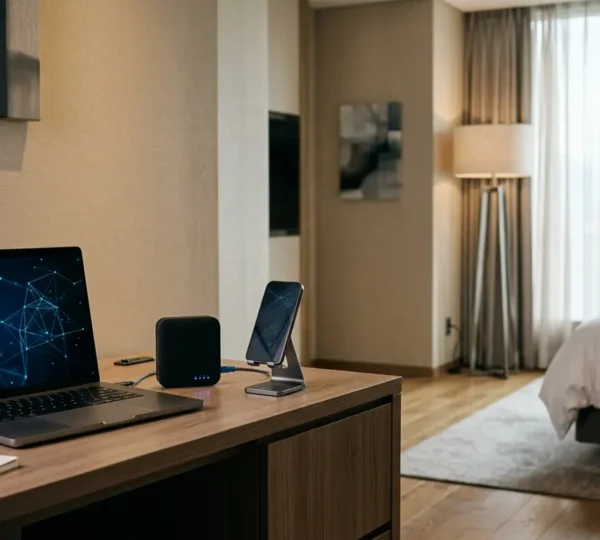
Business-Critical WiFi: A Professional’s Guide to Guaranteed Connectivity on the Go
In summary: Standard hotel WiFi often fails for professional use due to poor network quality (jitter, packet loss), not just slow speeds. Professionals must perform « connectivity forensics » before check-in by testing latency and stability in the hotel lobby. A dedicated…
Lire la suite
Planning Adequate Personal Space to Prevent Claustrophobia During Week-Long Stays
The advertised square footage of a hotel room is a misleading metric; your comfort depends on the ‘livable area’ which is often 40% smaller. Professional hotel photos use wide-angle lenses to distort space; use fixed objects like doors and beds…
Lire la suite
Understanding How Hotel Classification Systems Vary Internationally to Avoid Disappointment
Hotel star ratings don’t measure subjective ‘quality’ or ‘luxury’; they are a formal language for a hotel’s physical infrastructure and available amenities, leading to frequent traveler disappointment. Official ratings are based on objective, checklist-style criteria (e.g., room size, presence of…
Lire la suite
Decoding Hotel Booking Guarantees to Build Flexible Booking Confidence
Hotel guarantees are not designed to protect you; they are marketing tools with deliberate loopholes that can leave you out of pocket. « Free Cancellation » policies often contain strict cut-off times and non-refundable components that lead to unexpected charges. Over 50%…
Lire la suite
How to Evaluate True Service Excellence: A Consultant’s Guide to Vetting Premium Hotels Before You Book
Contrary to popular belief, a hotel’s star rating and amenity list are poor predictors of true service quality. Authentic service stems from an empowered staff culture and a commitment to generosity, not just scripted procedures or lavish features. You can…
Lire la suite
Why Top-of-the-Range Hotels Justify Their 300% Price Premium for Special Occasions
The premium for a top-tier hotel is not a cost; it’s an investment in ‘memory insurance’ for your most important life events. Genuine luxury is defined by invisible systems—like acoustic engineering and predictive service—that guarantee flawless execution, not just visible…
Lire la suite