The key to standout hotel wellness content is shifting your mindset from a ‘reviewer’ of facilities to a ‘storyteller’ of performance and experience.
- Successful narratives are built on a ‘performance ecosystem’—integrating workouts with sleep, nutrition, and recovery.
- Authentic content requires a strategic approach to photography, pre-booking verification, and always securing written permission from hotel management.
Recommendation: Instead of just showing the gym, document your personal adaptation and performance journey within the hotel’s entire wellness environment to create compelling, high-engagement stories.
For any travel fitness blogger, the scene is painfully familiar: a hastily snapped, poorly lit photo of an empty hotel treadmill, captioned “Getting the miles in!” This is the default, low-effort approach to documenting wellness on the road. The digital landscape is saturated with generic “Top 10 Hotel Gym” lists and superficial reviews that do little to engage an audience or build authority. These posts treat the hotel’s fitness centre as a simple amenity to be checked off a list, much like free Wi-Fi or a complimentary breakfast.
But what if the true potential for compelling content lies not in the facility itself, but in the narrative you can weave around it? What if the key to unlocking triple-digit engagement isn’t just showing the equipment, but telling a story of adaptation, performance, and authenticity? This is the fundamental shift from being a passive reviewer to an active content strategist. The real value for your audience isn’t a catalogue of dumbbells; it’s a blueprint for how they too can maintain their peak performance and wellness routines while traveling, inspired by your authentic experience.
This guide provides a strategic framework to move beyond the clichés. We will deconstruct how to find and verify the best facilities, master the art of visual storytelling without getting banned, negotiate access like a professional, and ultimately tie it all together into a powerful performance narrative that resonates deeply with your followers. It’s time to treat hotel wellness not as a footnote in your travel blog, but as the headline story.
To help you master this new approach, this article is structured to provide a complete strategic framework. Below is a summary of the key pillars we will explore, from understanding audience engagement to the practicalities of content creation and maintaining athletic performance on the move.
Summary: A Strategic Guide to Hotel Wellness Content
- Why Fitness Centre Reviews Generate Three Times More Blog Engagement Than Room Reviews
- How to Photograph Hotel Fitness Centres for Compelling Visual Storytelling
- Boutique Hotel Gym or Chain Fitness Centre: Which Creates Better Blog Content?
- The Photography Mistake That Gets Content Creators Banned From Hotel Facilities
- How to Negotiate Complimentary Hotel Access for Authentic Blog Coverage
- How to Verify Sports Equipment Quality and Variety Before Confirming Booking
- Photo Documentation or Written Journaling: Which Better Preserves Travel Memories?
- Maintaining Athletic Performance Through Quality Sports Facility Access While Traveling
Why Fitness Centre Reviews Generate Three Times More Blog Engagement Than Room Reviews
The conventional wisdom for travel blogging focuses on the room, the view, and the food. However, the data reveals a significant shift in audience priorities. Content centred on wellness and fitness isn’t just a niche; it’s a high-engagement powerhouse. The reason is simple: utility and aspiration. A room review is a passive experience, but a fitness centre review is an actionable guide. It helps an engaged, health-conscious audience answer a crucial question: “Can I maintain my lifestyle and goals at this destination?” This creates a much stronger emotional connection and provides tangible value.
This trend is supported by hard data showing that wellness amenities are no longer an afterthought. A Cornell University study found that hotels with excellent health facilities boast repeat visitation rates between 45% and 60%, far surpassing those without. For a content creator, this signals that fitness content taps into a core driver of guest loyalty and decision-making. Furthermore, audience behaviour reflects this priority. A recent report revealed that 51% of business travelers actively seek hotels with gym, swimming pool, or spa facilities. By focusing on wellness, you’re not just serving a niche; you’re serving a powerful and motivated segment of the entire travel market, which translates directly to higher engagement on your platform.
How to Photograph Hotel Fitness Centres for Compelling Visual Storytelling
A great hotel gym photo is not a simple inventory of machines; it’s a story. To elevate your content beyond a sterile catalogue, you must think like a filmmaker and adopt a three-act narrative structure for your photography. This approach transforms a static space into a dynamic environment filled with potential, action, and resolution. Your goal is to make your audience feel the energy of the space and imagine themselves within it, which is far more powerful than just showing them a cross-trainer.
This structured workflow ensures you capture a range of shots that tell a complete story:
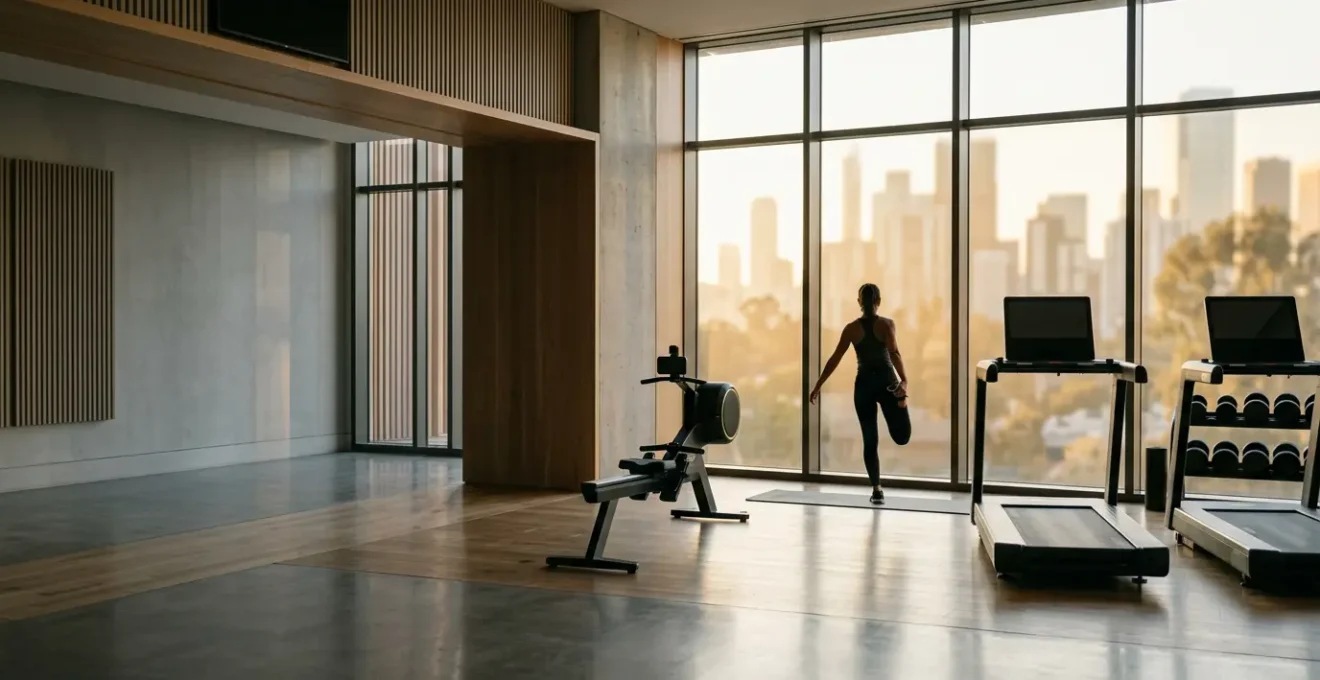
- Act 1 – The Setup: Start with wide, empty shots of the space, ideally at dawn or during the “golden hour.” Use a smaller aperture (e.g., f/5.6-f/11) to ensure greater depth of field, keeping most of the scene in focus. This establishes the environment and creates a sense of clean, quiet potential before the action begins.
- Act 2 – The Confrontation: This is where you capture the action. Shoot close-ups of equipment details and textures. Use a large aperture (e.g., f/1.8-f/2.8) to create a shallow depth of field, blurring distracting backgrounds and focusing the viewer’s eye on a specific detail, like hands gripping a bar or the knurling on a dumbbell.
- Act 3 – The Resolution: Document the post-workout moments. This could be the rewarding view from the treadmill window, the steam in the sauna, or a shot of a refreshing post-workout drink. These images provide narrative closure and tap into the aspirational feelings of accomplishment and relaxation.

Throughout this process, focus on including anonymous human elements to add life without violating privacy. A shot of feet on a treadmill, a hand adjusting a weight, or a silhouette stretching against a window is far more evocative than an empty machine. By combining this three-act structure with sensory details—light hitting the water in a pool, reflections in mirrors, the texture of a yoga mat—you create an immersive visual narrative that captivates your audience.
Boutique Hotel Gym or Chain Fitness Centre: Which Creates Better Blog Content?
The debate between a unique boutique gym and a predictable major chain fitness centre is not about which is “better” for a workout, but which provides a better canvas for your content. The answer, for a content strategist, is that they serve two distinct narrative purposes. A boutique hotel gym often provides ‘character,’ while a global chain provides a reliable ‘setting.’ Understanding how to leverage both is key to a versatile content strategy.
As the NerdWallet Travel Expert highlighted in “The 16 Best Hotel Gyms, According to a Fitness Buff”:
Boutique hotels offer ‘character’ – unique design, quirky equipment, a distinct vibe, while chain gyms provide reliable ‘setting’ for stories about discipline and consistency.
– NerdWallet Travel Expert, The 16 Best Hotel Gyms, According to a Fitness Buff
A boutique gym is perfect for stories about discovery, adaptation, and unique experiences. The unusual equipment, artistic design, or stunning views become the protagonist of your content. It allows you to create aspirational content that feels exclusive and special. A chain fitness centre, on the other hand, is the ideal backdrop for stories about discipline, routine, and achieving goals against a familiar landscape. It shows your audience that it’s possible to maintain a consistent training regimen anywhere in the world. The narrative here is less about the place and more about your personal performance within it.
The choice isn’t mutually exclusive; it’s strategic. By embracing both, you cater to different audience desires—the search for the unique and the need for the reliable. This dual approach demonstrates your expertise and broadens your appeal in a rapidly expanding market. With the wellness market is projected to reach $7.3 trillion in 2025, mastering both types of narratives is essential for capturing a piece of this massive audience.
The Photography Mistake That Gets Content Creators Banned From Hotel Facilities
The single fastest way for a fitness blogger to get banned from a hotel’s wellness facilities isn’t capturing another guest in a shot—it’s creating the *perception* of unsanctioned commercial filming. Hotels operate in a complex liability landscape, and the appearance of professional camera gear during peak hours triggers alarms for management. It signals potential disruption to paying guests and raises questions about commercial use of the property without a contract. The mistake is not understanding the hotel’s perspective.
The Cautionary Tale of the Aviation Reviewer
A well-known aviation reviewer was detained by police after filming on a Kuwait Airways flight. Despite breaking no rules and adding his voiceover later to avoid disturbing passengers, his professional-looking gear (gimbals, multiple cameras) was perceived as a commercial operation. The incident, though resolved with an apology, shows how hospitality businesses react to the *appearance* of professional filming. They are trained to see it as a potential liability and disruption, leading to immediate intervention, whether on a plane or in a hotel gym.
To avoid this pitfall and position yourself as a professional partner rather than a liability, you must adopt a strict code of conduct. The goal is to capture high-quality content without disrupting operations or creating legal exposure for the hotel. This requires a proactive and respectful approach.
- Do Your Research: Before booking, check the hotel’s website for any stated policies on commercial photography or filming.
- Get Written Permission: Always seek express written permission from the hotel’s marketing or PR department *before* your stay. A verbal ‘okay’ from the front desk staff is not sufficient protection.
- Respect Privacy Zones: Never film in areas with an absolute expectation of privacy, such as locker rooms, saunas, or changing areas, even if they appear empty. This is non-negotiable.
- Be Discreet: Use high-quality smartphone equipment during off-peak hours. Avoid large cameras, tripods, and gimbals during busy periods to minimize your footprint.
- Be a Partner: In your communications, frame your work as a professional collaboration that offers them valuable exposure, not as a casual guest taking pictures.
How to Negotiate Complimentary Hotel Access for Authentic Blog Coverage
Negotiating a complimentary stay in exchange for content is not about asking for a “freebie.” It’s a business-to-business proposal where you offer tangible marketing value. The key to a successful pitch is to shift the hotel’s perspective from seeing you as a cost to seeing you as a high-return investment. Your pitch must be built on a foundation of professionalism, proven results, and a clear understanding of the hotel’s own business goals. Stop thinking like an influencer asking for perks and start thinking like a marketing consultant offering a solution.
Your proposal should be a meticulously crafted pitch that demonstrates you can create authentic, high-quality content that drives bookings. This is where your portfolio comes in. Show them the kind of emotional, aspirational content you produce—content that goes beyond sterile equipment shots and captures the true feeling of a wellness experience. You’re not just offering photos; you’re offering a story that their future guests can see themselves in.

The core of your negotiation leverage comes from data. Remind them of the Cornell study showing that hotels with superior wellness facilities see up to a 60% repeat visitation rate. Frame your proposal as a direct way for them to tap into this lucrative market. You are the bridge between their fantastic facility and the high-value guests who are actively searching for it. Your pitch should include a clear media kit with your audience demographics (especially if they align with the hotel’s target market), engagement rates, and examples of past successful collaborations. Offer a clear set of deliverables—for instance, one blog post, 10 high-resolution images for their own marketing use, and a series of five Instagram stories. This transforms an ambiguous request into a clear, professional marketing service agreement.
How to Verify Sports Equipment Quality and Variety Before Confirming Booking
The term “hotel gym” can mean anything from a single, dusty treadmill in a converted closet to a state-of-the-art fitness centre. For a fitness-focused traveler, this ambiguity is a major risk. Confirming the quality and variety of equipment *before* booking is essential for both maintaining your training and creating credible content. Relying solely on the hotel’s professionally shot, often misleading, marketing photos is a recipe for disappointment. As research shows 33% of travelers find accommodations with on-site fitness centers more attractive, the incentive for hotels to oversell their facilities is high. To get the real story, you must become a digital detective.
This pre-booking verification process is a critical part of your content strategy. It ensures you select hotels that genuinely meet your standards, providing a solid foundation for an authentic performance narrative. Instead of a story about disappointment, you get to tell a story of a successful search for excellence. This proactive investigation is, in itself, valuable content that establishes your authority and provides immense utility to your audience.
Your Audit Checklist: The Digital Detective Method
- Go Beyond Official Photos: Search the hotel’s location tag and hashtags on Instagram. Look for recent, user-generated photos and videos tagged in the gym to see the real, current conditions and equipment that actual guests are using.
- Leverage Google Maps: Dive into the “Photos” section for the hotel’s listing on Google Maps. This is a goldmine of unfiltered guest pictures that show actual equipment quality, layout, and maintenance levels, bypassing professional marketing gloss.
- Create a Brand-as-Proxy Checklist: Look for specific, high-quality equipment brands in photos (e.g., Rogue, Technogym, Life Fitness, Peloton). The presence of these brands serves as a reliable proxy for the hotel’s overall investment in its fitness offering.
- Deploy an Expert Inquiry Script: When contacting the hotel, ask specific, knowledgeable questions. Instead of “Is your gym good?”, ask “Can you confirm if you have an Olympic barbell and a squat rack?” or “What is the maximum weight of your dumbbells?” This forces a concrete answer.
- Consult Specialized Platforms: Use dedicated hotel gym rating platforms like HotelGyms.com. These sites often use detailed algorithms (considering 50+ data points) to provide standardized “GymFactor” scores, allowing for objective comparisons.
Photo Documentation or Written Journaling: Which Better Preserves Travel Memories?
For a content creator, the question isn’t whether photos or journaling are better for preserving memories, but how they can be strategically combined to create more powerful and immersive content. Photos capture moments, but journaling captures meaning. Relying on one without the other leaves your content feeling incomplete. Photos alone risk being superficial, while journaling alone can lack visual impact. The professional’s approach is a synergistic workflow where each medium enhances the other.
As detailed by hotel photography experts, the most effective visual storytelling emerges when the creator answers the unspoken question in a potential guest’s mind: “What will it feel like to stay here?” This is where journaling becomes a powerful tool for content pre-production. Professional creators often use in-the-moment written notes to capture feelings, sounds, smells, and specific thoughts. This journal then becomes a creative brief or a shot list, guiding the photographer to visually capture the very emotions and details that were documented. The resulting photo is imbued with purpose, and the original journal entry becomes a powerful, authentic caption that resonates on a much deeper level than a simple description.
A modern, highly effective twist on this technique is audio journaling. This workflow is incredibly potent for capturing the raw authenticity of a fitness experience:
- Immediate Capture: Use your phone’s voice memo app immediately after a workout to record 30-60 seconds of raw, unscripted thoughts and feelings.
- Sensory Immersion: Intentionally let the ambient sounds of the gym—the clank of weights, the hum of the AC—become part of the recording. This adds a layer of sensory reality.
- Content Repurposing: Transcribe the audio for rich, detailed blog content, ensuring you capture the precise phrasing of in-the-moment feelings that photos cannot convey.
- Video Enhancement: Use snippets of the raw audio as narration over video reels. This creates an incredibly immersive and authentic viewer experience that scripted voiceovers can’t match.
This process highlights the different roles of each medium. A photo prompts passive recall of an event. Journaling, whether written or audio, is an act of active creation, constructing a narrative of feeling and meaning that elevates your entire content package.
Key takeaways
- Shift your focus from reviewing facilities to creating a ‘performance narrative’ that documents your personal training journey.
- Master the three-act structure of visual storytelling (Setup, Confrontation, Resolution) to create compelling gym photography.
- Always secure express written permission from hotel PR or marketing before filming to avoid being banned and to position yourself as a professional partner.
Maintaining Athletic Performance Through Quality Sports Facility Access While Traveling
Ultimately, for a fitness creator, travel content must serve a dual purpose: engaging an audience and supporting one’s own athletic performance. The two are inextricably linked. You cannot create an authentic performance narrative if your performance is compromised by substandard facilities or poor planning. Therefore, the pinnacle of travel fitness content is the performance ecosystem narrative. This is where you expand the story beyond the four walls of the gym to document how the entire hotel environment supports or hinders your peak performance.
This holistic approach reflects a massive consumer trend, with the global wellness tourism market is projected to reach $2.096 trillion by 2030. Your audience isn’t just interested in a workout; they’re interested in a complete wellness lifestyle. Your content should mirror this by documenting the entire ecosystem that supports athletic achievement. This elevates your content from a simple gym review to a comprehensive case study in high-performance travel.
To execute this, your content strategy should document the following elements:
- The Adaptation Narrative: Don’t just log your workout. Show how you creatively adapted your specific training protocol using the available hotel equipment. This demonstrates expertise and provides real utility.
- Wearable Data as a Co-Star: Integrate simple graphics from your Whoop, Garmin, or Apple Watch. Show how the travel, hotel sleep quality (thanks to blackout curtains), and workout impacted your recovery, sleep, and strain scores.
- The Full Performance Ecosystem: Expand your content beyond the gym. Review the healthy protein options at the breakfast buffet, the effectiveness of the blackout curtains for sleep quality, and how the spa or pool facilities aided in your active recovery.
- Equipment Versatility Showcase: Instead of complaining about limited equipment, create content that demonstrates how compact, multifunctional hotel gym gear can still support serious training goals.
- Tech Integration: Highlight how you used integrated hotel tech, like virtual fitness platforms (e.g., Wexer), to access a wider variety of classes and maintain your routine, even with limited physical equipment.
Now that you have the complete strategic framework, the next step is to apply it. Start viewing your next hotel stay not as a break from your routine, but as the setting for your next high-engagement performance narrative.