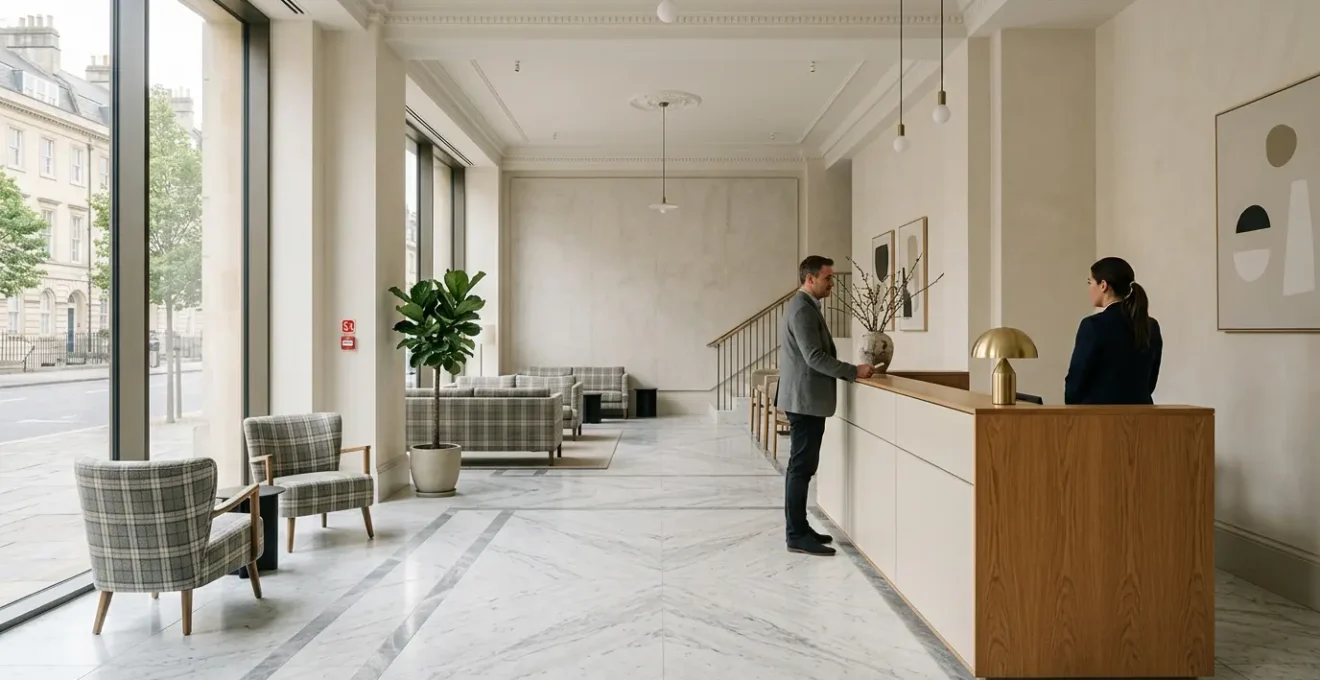
In summary:
- Every UK hotel, regardless of price, must legally provide fundamental standards of safety, cleanliness, and functionality.
- Your rights are protected by the Consumer Rights Act 2015, which requires services to be « fit for purpose » and delivered with « reasonable care and skill. »
- Key non-negotiables include a working lock, hot and cold water, adequate heating, and mandatory fire safety measures.
- Paying for bookings over £100 with a UK credit card gives you powerful Section 75 protection if things go wrong.
That moment you first open your hotel room door holds a unique mix of excitement and apprehension. For a first-time traveller, especially a young person on a budget, the question quickly arises: is this what it’s supposed to be like? It’s a common assumption that a lower price tag automatically means a significant compromise on quality. We often hear that « you get what you pay for, » leading to an acceptance of subpar conditions in budget accommodation. While a five-star hotel will certainly offer more luxuries, the foundational essentials of a safe and habitable stay are not up for negotiation.
The real key to a confident hotel stay isn’t found in the star rating or the price, but in understanding the legal baseline standard that every single UK hotel must meet. This baseline is rooted in UK consumer law, which defines a set of non-negotiable services and safety features. Many travellers are simply unaware that these rights exist, or how they translate into tangible, verifiable features of their room. The difference between a minor inconvenience and a breach of your consumer rights is often just a matter of knowing what to look for.
This guide moves beyond the glossy brochure promises to provide a practical framework. We will transform abstract legal concepts like « fit for purpose » and « reasonable care » into a simple checklist you can use. We’ll explore the non-negotiable fire safety measures you must be able to verify, the ten universal services included in every booking, the real rules on housekeeping, and the critical accessibility features hotels often overlook. By the end, you won’t just be a guest; you’ll be an informed consumer, empowered to ensure you receive the safe and fair experience you are legally owed.
This article provides a detailed breakdown of your rights and the standards you should expect. Explore the sections below to become a more confident and informed traveller.
Summary: Knowing Which Essential Services Every UK Hotel Must Legally Provide
- Why Fire Safety and Emergency Exits Are Non-Negotiable in Every UK Hotel
- How to Identify the Ten Universal Services Every Hotel Price Point Includes
- Daily Housekeeping as Standard or Optional: What UK Hotels Must Provide
- The Legally Required Accessibility Feature 20% of Budget Hotels Omit
- When to Complain About Missing Universal Services for Immediate Resolution
- How to Verify if Your Hotel Booking Is Protected Under UK Consumer Rights Law
- What British Hospitality Law Defines as Minimum Acceptable Accommodation Standards
- Decoding Hotel Booking Guarantees to Build Flexible Booking Confidence
Why Fire Safety and Emergency Exits Are Non-Negotiable in Every UK Hotel
Of all the standards a hotel must meet, fire safety is the most critical and rigorously enforced. It is an area where there is zero tolerance for corner-cutting, as the potential consequences are devastating. The responsibility for ensuring guest safety lies squarely with the hotel operator under the Regulatory Reform (Fire Safety) Order 2005. However, the reality is that compliance is not always perfect. Shockingly, recent official UK fire prevention statistics revealed that 42% of fire safety audits identified compliance failures in commercial properties. This figure underscores why a guest’s own awareness is a crucial final layer of defence.
As a guest, you are not expected to be a fire marshal, but you can and should take two minutes upon arrival to familiarise yourself with the basic safety features of your room and floor. This is not about paranoia; it’s about building a mental map for a calm and effective reaction in a high-stress emergency. Key elements to look for include a clearly displayed evacuation plan (usually on the back of your door), unobstructed fire exits in the corridor, and a room door that closes firmly on its own. A fire door propped open is a major red flag, as it renders a key safety system useless.
Understanding these basic checks empowers you and ensures you are not staying in a property with obvious and dangerous safety lapses. The following checklist provides a simple, non-intrusive routine to adopt for every hotel stay, giving you peace of mind from the moment you check in.
Your 2-Minute Fire Safety Room Check:
- Locate the Plan: Find the evacuation plan on the back of your room door and identify your nearest fire exit route.
- Walk the Route: Physically walk to the nearest fire exit to ensure the corridor is clear, the door is not blocked, and you know the path, even in potential darkness.
- Find the Alarm: Locate the nearest fire alarm call point in the hallway outside your room so you know where to go to raise an alarm.
- Inspect Your Door: Check that your room’s fire door closes fully by itself and that its seals are intact. It should never be wedged open.
- Check the Windows: If you are above the ground floor, ensure the windows can be opened if needed for emergency ventilation.
How to Identify the Ten Universal Services Every Hotel Price Point Includes
A common misconception among first-time travellers is that a budget hotel price means accepting a room that might be broken, uncomfortable, or missing basic amenities. This is not the case under UK law. The Consumer Rights Act 2015 is your most powerful tool as a guest, establishing a legal baseline that applies to every single hotel, from a cheap roadside inn to a luxury city high-rise. It ensures you receive what you paid for, and that the service is delivered to a reasonable standard.
This law contains a crucial principle: any service must be carried out with « reasonable care and skill. » For a hotel, this means the room and its facilities must be fundamentally usable and safe. A second, equally important principle is that goods and services must be « fit for purpose. » A hotel room that fails to provide a secure, habitable environment is legally not fit for its intended purpose of providing accommodation. This legal standard is the bedrock of your rights and has nothing to do with the hotel’s star rating.
As the UK’s core consumer law in this sector states, this is a contractual obligation. The following was enshrined to protect consumers from substandard services:
Every contract to supply a service must be performed with reasonable care and skill
– Consumer Rights Act 2015, UK Consumer Law in the Hospitality Sector
This legal duty translates into five non-negotiable physical features that your room must have to be considered ‘fit for purpose’. If any of these are missing or broken, the hotel is in breach of its contract with you, regardless of how much you paid:
- A secure, working lock on your room door. This is a fundamental security requirement.
- Running potable (drinkable) water, both hot and cold. A lack of either renders the room legally unfit.
- Adequate heating. A room without functional heating in cold weather fails the habitability test.
- Freedom from pest infestation. The presence of bed bugs, rodents, or other pests is an immediate breach of hygiene standards.
- Basic cleanliness. While ‘clean’ can be subjective, the room must meet fundamental sanitation levels, free from obvious dirt, stains, and previous guests’ rubbish.
Daily Housekeeping as Standard or Optional: What UK Hotels Must Provide
The question of housekeeping has become more complex in recent years. Traditionally, daily room cleaning was a standard, expected service. However, driven by both environmental initiatives and operational cost-saving, many hotel chains now operate an ‘opt-in’ or ‘on-request’ model for daily housekeeping, particularly for multi-night stays. While this change is legal, it does not absolve the hotel of its fundamental duty to provide a hygienic environment.
The law distinguishes between two concepts: daily servicing (making the bed, changing towels, tidying) and fundamental hygiene. While a hotel can legally make daily servicing optional, it cannot compromise on the baseline cleanliness of the room you check into. The room must be thoroughly cleaned and sanitised between guests. Furthermore, if your stay is longer, the hotel must still provide a means for you to maintain a hygienic environment, such as providing fresh towels and removing rubbish upon request, even if they don’t perform a full daily clean.

The legal backing for this is robust. Local authority Environmental Health Officers have the power to inspect hotels and enforce strict hygiene standards. A failure to maintain these standards can have severe consequences for the hotel operator, far beyond a bad online review. As UK regulations make clear, this is a matter of public welfare.
If an environmental health officer visits your hotel and discovers poor hygiene standards they have the right to close your hotel for the welfare of your guests
– UK Environmental Health Regulations, UK Hotel Laws & Legislation
Therefore, while you may need to hang a sign on your door to request daily service, you should never have to accept a room that is dirty upon arrival. Any issues with fundamental cleanliness, such as stained bedding, dirty bathrooms, or overflowing bins from a previous guest, are legitimate grounds for an immediate complaint and a request for a different, properly cleaned room.
The Legally Required Accessibility Feature 20% of Budget Hotels Omit
The provocative title highlights a frequent failing, but the core issue goes deeper than one specific feature. Under the Equality Act 2010, UK hotels have a legal duty to anticipate the needs of disabled guests and make « reasonable adjustments. » This is an *anticipatory duty*, meaning they cannot wait for a guest to complain or request a feature; they must have proactively implemented measures to ensure their services are accessible. This applies to guests with mobility, visual, hearing, and cognitive impairments.
While many people think of accessibility purely in terms of wheelchair ramps, the legal requirements are far broader. These adjustments range from physical modifications to staff training and, crucially, digital access. The journey for a disabled traveller often begins online, and if a hotel’s website isn’t accessible, they are already failing their legal duty. Unfortunately, this is a widespread problem; studies show that 97% of UK websites contain detectable accessibility errors, effectively locking out potential guests before they can even book.
For a hotel to be compliant, it must anticipate and provide a range of adjustments. It’s not about having every feature in every room, but about having them available and ensuring staff know how to assist. The most common « omitted » feature is often not a physical object but a lack of proactive service and information.
Essential ‘reasonable adjustments’ that hotels must legally anticipate include:
- Physical Access: This goes beyond a ramp at the front door. It includes available rooms with widened doorways, roll-in showers, and sufficient space to navigate. Lifts are essential for multi-story properties.
- Visual Impairments: Adjustments like large-print menus, good-contrast room numbers, and tactile signage are legal requirements, not optional extras.
- Hearing Impairments: Hotels must be able to provide vibrating pad fire alarms for pillows and visual alarm systems for guests who are deaf or hard of hearing.
- Digital Accessibility: The hotel’s website and booking system must be compatible with screen-reader software, meeting the WCAG 2.1 AA standard.
- Staff Training: Perhaps the most critical part, all staff must have disability awareness training to provide assistance respectfully and effectively, without discrimination.
When to Complain About Missing Universal Services for Immediate Resolution
Knowing your rights is the first step, but knowing when and how to act is what ensures a positive outcome. The key is to distinguish between a preference and a failure to meet a baseline standard. A lumpy pillow is an annoyance; a broken window lock is a safety failure. Your room being smaller than expected is a disappointment; having no hot water is a breach of the « fit for purpose » rule. Complaints for immediate resolution should be reserved for the latter.
If you encounter a failure of a non-negotiable service upon checking in—such as a broken lock, no hot water, evidence of pests, or critical hygiene failures—you should raise the issue with the front desk immediately and politely. Do not unpack. The goal is an immediate resolution, which is typically a room change. If the hotel is full and cannot offer an alternative room, you are within your rights to ask them to find you equivalent accommodation elsewhere at their expense or to cancel the booking for a full refund so you can find your own.

When you complain, be calm, specific, and firm. State the problem clearly (« There is no hot water in my room, which means it isn’t fit for purpose ») and your desired outcome (« I need to be moved to a room that has hot water »). Documenting the issue with photos or a short video on your phone is a smart move, providing evidence if the complaint needs to be escalated. This isn’t about being confrontational; it’s about calmly asserting your consumer rights.
Furthermore, your payment method provides a powerful layer of protection. If you paid by credit card for a booking costing over £100, you are protected by Section 75 of the Consumer Credit Act. This means your credit card company is jointly liable with the hotel. If the hotel fails to resolve the issue, you can raise a dispute with your card provider to reclaim your money. It’s a vital safety net, as consumer protection legislation states that Section 75 protection applies to hotel bookings between £100 and £30,000.
How to Verify if Your Hotel Booking Is Protected Under UK Consumer Rights Law
Understanding where your contract lies is fundamental to knowing who to hold accountable if things go wrong. When you book a hotel, you are entering into a legal contract, but the party you have that contract with can change depending on how you book. This distinction is crucial, as it determines how the Consumer Rights Act 2015 applies and what your path to resolution is. The main difference lies between booking directly with a hotel versus using an Online Travel Agent (OTA) like Booking.com or Expedia.
When you book directly with a UK-based hotel, your contract is clear: it’s with the hotel. You are fully protected by the Consumer Rights Act. If you book a foreign hotel directly, the contract may be governed by local laws, which can be harder to enforce. However, your UK credit card protection (Section 75) still applies, offering a strong safety net. Booking through an OTA introduces a third party. Your contract might be with the OTA or directly with the hotel—you must check the fine print in your confirmation email to know for sure. This determines whether you should contact the OTA’s resolution centre or the hotel first in case of a problem.
The following table, based on guidance from consumer rights experts, breaks down the key differences in legal protection. As this comparative analysis of booking methods shows, paying with a UK credit card is almost always the safest option.
| Booking Method | Contract Holder | Consumer Rights Act Applies | Section 75 Protection | Who to Complain To |
|---|---|---|---|---|
| Direct Hotel Booking (UK) | Hotel | Yes – Full protection | Yes (if paid by UK credit card, £100+) | Hotel directly, then credit card provider |
| Online Travel Agent (e.g. Booking.com, Expedia) | OTA or Hotel (varies) | Depends on contract terms | Possible – check confirmation email | OTA resolution centre first, then hotel |
| Foreign Hotel Direct | Foreign Hotel | May not apply – local law may govern | Yes (if paid by UK credit card, £100+) | Credit card provider (Section 75 still applies) |
The key takeaway is to always check your booking confirmation to identify the contract holder. Regardless of the booking method, using a credit card for payments over £100 provides an invaluable layer of protection that follows you worldwide, making it the most secure way to pay for accommodation.
What British Hospitality Law Defines as Minimum Acceptable Accommodation Standards
While we’ve established that a room must be « fit for purpose, » British law also requires that the service is delivered with « reasonable care and skill. » This legal concept from the Consumer Rights Act 2015 goes beyond the absolute basics (like having water) and addresses the overall quality and safety of the accommodation. It implies that the hotel has a duty to maintain the property to a standard that prevents harm and ensures a reasonable level of comfort and security for its guests.
This principle acts as a safeguard against negligence. It means a hotel can’t just provide the bare essentials; they must ensure those essentials are safe, functional, and properly maintained. For instance, having a light in the bathroom meets the basic need for lighting, but if that light has exposed wires, the hotel has failed to exercise reasonable care and skill. This is a critical distinction that elevates the minimum standard from merely functional to safely operational.
According to guidance from legal experts on UK hospitality regulations, the Consumer Rights Act 2015 requires services to meet this standard of care. In practice, this translates into several specific areas of the hotel room that you have a right to expect are well-maintained:
- Security: Beyond a primary lock, this includes windows that close and lock securely, especially on lower floors.
- Heating & Ventilation: You should have control over the room’s temperature to a reasonable degree. The system should work without making excessive noise or emitting strange odours.
- Lighting: All lighting fixtures in the room and bathroom must be safe and functional. There should be no flickering bulbs, exposed wiring, or broken switches.
- Water & Sanitation: The facilities must not only provide hot and cold water but also drain properly. A blocked sink or shower is a failure to meet this standard.
- Structural Safety: The room should be free from obvious hazards. This includes sound floors without loose carpets that could cause a trip, walls and ceilings free from damp or damage, and furniture that is stable and not at risk of collapsing.
These elements, taken together, define the minimum acceptable standard of accommodation under British law. They ensure that even the most budget-friendly hotel provides an environment that is not just usable, but safe.
Key takeaways
- Universal Standards: Every UK hotel, regardless of its price, must legally meet baseline standards for safety, hygiene, and functionality under the Consumer Rights Act 2015.
- Your Core Rights: Your room must be « fit for purpose, » which means having a secure lock, hot/cold water, and adequate heating as non-negotiable minimums.
- The Ultimate Safety Net: Paying for a hotel stay over £100 with a UK credit card activates Section 75 protection, making your card provider jointly liable if the hotel fails to deliver.
Decoding Hotel Booking Guarantees to Build Flexible Booking Confidence
Navigating the world of hotels for the first time can feel like a gamble. With varying prices, countless reviews, and confusing booking platforms, it’s easy to feel anxious about making the right choice. However, the legal framework in the UK is designed to remove much of that uncertainty. The guarantees embedded in consumer law are not just tools for resolving problems after they happen; they are powerful instruments for building confidence *before* you even book.
Think of the Consumer Rights Act 2015 not as a rulebook for complaints, but as a silent service guarantee included with every booking. It promises that your room will be safe, habitable, and functional. Likewise, Section 75 protection on your credit card is not just a refund mechanism; it’s a financial backstop that allows you to book with the assurance that your money is protected against a fundamental failure of service. These laws create a floor of quality and security beneath which no legitimate UK hotel can fall.
For a young traveller, this knowledge is transformative. It shifts the power dynamic. You are no longer just a passive guest hoping for the best; you are an informed consumer who understands the baseline standards you are owed. You can book a budget-friendly hotel not with trepidation, but with the confidence that it must still legally provide a secure lock, a clean environment, and essential facilities. This understanding allows you to focus on what matters most—location, reviews, and amenities—knowing that the non-negotiable foundations are already guaranteed by law.
Your next step is to apply this knowledge. Begin planning your next trip with the confidence that you know your rights and can verify the standards you are legally entitled to upon arrival, ensuring a safe and enjoyable stay.