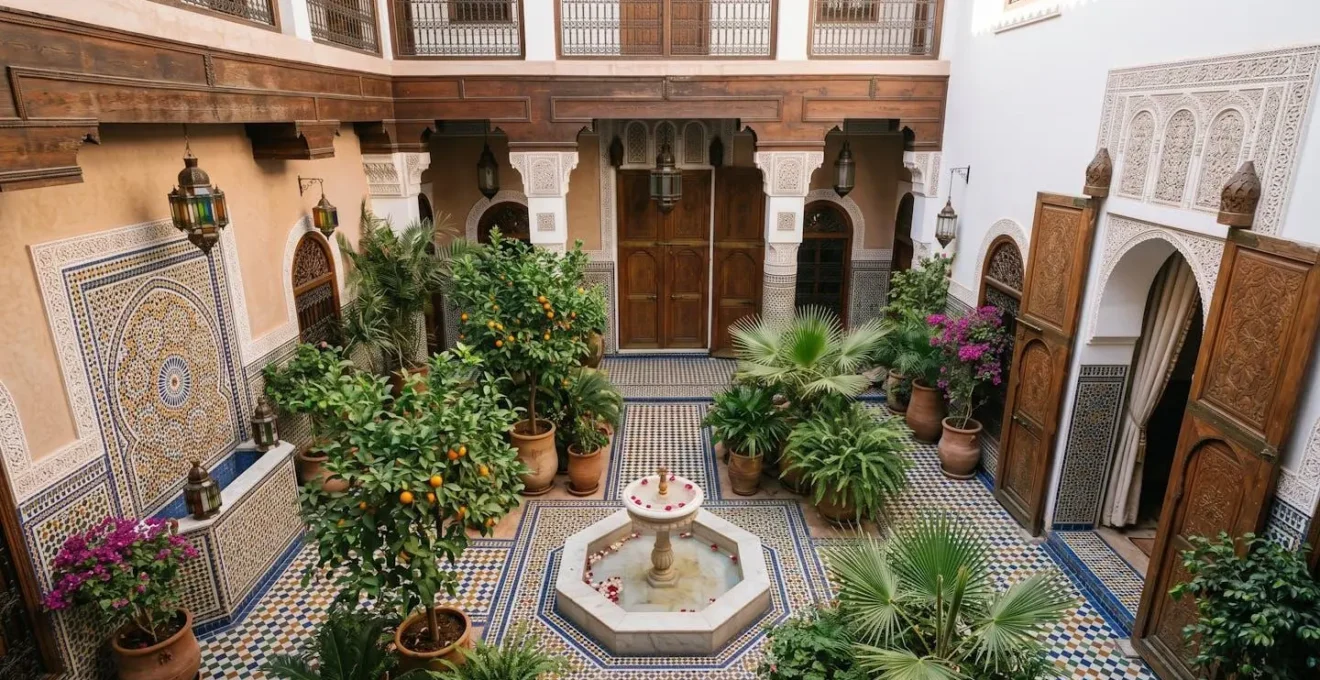
The secret to an authentic Moroccan experience isn’t just staying in a riad; it’s mastering the cultural interface where hospitality and commerce intertwine.
- Differentiate genuine warmth (like a shared pot of mint tea) from gentle, commission-based upsells.
- Utilise specific, proven protocols for navigating car-free medinas to reduce stress and start your stay positively.
Recommendation: Shift your mindset from ‘avoiding scams’ to ‘navigating cultural differences’ to unlock the genuine human connections that make a trip to Morocco unforgettable.
For many UK travellers, Morocco evokes a powerful allure: the scent of spices in a bustling souk, the intricate beauty of a hidden courtyard, and the promise of a truly authentic cultural escape. The dream is to trade grey skies for the vibrant chaos of a Fes medina or the sunset hues of Marrakech. Yet, the reality can sometimes feel different. The line between genuine hospitality and a tourist transaction can seem blurry, and the path to authentic connection can feel obscured by a well-trodden tourist trail.
Conventional advice often stops at “stay in a riad” or “haggle for a good price.” But these tips only scratch the surface. They don’t equip you with the understanding needed to navigate the subtle, yet crucial, social dynamics. With a record 17.4 million tourists visiting Morocco in a single year, the pressure on local economies is immense, and the tourist experience has become a complex ecosystem of its own.
But what if the key to unlocking an authentic, budget-friendly experience wasn’t about avoiding the system, but learning to navigate it with grace and understanding? This guide moves beyond the platitudes. It proposes that true cultural immersion comes from mastering the “cultural interface”—the space where your expectations as a visitor meet the intricate weave of Moroccan hospitality and commerce. We will provide you with the strategies to not just see Morocco, but to connect with it on a deeper, more meaningful level.
This article provides a complete roadmap for the savvy traveller. We’ll explore why riads are more than just accommodation, offer practical solutions for logistical challenges, compare the country’s two great cultural capitals, and decode the subtle sales tactics you might encounter, equipping you to respond with confidence and warmth.
Summary: A Strategic Guide to Authentic, Budget-Friendly Morocco
- Why Moroccan Riads Deliver More Authentic Experiences Than International Hotels
- How to Navigate Medina Accommodation Access Without Vehicle-Compatible Streets
- Marrakech or Fes: Which Moroccan City Delivers Better Budget Cultural Immersion?
- The Moroccan Accommodation Sales Tactic That Pressures 70% of Budget Guests
- When to Visit Morocco for Comfortable Weather Without Peak-Season Crowds
- How to Identify Authentically Spanish Luxury Hotels Versus International Franchises
- When to Venture Outside the Tourist Complex for Authentic Local Experiences
- Selecting Premium Spanish Hotels Combining Historic Grandeur With Modern Sophistication
Why Moroccan Riads Deliver More Authentic Experiences Than International Hotels
The first decision in planning a Moroccan adventure often boils down to accommodation: a familiar international hotel or a traditional riad? While hotels offer predictable comfort, they often insulate you from the very culture you came to experience. A riad, by contrast, is a gateway. These traditional homes, built around a central courtyard, are architectural marvels designed for inward-looking tranquillity, a stark contrast to the bustling medina outside. But their true value lies beyond aesthetics.
Choosing a riad is an economic and cultural statement. Unlike corporate chains, most riads are family-owned and operated. This means your stay directly supports a local household, not distant shareholders. This intimate scale fosters a completely different dynamic. Your host isn’t a front-desk employee; they are often the owner, whose personal reputation is tied to your well-being. This results in a level of personalised care, from home-cooked meals to insider tips on the best local hammam, that a larger hotel simply cannot replicate.
Case Study: The Riad Value Proposition
Analysis shows that the riad model offers a significant financial advantage. A mid-range, family-operated riad typically costs 20-30% less than a comparable international hotel. This cost saving doesn’t come at the expense of experience; it enhances it. The value proposition is clear: you pay less for a deeper cultural immersion, personalised service, and the knowledge that your travel spending is making a positive impact on the local community.
Ultimately, a hotel gives you a room; a riad offers you a temporary home and a window into Moroccan life. It’s the difference between observing a culture from behind glass and being invited inside for a glass of mint tea. For the traveller seeking genuine connection, the choice is clear.
How to Navigate Medina Accommodation Access Without Vehicle-Compatible Streets
Your taxi pulls up to the ancient gate, or ‘Bab’, of the medina. The driver points down a narrow, winding alley. “Your riad is in there.” This is a classic first-time-in-Morocco moment, a mix of excitement and slight panic. The ancient medinas of Fes and Marrakech are UNESCO World Heritage sites, and their labyrinthine streets were designed for pedestrians and donkeys, not cars. Navigating this final stretch with luggage can be your first real challenge or your first authentic victory.
This is not a problem to be solved with technology alone, though an offline map is essential. This is a moment to engage with a local system that has worked for centuries: the porters. Men with handcarts (a ‘charrette’ or ‘karoussa’) are a fixture at every major medina gate. They are licensed professionals who know the medina’s every twist and turn. Engaging their services is not a sign of weakness; it’s the smart, local-approved way to get your bags to your door with minimal stress.
The key is to follow a simple protocol. Agree on the price beforehand, have small change ready, and treat the interaction with respect. This isn’t just a luggage transfer; it’s your first transaction within the medina’s unique ecosystem. Getting it right sets a positive tone for your entire stay, turning a potential moment of frustration into a smooth, efficient, and genuinely Moroccan experience.
Your Medina Arrival: A 5-Step Porter Protocol
- Pre-Arrival Prep: Before you land, confirm the nearest vehicle-accessible gate (Bab) with your riad host and download offline maps (e.g., Google Maps) for the area.
- Engage an Official Porter: At the gate, look for the official porters with their handcarts. They are a reliable and integral part of the medina’s infrastructure.
- Agree on the Price First: Show the porter your riad’s address. Clearly agree on the price *before* they touch your luggage. A fair price is typically 20-50 Moroccan Dirhams, depending on distance and bag quantity.
- Keep Small Cash Ready: Have the agreed amount, plus a small optional tip, readily accessible so you’re not fumbling for cash upon arrival at your riad’s door.
- Trust the Process: Follow your porter with confidence. They navigate these alleys daily and are your most reliable guide for this final leg of the journey.
Marrakech or Fes: Which Moroccan City Delivers Better Budget Cultural Immersion?
The debate is a classic for first-time visitors: Marrakech or Fes? Both cities are epicentres of Moroccan culture, but they offer vastly different flavours of immersion, especially for the budget-conscious traveller. The choice isn’t about which is “better,” but which is right for the type of experience you’re seeking. Marrakech is a dazzling performance; Fes is a living museum.
Marrakech is cosmopolitan, vibrant, and highly attuned to tourism. The Djemaa el-Fna square is a world-famous spectacle of snake charmers, storytellers, and food stalls. The tourist infrastructure is highly developed, making it an easier and often more straightforward destination for a first visit. It’s polished, energetic, and endlessly entertaining. Fes, on the other hand, feels more preserved and less performative. Its medina, Fes el-Bali, is one of the largest car-free urban zones in the world. Its soul lies in its craft guilds—the tanneries, the metalworkers, the weavers—and its history as the intellectual and spiritual heart of Morocco. It demands more from the visitor but offers a profound sense of stepping back in time.
For the budget traveller, the distinction is also financial. Fes generally offers better value for money, particularly in accommodation and daily expenses. This cost difference allows your budget to stretch further, perhaps affording an extra day of exploration or a hands-on artisan workshop. The following table breaks down the key differences to help you make an informed choice based on your priorities.
| Category | Marrakech | Fes | Difference |
|---|---|---|---|
| Mid-range riad (per night) | 600-1,200 MAD | 400-900 MAD | Fes 20-30% cheaper |
| Average daily cost per person | $103 | $95 | Fes 8% cheaper |
| Street food meal | Similar pricing | Similar pricing | Comparable |
| Cooking class | More options, similar pricing | Slightly more expensive but more intimate | Quality vs. quantity |
| Cultural atmosphere | Cosmopolitan, performance-driven | Preserved, craft-based, intellectual | Different immersion types |
| Navigation difficulty | Moderate (circular medina) | High (multi-layered labyrinth) | Fes more challenging |
| Tourist infrastructure | Highly developed | Less polished, more authentic | Marrakech easier for first-timers |
Ultimately, if you seek energy, accessibility, and spectacle, choose Marrakech. If you crave a deeper, more challenging, and arguably more authentic dive into historic Moroccan urban life, Fes is your destination.
The Moroccan Accommodation Sales Tactic That Pressures 70% of Budget Guests
You’ve settled into your beautiful riad. Your host, who has been incredibly gracious, sits down with you. He pours you a glass of sweet mint tea—the ultimate symbol of Moroccan hospitality. As you sip, he mentions a “very special” desert tour his cousin runs, or a “friend’s” carpet shop with the “best prices.” This is a pivotal moment. It’s where genuine hospitality and gentle commerce intersect, a dynamic that can feel confusing or pressuring if you’re not prepared for it.
This is the “hospitality-commerce weave,” a deeply ingrained cultural trait where business and personal relationships are often intertwined. It’s not a “scam”; it’s a soft-sell approach rooted in a commission-based ecosystem. Your host is often just trying to earn a little extra by facilitating services for his guests. The pressure comes from your own cultural conditioning, where a clear line usually exists between a friendly chat and a sales pitch. The key is not to get defensive, but to have a strategy for navigating it with grace.
The solution is a “Polite Refusal Playbook.” It involves learning a few key phrases and, more importantly, adopting a warm, appreciative, yet firm posture. The goal is to decline the offer without damaging the relationship with your host. By accepting the tea and the conversation (the hospitality) while politely declining the upsell (the commerce), you demonstrate cultural understanding. This approach allows you to maintain control of your itinerary and budget while preserving the goodwill that is essential for a positive riad experience.
- For tour offers: “That sounds wonderful, thank you for the offer, but we have other plans already. Perhaps next time!”
- For shop recommendations: “We appreciate the suggestion, but we prefer to explore on our own today.”
- For dinner upsells: “We’re looking forward to trying different local spots recommended by other travellers.”
- Maintain warm body language: A smile while declining is crucial to show you’re refusing the offer, not the person.
- Distinguish genuine hospitality: Accept small gestures like the initial tea. A reasonably priced dinner at the riad is hospitality; a pushy, overpriced tour is a commission play.
When to Visit Morocco for Comfortable Weather Without Peak-Season Crowds
Timing your Moroccan trip is a crucial balancing act between weather, crowds, and cost. While the country is a year-round destination, certain periods offer a superior blend of all three, allowing for a more comfortable and authentic experience. The peak summer months (June-August) are scorching in the interior cities like Marrakech and draw large crowds to the cooler coastal areas. Conversely, the heart of winter (December-January) can be surprisingly cold, especially in the mountains.
The “shoulder seasons” are widely considered the sweet spot for a Moroccan adventure. Spring (March-May) brings pleasant temperatures and stunning green landscapes as the country blooms. Autumn (September-October) is perhaps even better, offering warm, sunny days left over from summer but with significantly fewer crowds as the European holidays end. Prices for accommodation and flights are also typically lower during these periods.
Even visiting during a major cultural event like Ramadan can be a uniquely rewarding experience. While it requires some adjustments (many restaurants are closed during the day), it offers an unparalleled opportunity to witness the country’s spiritual side and share in the festive evening ‘iftar’ meals. As the travel experts at Lonely Planet note, strategic timing can make all the difference. The following seasonal guide provides a detailed breakdown to help you choose the perfect time for your visit.
September is probably the best month for good weather and fewer crowds, when domestic and international travelers head back to school and work after the August summer holidays.
– Lonely Planet Morocco Travel Guide, Lonely Planet – Best time to visit Morocco
To make the best decision for your travel style and budget, consider this detailed breakdown of what to expect throughout the year, as shown in a recent analysis by Intrepid Travel.
| Season/Month | Temperature Range | Crowd Level | Key Benefits | Cultural Events |
|---|---|---|---|---|
| January-February (Green Winter) | 50-68°F (10-20°C) | Very Low | Lowest prices, green landscapes, comfortable daytime temps for cities | Yennayer (Amazigh New Year) |
| March-May (Spring) | 64-77°F (18-25°C) | Moderate-High | Pleasant weather, blooming landscapes, ideal for all activities | Rose Festival (Dades Valley – May) |
| June-August (Summer) | 75-100°F+ (24-38°C+) | High (coastal areas) | Perfect for beaches, coastal cities cooler | Gnaoua World Music Festival (Essaouira) |
| September-October (Shoulder) | 68-86°F (20-30°C) | Low-Moderate | Best overall: warm weather, fewer crowds, lower prices | Erfoud Date Festival (October) |
| Ramadan (varies) | Varies by timing | Moderate | Ultimate cultural immersion, witness spiritual traditions, share iftar meals | Evening festivities, Taraweeh prayers |
How to Identify Authentically Spanish Luxury Hotels Versus International Franchises
While this title points to a Spanish context, the core question—how to identify true authenticity versus a branded imitation—is universal and profoundly relevant to travelling in Morocco. In Spain, the search might be for a historic ‘parador’ over a generic chain. In Morocco, the principle is the same, but the markers of authenticity are different. It’s less about identifying a franchise and more about learning to read the subtle signals that distinguish a living, breathing cultural space from a place merely decorated in a Moroccan style.
The most authentic Moroccan “luxury” is not found in gold taps or expansive spas, but in the richness of the experience and the genuineness of the human connection. An authenticity signal might be the riad owner’s personal collection of antique textiles displayed on the walls, the unique flavour of the breakfast bread because it comes from a specific neighbourhood bakery, or the way the host remembers you prefer your mint tea without sugar. These are details an international franchise, with its standardised operating procedures, can never replicate.
Therefore, the strategy for finding authenticity in Morocco involves a shift in focus. Look past the star ratings and slick photography. Instead, read guest reviews carefully, looking for mentions of the hosts by name. Scrutinise the details: does the riad feel like a home, or a hotel designed to look like one? The goal is to find a place with a soul, a story, and a direct connection to the community around it. This is the true luxury available to the savvy budget traveller in Morocco.
When to Venture Outside the Tourist Complex for Authentic Local Experiences
This question is at the heart of the quest for authentic travel. The “tourist complex” isn’t just a physical place like an all-inclusive resort; it’s a mindset and a set of pre-packaged experiences. In Morocco, even a beautiful riad in the heart of the medina can function as a comfortable bubble. Venturing outside it—both physically and mentally—is where transformative travel happens, but it requires discernment and respect.
The first step is recognising opportunities. When your riad host invites you to a family celebration or to join them for an iftar meal during Ramadan, this is a golden ticket. It’s a genuine invitation to step across the cultural threshold. Accepting with grace and gratitude can lead to the most memorable moments of your trip. Another opportunity is to seek out experiences that are not designed for tourists. Instead of a “tourist hammam,” ask your host to recommend a neighbourhood public hammam. The experience will be less polished but infinitely more authentic.
However, venturing out also requires caution. The “helpful” young man who offers to be your unsolicited guide in the Fes medina is likely looking for a commission or a hefty tip. The key is to distinguish between a genuine invitation and a commercial proposition. Generally, genuine invitations come from people with whom you’ve already established a relationship (like your riad host) and don’t involve a request for money upfront. Learning to say “no, thank you” (“La, shukran”) politely but firmly to unsolicited offers is as important a skill as knowing when to say “yes.”
Key Takeaways
- Authenticity is found in the ‘how’ not the ‘what’: Master the cultural interface of hospitality and commerce.
- Riads offer superior value by directly connecting you with local families and economies, often for 20-30% less than a hotel.
- Mastering logistics like medina arrivals and employing a ‘Polite Refusal Playbook’ for upsells reduces stress and builds confidence.
Selecting Premium Spanish Hotels Combining Historic Grandeur With Modern Sophistication
Just as a discerning traveller in Spain might seek a hotel that marries historic grandeur with modern sophistication, the savvy traveller in Morocco seeks a similar, yet distinctly Moroccan, blend. Here, “historic grandeur” is embodied in the ancient architecture of the riad—the centuries-old zellige tiles, the hand-carved cedarwood ceilings. “Modern sophistication,” however, is not about high-tech amenities or minimalist design. It is the sophistication of you, the traveller, in your ability to navigate the culture with awareness and grace.
The ultimate “premium” experience in Morocco is not a transactional one that can be bought; it is a relational one that must be earned through understanding. It’s the moment when your host stops seeing you as just another guest and starts treating you as a friend. It’s the unexpected invitation for a meal, the shared laughter over a cultural misunderstanding, or the quiet satisfaction of navigating the souk with newfound confidence. This is the modern sophistication that pairs so beautifully with Morocco’s historic grandeur.
This guide has aimed to equip you with the tools for this journey. By understanding the economics of a riad, the logistics of a medina, the nuances of the hospitality-commerce weave, and the rhythm of the seasons, you elevate yourself from a passive tourist to an active, engaged participant. You learn to seek value not just in what you pay, but in the richness of the connections you make.
Your Moroccan adventure awaits. By applying these strategies, you’re not just planning a holiday; you’re preparing for a journey of genuine cultural immersion, ready to unlock the warmth and beauty that lies just beneath the surface.