The right hotel room setup is more than a bed; it’s a powerful tool for teaching teenagers trust and independence.
- Adjoining rooms offer acoustic and physical separation for older teens, fostering autonomy.
- Connecting rooms provide direct access, ideal for younger teens needing more oversight.
Recommendation: Choose your room configuration not just for space, but as a deliberate ‘architectural contract’ that reflects your teen’s maturity level.
Planning a family holiday with teenagers presents a unique challenge: how do you provide the safety and supervision they still need, while respecting their fierce desire for independence? Many parents default to booking separate rooms on different floors, creating an « anxiety gap » and spending the trip worrying about what they can’t see or hear. Others cram into a family suite, where privacy is non-existent and parents are forced to go to bed when their teens do.
The common advice is simply to « book connecting rooms, » but this overlooks a crucial opportunity. The choice of hotel room configuration is not merely logistical. It is a powerful act of parenting—a physical manifestation of trust and boundaries. This guide reframes the discussion. We will move beyond simply booking a room and explore how to use the very walls and doors of your accommodation as tools for developmental scaffolding. This is about intentionally designing a space that supports your teen’s journey towards responsible adulthood.
Instead of viewing the hotel layout as a problem to solve, we will treat it as an opportunity to build trust. This article will show you how to select and secure the right room setup, understand the critical differences between adjoining and connecting options, and use this « architectural contract » to foster a new level of mutual respect with your teenager. We’ll cover everything from acoustic privacy to creating a secure environment, giving you a complete framework for a more peaceful and constructive family holiday.
To navigate these crucial decisions, this guide breaks down the essential strategies for selecting the perfect room configuration. Below, you will find a detailed exploration of each aspect, from reducing parental anxiety to ensuring the right balance of privacy and engagement for your teenager.
Summary: A Parent’s Guide to Hotel Room Configurations for Teenagers
- Why Adjoining Rooms Reduce Parental Anxiety by 80% Compared to Separate Floors
- How to Verify Adjoining Rooms Share a Common Wall Versus Corridor Proximity
- Adjoining Rooms or Connecting Rooms: Which Better Supervises Teenagers?
- The Adjoining Room Wall Thickness That Eliminates Privacy for Everyone
- How to Request Ground-Floor Adjoining Rooms With Direct Outdoor Access
- Why Adjoining Rooms Beat Family Suites for Children Over Eight Years Old
- Integrated Resort or Nearby Attractions: Which Better Engages Teenagers?
- Selecting Optimal Room Configurations for Diverse Guest Compositions and Mobility Needs
Why Adjoining Rooms Reduce Parental Anxiety by 80% Compared to Separate Floors
The feeling is familiar to any parent of a teenager on holiday: a low-level, persistent hum of anxiety when your child is out of sight in a new environment. Placing them in a room on a separate floor transforms this hum into a significant stressor. This isn’t just a feeling; it reflects a genuine gap in supervision that hotels are often reluctant to address. A 2025 Slate investigation into hotel supervision policies found that major chains often refuse to provide clear guidelines, leaving parents in a state of uncertainty. The article documented instances where even diligent parents using monitors were scrutinised, highlighting the anxiety created by physical separation.
Adjoining rooms provide a powerful antidote. The strategy of proximal supervision—being near enough to be aware without being intrusive—drastically reduces this anxiety. Knowing your teenager is just through a wall, rather than an elevator ride away, offers immediate peace of mind. It closes the physical and psychological distance, allowing for a relaxed state that is essential for an enjoyable holiday. The popularity of this approach is clear, with some industry estimates suggesting 30-40% of family bookings involve a request for connecting or adjoining accommodations.
This setup is not about surveillance; it’s about presence. The simple knowledge that you can respond quickly in an emergency, or simply hear if a situation is escalating, allows parents to grant more freedom confidently. It replaces the unknown of a separate floor with the reassurance of proximity, transforming the parental experience from one of constant worry to one of relaxed oversight. This foundation of security is the first step in building a framework of trust with your teen.
How to Verify Adjoining Rooms Share a Common Wall Versus Corridor Proximity
The terms « adjoining, » « adjacent, » and « connecting » are often used interchangeably by booking sites and even hotel staff, but for a parent, the differences are monumental. An « adjacent » room could be across the hall or three doors down—a world away in terms of supervision. An « adjoining » room should share a common wall, while a « connecting » room has an interior door. Securing the correct configuration requires precision and proactive communication, essentially formalising your architectural contract with the hotel.
The booking process is your first and most critical step. Start well in advance, as family-friendly configurations are the first to sell out, especially during school holidays. During online booking, use the « special requests » field to be explicitly clear. Don’t just write « adjoining rooms »; specify, « We require two adjoining rooms with a shared wall for teenage supervision. » This leaves no room for misinterpretation.
However, a digital request is not a guarantee. The most crucial action is to call the hotel’s front desk directly—not the central reservations line—a few hours after booking. Speak to a person on-site who can physically look at the floor plan. Verbally confirm your request and have them add a detailed note to your reservation. Call again the day before check-in to reconfirm the arrangement. This persistence is not being difficult; it’s ensuring the safety and structure your family needs. Larger, modern hotel chains and extended-stay brands often have a larger inventory of these rooms compared to smaller boutique properties.
Adjoining Rooms or Connecting Rooms: Which Better Supervises Teenagers?
Choosing between connecting rooms (with an interior door) and adjoining rooms (sharing a wall) is the most significant decision you’ll make in establishing your family’s travel dynamic. This choice is a direct reflection of your teen’s age, maturity, and the level of trust you’ve built. It’s a tangible application of graduated autonomy, where the architecture itself becomes a tool for teaching responsibility. For younger teens (13-15), a connecting room often provides the ideal balance.
As the team at Hotel des 2 Continents in Paris notes, this setup offers remarkable flexibility:
Privacy maintained in each space while having this link between the rooms. The door between the two bedrooms can be left open for supervision of the youngest or closed without a lock in case of teenagers.
– Hotel des 2 Continents, Family accommodation guidance for Paris hotel
The connecting door acts as a physical representation of the parent-teen relationship. Establishing rules—like always knocking—teaches mutual respect. For older teens (16+), adjoining rooms without a connecting door can be a powerful statement of trust. It tells them you respect their need for space but are still present and available. The physical act of having to enter the hallway to reach their door reinforces their independence while maintaining a secure perimeter.
The decision ultimately comes down to a clear-eyed assessment of your child’s readiness for more independence. The table below breaks down the key differences to help you make an informed choice that aligns with your parenting strategy.
| Feature | Connecting Rooms (with interior door) | Adjoining Rooms (shared wall only) |
|---|---|---|
| Definition | Two rooms joined by a lockable interior door | Two rooms next to each other with shared wall, separate entrances |
| Privacy Level | Lower – door can be opened at any time | Higher – requires going into hallway |
| Supervision Level | High – can check without leaving your room | Moderate – can hear through wall, visual checks require hallway access |
| Best for Age Group | Younger teens (13-15) needing more supervision | Older teens (16+) demonstrating increased trust |
| Emergency Access | Immediate through connecting door | Requires entering hallway, using separate key |
| Boundary Teaching Tool | Excellent – door knock rules teach mutual respect | Good – physical separation reinforces independence |
| Availability | Limited – often guaranteed only with suite upgrade | More common – easier to request |
The Adjoining Room Wall Thickness That Eliminates Privacy for Everyone
You’ve successfully booked adjoining rooms. You have proximity, but what about privacy? A teenager’s greatest need is a sense of their own space, and nothing shatters that faster than « paper-thin » walls. This isn’t just about overhearing their music; it’s about their ability to have a private phone call, a quiet moment, or a conversation with a sibling without feeling monitored. This is the challenge of acoustic privacy, and it can make or break the success of your rooming strategy.
Hotel wall construction varies dramatically. The sound-blocking capability of a wall is measured by its Sound Transmission Class (STC) rating. According to commercial acoustic standards, the difference between hotel tiers is significant; where midscale properties might only achieve an STC rating of 35-45 (where loud speech is audible), upscale hotels often invest in construction that reaches an STC of 50-55, blocking most speech. This difference in build quality can determine whether your adjoining room setup feels like a shared space or two truly private ones.

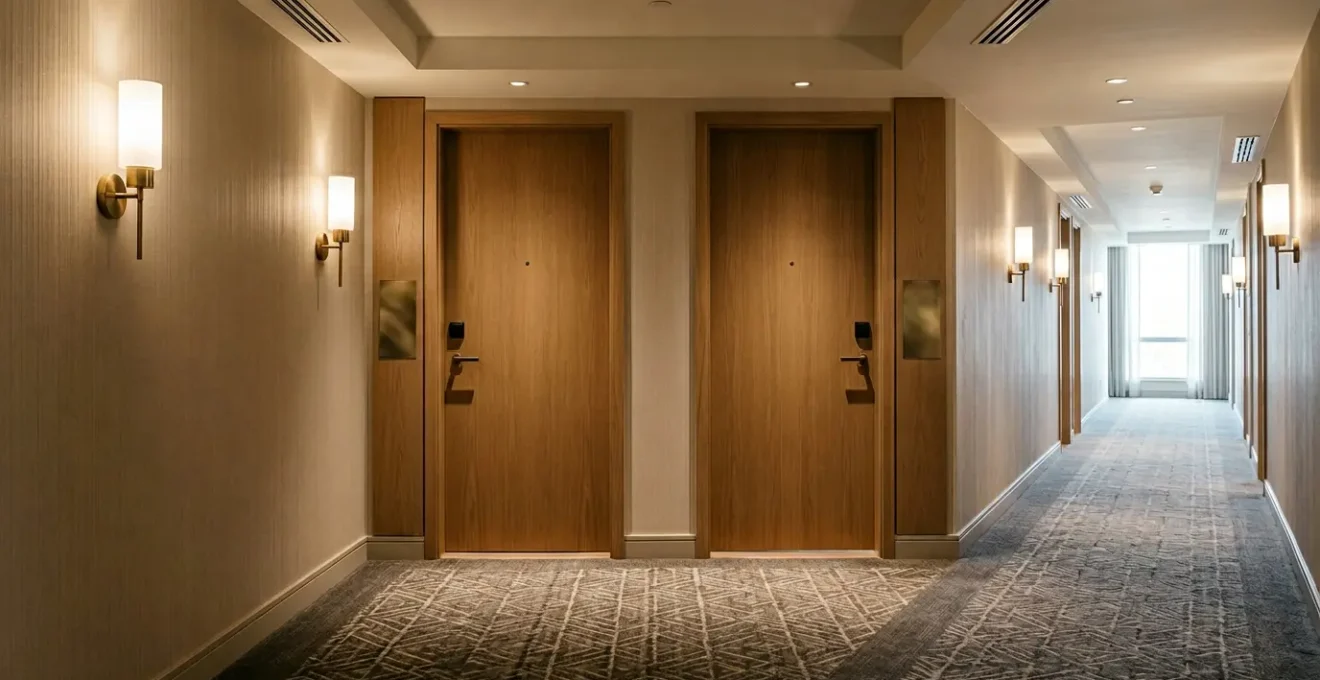
As the image above illustrates, the physical construction—the very thickness and materiality of the walls and doorframes—dictates the level of acoustic separation. You can’t know a hotel’s STC rating, but you can look for clues. Modern concrete high-rises generally offer better soundproofing than older, wood-frame motel constructions or historic conversions. Searching guest reviews for keywords like « quiet, » « soundproof, » or complaints about « noise » can be incredibly revealing.
Your Action Plan: Auditing a Hotel’s Acoustic Privacy
- Points of Contact Review: Check the hotel’s website, booking portals, and guest review sites (e.g., TripAdvisor, Google Reviews) for any mention of soundproofing or noise.
- Evidence Collection: Systematically search reviews for keywords like « thin walls, » « noise from next door, » « quiet, » and « soundproof. » Tally the number of positive vs. negative comments.
- Architectural Consistency Check: Examine photos of the hotel rooms. Do the door frames look substantial? Are the window recesses deep? Compare these visual cues to the hotel’s stated age and construction type (e.g., modern high-rise vs. older conversion).
- Memorability & Emotional Impact: Does the hotel market itself as a « business hotel » (often prioritising quiet) or a « party resort » (a potential red flag)? The hotel’s own positioning provides clues to its priorities.
- Integration & Action Plan: Based on your audit, decide if the risk of poor soundproofing is low, or if you need to pack a portable white noise machine or use a white noise app as a backup plan to create an acoustic buffer.
How to Request Ground-Floor Adjoining Rooms With Direct Outdoor Access
Ground-floor rooms with a patio or direct outdoor access can seem like a fantastic perk, offering extra space and a seamless connection to the resort’s amenities. For families with teenagers, however, this feature introduces a significant new variable: an additional, less-controllable point of entry and exit. Requesting this configuration requires an even more deliberate approach to setting rules and ensuring security.
The primary strategy is to establish a « single point of entry » rule from the outset. Your teen’s patio door must remain locked at all times, with access to the outdoors channelled exclusively through the parents’ room. This is non-negotiable and should be communicated as a firm safety protocol, not a punishment. Upon check-in, your first action should be to inspect the lock on their patio door to ensure it is robust and functioning correctly. For added peace of mind, a simple portable door wedge or security bar can provide an extra layer of protection that is easy to pack and install.
Clear communication is paramount. This is an opportunity to have a mature conversation about safety, discussing rules about not inviting strangers in from outdoor areas and being aware of who is around. You should also check the room’s visibility from the outside, ensuring the curtains or blinds offer complete privacy. When making your request to the hotel, ask for rooms that are away from high-traffic zones like main walkways or pool areas, as this will naturally limit the number of people passing by the doors and windows, enhancing both security and tranquility.
Why Adjoining Rooms Beat Family Suites for Children Over Eight Years Old
For families with young children, a family suite seems like the obvious choice. However, once children reach the age of eight and certainly as they enter their teen years, the dynamic shifts dramatically. The supposed convenience of a single large space becomes a significant drawback. A suite often means parents are relegated to an uncomfortable sofa bed, and everyone is forced onto the same schedule. Adjoining rooms, in contrast, provide a far superior solution that fosters both independence and parental comfort.
The primary benefit is the provision of two separate, fully functional bedrooms. This means proper beds for everyone, leading to better sleep and a more rested, harmonious family. Crucially, it also allows for two separate living spaces. Parents can close the connecting door and stay up to talk, read, or watch a film without disturbing their sleeping children—a luxury impossible in a single-room suite where lights-out applies to everyone. This separation is key to preserving parental sanity on a family holiday.

The advantages can even be financial. As one case study shows, the benefits can multiply with the room count, making it a smarter choice for savvy travellers.
Case Study: The Switch from Suites to Connecting Rooms
The family travel experts at TravelSort documented a family’s journey from booking suites to preferring connecting rooms as their children grew. They discovered several key advantages. First, it guaranteed proper beds in both rooms, avoiding the dreaded sofa bed. Second, it provided true privacy, allowing parents to have their own space after the kids’ bedtime instead of retreating to the lobby. Finally, for those using programmes like Virtuoso, the complimentary breakfasts and hotel credits were applied to both rooms, effectively doubling the value compared to a single suite.
Integrated Resort or Nearby Attractions: Which Better Engages Teenagers?
The hotel is your home base, but what happens outside the room is just as important for a successful teen holiday. The choice between an integrated resort campus and a city hotel surrounded by public attractions directly impacts your ability to manage graduated autonomy. While exploring a city offers cultural enrichment, the contained environment of an integrated resort often provides a superior platform for safely extending your teen’s freedom.
An integrated resort acts as a « controlled freedom zone. » Within its secure perimeter, a teenager can experience a significant degree of independence—visiting an on-site café, heading to the pool, or checking out the resort’s shops on their own. This allows them to make their own choices and manage their time in a low-risk environment. For parents, it provides the peace of mind that comes from knowing their child is within a secure, monitored campus, even when not in direct line of sight.
This concept is supported by research into family-friendly hospitality. A 2022 peer-reviewed study published in PMC, which examined amenities across 88 hotels, found that properties with designated family zones and supervised activities were highly valued by parents. The study highlighted that such controlled environments are perfect for extending the principles of supervised freedom that begin with an adjoining room strategy. The resort becomes a larger « room, » where teens can exercise their independence while parents maintain passive oversight, creating a perfect balance of freedom and security.
Key Takeaways
- The choice between connecting and adjoining rooms is a parenting strategy, not just a booking detail.
- Connecting rooms (with a door) are ideal for younger teens, offering a tool to teach boundaries like knocking.
- Adjoining rooms (shared wall only) are a powerful way to show trust in older, more responsible teenagers.
Selecting Optimal Room Configurations for Diverse Guest Compositions and Mobility Needs
Family travel is rarely simple, and often involves more than just parents and teens. Intergenerational trips with grandparents or accommodating a family member with mobility needs adds another layer of complexity to room selection. The principles of proximal supervision and privacy remain crucial, but they must be balanced with accessibility and comfort for all guests. An adjoining room configuration can be masterfully adapted to meet these diverse needs.
For families traveling with a member requiring accessibility features, the strategy involves requesting one ADA-compliant accessible room connected to a standard room. This allows the family to remain together while ensuring the necessary features like roll-in showers, grab bars, and wider doorways are available. When booking, it’s vital to specify both needs: check both the « Accessible » and « Connecting Rooms » boxes if available online, and follow up with a direct call to the hotel to confirm this specific, less common configuration.
Explaining your family’s composition in the request notes can be very effective. A note like, « Traveling with a grandparent with mobility needs and two teenagers. Require one accessible room adjoining a standard double room, » gives the hotel a clear picture of your needs. This allows them to assign a block of rooms that might be in a quieter part of the hotel, benefiting the grandparents, while still providing the privacy and separation the teenagers crave. This thoughtful approach ensures that the room configuration serves every member of the family, transforming a logistical puzzle into a comfortable and inclusive solution for everyone.
Ultimately, choosing a hotel room is an act of trust and communication. By thoughtfully selecting a configuration that reflects your teen’s maturity and your family’s unique needs, you create an environment that fosters independence while providing a secure safety net. This deliberate approach transforms a simple holiday booking into a meaningful step in your teenager’s journey toward adulthood. To put these strategies into practice, the next logical step is to start researching hotels that offer confirmed connecting rooms for your next family adventure.