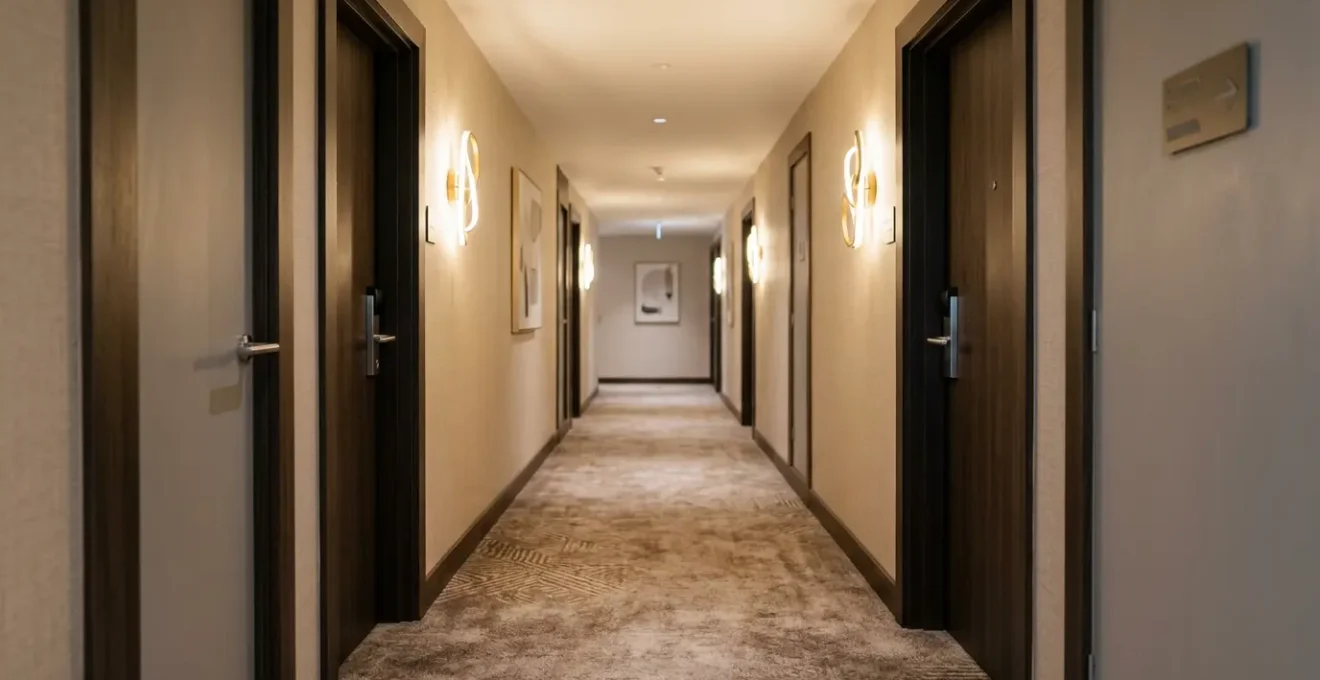
Securing connecting rooms is less about asking nicely and more about understanding hotel systems and mastering spatial dynamics to create a deliberate balance of proximity and privacy.
- Connecting room availability is fundamentally an inventory management challenge for hotels, not a service failure, with often less than 10% of rooms being connectable.
- Modern booking technology from major chains now allows for instant, binding guarantees at the time of reservation, eliminating check-in uncertainty.
Recommendation: Shift your mindset from making a hopeful ‘request’ to executing a ‘configuration strategy’ by choosing the right room type and using systems that offer confirmation.
The familiar sinking feeling at the hotel check-in desk is a rite of passage for many multi-generational families. You booked two rooms months ago, added a polite note requesting they be connecting, and spent the journey hoping for the best. Yet, the apologetic front desk agent informs you, « We couldn’t accommodate the request. The best we can do is rooms on the same floor. » This scenario highlights a core tension in group travel: the deep-seated need for both family cohesion and individual privacy. The common advice—call ahead, book early, be persistent—often fails because it misunderstands the root of the problem. The challenge isn’t a lack of willingness from hotel staff, but the rigid logic of hotel inventory systems and the architectural reality of the building.
But what if securing that connecting door wasn’t a game of chance? What if, instead of just making a request, you could execute a deliberate strategy? The key is to move beyond simple hope and adopt the mindset of a spatial-psychology specialist. This involves understanding why connecting rooms are so scarce, knowing which booking methods provide binding guarantees, and making a conscious choice between different room configurations based on your group’s specific needs for privacy and togetherness. It’s about transforming a frustrating travel problem into a solvable strategic puzzle, ensuring your holiday base enhances family connection rather than causing logistical stress.
This guide provides a strategic framework to navigate the complexities of hotel room configuration. By understanding the underlying systems, you can move from making hopeful requests to securing guaranteed arrangements that perfectly balance your group’s need for proximity and personal space.
Summary: Securing Connecting Rooms That Balance Family Cohesion With Personal Privacy
- Why Connecting Rooms Represent Only 15% of Hotel Inventory Availability
- How to Request Binding Connecting Room Guarantees at Initial Reservation
- Connecting Rooms or Family Suite: Which for a Three-Generation Holiday?
- The Connecting Door Security Risk When Hotels Assign Unrelated Guests
- When to Request Connecting Rooms to Maximize Assignment Probability
- The Room Configuration Mistake That Separates Families Across Floors
- Adjoining Rooms or Connecting Rooms: Which Better Supervises Teenagers?
- Supervising Children Through Adjoining Room Proximity Without Invading Privacy
Why Connecting Rooms Represent Only 15% of Hotel Inventory Availability
The primary reason securing connecting rooms feels like winning the lottery is a simple matter of scarcity. These rooms are not a standard feature but a specific, limited architectural element. For a hotel, a pair of connecting rooms is an inflexible asset; they can only be sold as a pair to one group or as two separate rooms to two different parties. This creates a significant inventory management challenge. If the hotel holds a connecting room for a potential family booking, the adjacent room might sit empty, losing revenue. Conversely, selling one room to a solo traveller instantly removes the ‘connecting’ option for the other.
This operational complexity means hotels are built with very few of these configurations. While the title suggests 15%, industry analysis often paints an even starker picture. According to hospitality industry analysis, it’s common for less than 10 percent of a hotel’s total room count to be connectable. This scarcity is a structural reality, not a service choice. It’s why a simple « request » in a booking note is so often futile; if the limited inventory is already allocated or sold separately, no amount of goodwill from the front desk can create a door where one doesn’t exist. Understanding this inventory logic is the first step to shifting from hope to strategy.
How to Request Binding Connecting Room Guarantees at Initial Reservation
The traditional booking process relegated connecting rooms to a « request, » a non-binding wish left to the mercy of check-in availability. This created the « decades-old problem » of uncertainty for family and group travellers. However, the technological landscape is shifting. Major hotel groups have recognised this significant pain point and are implementing systems that offer what was once unthinkable: a binding guarantee at the moment of reservation. This moves the process from the realm of customer service negotiation to a transactional certainty.
The key is to use the hotel’s proprietary booking channels—their official website or dedicated mobile app—which are increasingly equipped with this advanced functionality. These systems can now parse inventory in real-time, identify available connecting pairs, and lock them into a single reservation. Instead of making two separate bookings and adding a note, travellers can follow a specific workflow to select and confirm the connected configuration instantly. This represents a paradigm shift, treating connecting rooms not as a special favour but as a bookable room attribute, much like a sea view or a king-size bed.
Case Study: Hilton’s Confirmed Connecting Rooms
Hilton was a pioneer among major hotel chains to solve this issue systemically. The company launched a feature allowing guests to book and instantly confirm connecting rooms through Hilton.com or the Hilton Honors app. As detailed in their announcement of the Confirmed Connecting Rooms program, the system provides a three-step booking process with instant confirmation, effectively ending the gamble of waiting until check-in. Rolled out globally, this feature directly addresses the core problem by integrating the « connecting » status into the main booking engine, making it a selectable and guaranteed attribute from the outset.
Connecting Rooms or Family Suite: Which for a Three-Generation Holiday?
For a multi-generational group, the choice is not just about securing enough beds; it’s a strategic decision about spatial psychology. Do you prioritise shared social space or absolute acoustic and personal privacy? This is the core dilemma when choosing between a pair of connecting rooms and a family suite. Connecting rooms offer two distinct, self-contained environments, each with its own bathroom and entrance. This configuration is ideal for establishing clear boundaries. Grandparents can retreat to their own quiet space, and parents can have a sanctuary away from the children’s noise and clutter.
A family suite, by contrast, is designed around a central, shared living area. This promotes togetherness and provides a natural hub for group activities, meals, and socialising. However, this shared space can also become a point of friction, with no true escape from the group dynamic. The decision hinges on your family’s travel style and social rhythm. If your goal is to maximise privacy and allow for independent schedules, connecting rooms are superior. If you value a communal heart for your family’s holiday home-away-from-home, a suite is the better choice. The following table breaks down the trade-offs.
This comparative analysis from Suiteness provides a clear framework for deciding which configuration best suits your group’s needs, turning the choice into a strategic one based on desired social dynamics rather than just room count. This breakdown of connecting rooms versus suites clarifies the pros and cons.
| Feature | Connecting Rooms | Family Suite |
|---|---|---|
| Privacy Level | High – Separate rooms with lockable door | Moderate – Shared living space with separate bedrooms |
| Bathrooms | 2 full private bathrooms (one per room) | Typically 1-2 bathrooms depending on suite size |
| Common Space | None – must choose one room or the other | Dedicated living room for gathering |
| Pricing Structure | Two separate room rates | Single suite rate (often 50% less than traditional two-bedroom suite) |
| Flexibility | Door can open or close as needed | Always shared space |
| Best For | Families wanting acoustic privacy at night | Groups prioritizing shared social space and distinct zones |
The Connecting Door Security Risk When Hotels Assign Unrelated Guests
While the connecting door is a boon for families, it can become a significant security vulnerability when hotels assign the adjacent rooms to unrelated strangers. These doors, often less robust than the main entryway, can be a weak point in the room’s perimeter. The locks may be old, poorly maintained, or misunderstood by guests who assume they are automatically secured. This creates a potential risk, not just from deliberate intrusion but also from accidental entry by a neighbouring guest who is unaware the door is unlocked.
Therefore, taking personal responsibility for securing this entry point is non-negotiable, whether you are part of a group or a solo traveller who has been assigned a connecting room. Upon entering any hotel room, the connecting door should be one of the first things you inspect. You must treat it with the same vigilance as the main door, verifying its locks and overall integrity. This proactive approach transforms you from a passive guest into an active participant in your own security.
The image below highlights the typical mechanisms you should look for: a primary deadbolt and often a secondary latch or chain for added security. Familiarise yourself with their operation immediately.

To ensure your peace of mind, it is crucial to perform a quick but thorough security audit of the connecting door as soon as you check in. This simple habit empowers you to identify and address any potential weaknesses before they become a problem, ensuring your private space remains truly private.
Your connecting door security audit checklist
- Confirm the deadbolt engages fully from your side: Test by locking and physically pushing from inside to ensure it holds securely.
- Verify the presence and function of a secondary physical latch or chain: Ensure it is intact and properly attached to both door and frame.
- Physically push on the door to test lock strength and check for light or sound leakage: This can indicate gaps, weak seals, or a poor fit in the frame.
When to Request Connecting Rooms to Maximize Assignment Probability
If you are unable to secure a binding guarantee through a hotel’s modern booking system, your strategy must then shift to maximising probability. This means understanding the hotel’s operational rhythm. The single most important factor becomes timing your stay to coincide with lower overall hotel occupancy. When a hotel is not sold out, the front desk has more flexibility and a wider choice of available rooms to satisfy requests. Trying to secure connecting rooms during a major city-wide convention or on a national holiday weekend is an uphill battle, as inventory is compressed and staff have few, if any, options.
A key piece of insider knowledge is the critical difference between « adjoining » and « connecting » rooms. Adjoining rooms are simply side-by-side, whereas connecting rooms have the crucial internal door. As Gilberto Garcia-Tunon, a hotel General Manager, notes, most hotels can easily guarantee adjacent rooms, but the connecting feature is subject to availability at check-in. Therefore, booking during shoulder seasons or mid-week for leisure hotels can dramatically increase your chances. When hotel occupancy is in the solid 60-70% range rather than a peak 80-90%, the assignment puzzle is much easier for staff to solve in your favour. Your request is no longer one of fifty they are juggling, but one of a handful they can genuinely try to accommodate.
The Room Configuration Mistake That Separates Families Across Floors
The most common and frustrating mistake that leads to families being separated is not a failure of the hotel, but a misunderstanding of how hotel reservation systems work. The critical error is making multiple, unlinked reservations. When a family books one room under one name and a second room under another, even for the same dates, the hotel’s Property Management System (PMS) sees them as two separate, unrelated parties. There is no automated flag that tells the system these two bookings belong together. The « request for connecting rooms » added to the notes is just a piece of text, unread by the automated room assignment algorithms that run overnight.
This is why a family can arrive to find their rooms are not only not connecting, but on entirely different floors or wings of the hotel. The system, in its efficiency, has simply placed each reservation in the most logical available slot for its room type. To avoid this, you must ensure all rooms are part of a single booking reference or that the reservations are explicitly linked by the booking agent or hotel staff. This creates a digital « bond » between the bookings, forcing the system and the staff to treat them as a single entity. Booking different room categories (e.g., one standard king, one deluxe twin) further complicates the puzzle, making a connecting pair physically impossible to assign.
The hotel’s reservation screen, a complex matrix of bookings and room types, has no way of intuiting your family relationships without explicit data linking the reservations together.
The solution is to always book all rooms under one reservation or, if that is not possible, to call the hotel directly and ask a reservation agent to manually link the different booking numbers in the system, confirming with them that they are now seen as a single group.
Adjoining Rooms or Connecting Rooms: Which Better Supervises Teenagers?
Supervising teenagers on holiday requires a delicate balance of providing security and respecting their growing need for independence. The choice between connecting rooms and adjoining (side-by-side) rooms is a strategic parenting decision that directly impacts this dynamic. Connecting rooms, with their internal door, offer a high degree of oversight. Parents can control the lock and have direct, immediate access to the teens’ room. This creates a secure, contained environment, ideal for younger teens or situations where parents feel a higher level of supervision is necessary. However, this level of access can also feel intrusive to a teenager, undermining a sense of trust.
Adjoining rooms, on the other hand, promote what can be termed ‘supervised independence’. With separate entrances from the main hallway, teens are given full control over their own door and a greater sense of autonomy. Supervision is still possible through proximity—parents are just a few steps away down the hall—but it requires more deliberate action. This configuration fosters responsibility and trust. It signals to the teenager that they are trusted to manage their own space, while the physical closeness still provides a parental safety net. The choice depends on the teenager’s age, maturity level, and the level of trust established within the family.
This comparative table, derived from insights on Suiteness, outlines the strategic considerations when choosing a room setup for supervising teenagers, highlighting the trade-offs between direct oversight and fostering independence, as noted in their analysis of room types.
| Factor | Connecting Rooms (Internal Door) | Adjoining Rooms (Side-by-side, No Door) |
|---|---|---|
| Access Control | Parents control internal door lock | Teens have full door independence |
| Supervision Level | Direct access for immediate check-ins | Must use hallway; proximity monitoring |
| Privacy for Teens | Moderate – door can open anytime | High – separate entrances |
| Acoustic Isolation | Lower – sounds travel through shared door | Higher – separate walls and entrances |
| Emergency Response | Immediate – direct internal access | Quick but requires hallway transit |
| Trust Building | Lower autonomy, higher oversight | Higher autonomy, teaches responsibility |
| Best For | Younger teens or high-security concerns | Older teens ready for supervised independence |
Key takeaways
- Securing connecting rooms is a challenge of limited hotel inventory, not poor customer service.
- Modern booking systems from major hotel chains now offer the ability to get instant, confirmed guarantees for connecting rooms.
- The choice between connecting rooms and a family suite is a strategic trade-off between absolute privacy and a shared social space.
Supervising Children Through Adjoining Room Proximity Without Invading Privacy
The ultimate goal of a successful multi-room family setup is to create a sense of security and connection without resorting to constant, invasive check-ins. It’s about leveraging proximity to build trust, not to enforce control. Even without a connecting door, the close proximity of adjoining rooms can be used to establish clever, low-tech communication channels that respect a child’s or teenager’s personal space. This approach shifts the dynamic from one of surveillance to one of mutual awareness and reassurance.
The focus should be on creating simple, agreed-upon rituals that provide peace of mind for parents and a sense of autonomy for children. These methods are not about monitoring behaviour, but about confirming well-being. They are subtle signals that say, « I’m here if you need me, » rather than, « I’m watching you. » This fosters a healthier family dynamic during travel, allowing everyone to relax into their own space while knowing the family unit remains connected and secure. For instance, a simple walkie-talkie on the bedside table is a direct, private line for immediate reassurance or emergencies, empowering the child without requiring a phone.

To implement this trust-based supervision, consider establishing a set of simple, non-intrusive communication protocols. These methods allow for check-ins that feel like a secret handshake rather than a formal inspection.
- Use travel walkie-talkies for communication between rooms, allowing children to reach parents instantly without phone dependency.
- Establish a simple knock signal system on the shared wall (e.g., three knocks means ‘I’m okay, goodnight’) for bedtime check-ins.
- Create a visual signal agreement, such as a specific item left in the hallway, to indicate that everything is fine.
- Set scheduled check-in times using room phones or a messaging app rather than engaging in constant, unannounced monitoring.
By applying these strategic principles—understanding hotel inventory, leveraging new booking technologies, making conscious spatial choices, and establishing trust-based communication—you can fundamentally change your family’s travel experience. Begin applying these spatial and booking strategies on your next trip to transform group travel from a gamble into a well-designed experience that honours both connection and personal space.