
Choosing the right hotel room for a family holiday isn’t about size or luxury; it’s about deploying strategic ‘configuration psychology’ to prevent conflict before it starts.
- A single, large family room often creates friction for children over 10 by eliminating privacy and forcing conflicting sleep schedules.
- Two smaller, adjoining rooms frequently offer better value, greater flexibility, and more practical separation than a single, expensive family suite.
Recommendation: For your next family trip, prioritise room layouts that enable ‘schedule decoupling’ and acoustic separation over chasing sheer square footage.
The scene is a familiar one for many parents on holiday: the children are finally asleep, but it’s only 8 PM. The room is plunged into a silent, trip-wire darkness where a single cough could awaken the little ones. The adults are left whispering in the bathroom or scrolling on their phones under the duvet, the evening’s potential for relaxation evaporating. This scenario highlights a fundamental truth many families discover too late: the standard « family room » is often a masterclass in shared misery, not shared joy. It’s a space designed for sleeping, but not for living harmoniously together.
Most travel advice focuses on amenities like kids’ clubs or booking deals, assuming the physical room is just a container. But this overlooks the powerful impact of layout on family dynamics. We instinctively book the « family » option, believing it’s the most logical choice. However, as children grow, their needs for privacy, autonomy, and a different sleep schedule clash directly with the open-plan nature of these rooms. The very space meant to bring a family together becomes the primary source of friction.
What if the key to a peaceful family holiday wasn’t a bigger room, but a smarter one? This guide introduces the concept of configuration psychology: the art and science of selecting a hotel room layout that actively works to minimise conflict and maximise harmony. It’s about understanding that the walls, doors, and even the distance between beds are strategic tools. Instead of accepting the default, we will explore how to analyse room types not by their name, but by their function, and why two seemingly smaller rooms often create a far more peaceful and functional holiday home than one large one.
This article will guide you through the critical factors to consider, from verifying usable space and understanding acoustic problems to making specific, effective requests at booking. By applying these principles, you can transform your next family holiday from a test of endurance into a genuinely restorative experience for everyone.
Summary: A Strategic Guide to Choosing a Family Hotel Room That Prevents Friction
- Why Family Rooms Create Friction When Children Exceed Ten Years Old
- How to Verify Family Rooms Offer Adequate Square Footage for Four People
- Family Room or Two Adjoining Rooms: Which Saves Money for a Family of Four?
- The Family Room Acoustics Problem That Ruins Children’s Sleep Quality
- How to Request Family Room Locations Minimizing Corridor Noise Disturbance
- Why Adjoining Rooms Beat Family Suites for Children Over Eight Years Old
- How to Balance Adult Interests With Children’s Needs in Shared Holiday Activities
- Selecting Optimal Room Configurations for Diverse Guest Compositions and Mobility Needs
Why Family Rooms Create Friction When Children Exceed Ten Years Old
The idyllic concept of a family room begins to fracture around the time a child enters their pre-teen years. Before this, a shared space is a cosy novelty. After, it becomes a pressure cooker of conflicting needs. The primary source of friction is the complete erosion of personal space and privacy. A ten-year-old is developing a stronger sense of self and personal boundaries, making the prospect of sharing a single room with parents and younger siblings feel increasingly invasive. Simple acts like getting changed, having a quiet moment to read, or listening to music become public performances.
This is compounded by the sleep schedule dilemma. A younger child may go to bed at 7 PM, while a teenager might not feel tired until 10 PM, and parents later still. In a single room, the entire family is held hostage by the earliest bedtime. As one parent interviewed for a Scary Mommy article lamented, « Who wants to sit in a room in silent darkness at 7PM to put a baby to sleep!? » This forces a choice between sacrificing the adults’ evening or compromising a child’s sleep. This single friction point—the conflict between different sleep/wake cycles—can set a negative tone for the entire holiday.
Furthermore, the issue extends beyond internal family dynamics. Hotels are not silent sanctuaries; they are often located in busy urban areas. Research shows that at least 20% of Europeans in urban areas are exposed to high levels of external noise. A single, large room offers fewer buffers from this external noise, and the internal noise of four people co-existing in one space only adds to the sensory overload, further fraying everyone’s nerves.
Ultimately, the « family room » model is built on an assumption of total togetherness, which becomes a liability, not an asset, once children develop their own social and personal needs.
How to Verify Family Rooms Offer Adequate Square Footage for Four People
Hotel marketing photos are masters of illusion, using wide-angle lenses to make even the most compact rooms appear spacious. When booking for a family of four, relying on these images alone is a recipe for disappointment. The stated « square footage » can also be misleading. A large number might include an unusable entryway, a long corridor, or a bathroom, leaving the actual living and sleeping area surprisingly cramped. The key is to shift your mindset from total area to functional space—the room you can actually move around and live in.
A good starting point is to establish a baseline. For instance, the average standard hotel room in North America is around 325 square feet (approximately 30 square metres). If a « family room » is listed at only slightly more than this, it’s a red flag. For a family of four to coexist comfortably, you should be looking for a room that provides distinct functional zones: a sleeping area, a small seating area, and clear circulation paths that aren’t blocked by luggage.
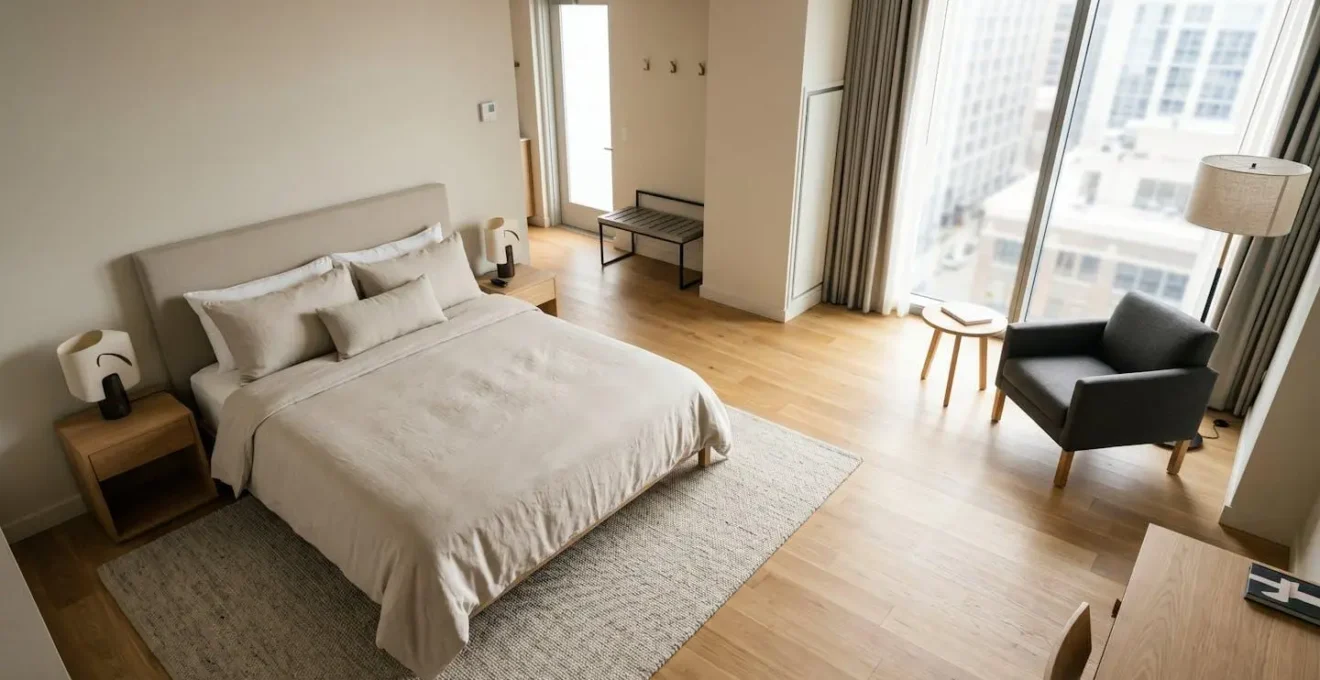
As the image above illustrates, a well-designed space allows for different activities to occur without people tripping over one another. Before booking, scrutinise the room’s floor plan if available. If not, don’t hesitate to call the hotel directly. Ask specific questions: « Does the square footage include the bathroom and entryway? » and « Is there a floor plan you can send me? » A reputable hotel should be able to provide this. Look for layouts that place beds against walls to maximise central floor space, rather than a layout where you must navigate around beds to get anywhere.
Remember, true comfort comes from a layout that breathes, not just one that boasts a big number on a website. It’s the difference between a relaxing basecamp and a cluttered storage locker for your family.
Family Room or Two Adjoining Rooms: Which Saves Money for a Family of Four?
The conventional wisdom is that booking one large « family suite » is the premium, and therefore more expensive, option, while cramming into a single family room is the budget choice. However, the often-overlooked middle ground—booking two standard, adjoining rooms—frequently emerges as the most cost-effective and functionally superior solution. This counter-intuitive reality stems from how hotels price and categorise their inventory. Family suites are considered specialty products, carrying a significant premium due to their scarcity.
In contrast, standard double rooms are the hotel’s bread and butter. Booking two of them can often be cheaper than a single suite. You also gain significant advantages: two full bathrooms, which is a game-changer for a family of four getting ready in the morning, and a clear zone of separation. This isn’t just theory; it’s borne out by real-world pricing.
Case Study: Disney Resort Cost Comparison
A concrete price analysis from Disney World resorts provides a clear example. In one comparison, a Family Suite at the All Star Music resort was priced at $346 per night. On the same dates, two standard rooms at the very same resort cost $158 each, for a total of $316. This demonstrates how booking two connecting rooms can deliver immediate savings of around $30 per night while also providing four proper beds instead of a mix of beds and sofa beds, plus double the bathroom access and a more flexible distribution of space.
This principle is even more pronounced when using loyalty points. As travel strategists at The Points Guy note, « Booking two standard rooms with points is significantly ‘cheaper’ in points-value than booking a single, high-demand ‘Family Suite’, which is classified as a premium room. » The takeaway is clear: you often get more space, more privacy, more bathrooms, and a lower price by thinking in multiples of two rather than seeking one large, and often overpriced, single unit.
Before assuming a suite is the answer, always price out the two-room alternative. You may find that the superior and more harmonious option is also the one that’s kinder to your wallet.
The Family Room Acoustics Problem That Ruins Children’s Sleep Quality
In the shared space of a family room, every sound is amplified. The gentle glow and low hum of a parent’s laptop can feel like a floodlight to a child trying to sleep. The crinkle of a snack packet, a whispered phone call, or the TV volume turned down to a single bar—these are the subtle acoustic « leaks » that degrade sleep quality. This is the internal acoustics problem: the sounds generated within the room itself. Children, particularly younger ones, are more sensitive to these disruptions, leading to fragmented sleep, night-time wakings, and grumpy mornings.
Modern hotel design often exacerbates this issue. The trend towards minimalist aesthetics with hard flooring, large glass windows, and minimal soft furnishings creates an environment where sound waves bounce freely. These hard, reflective surfaces do nothing to absorb the small noises that are an inevitable part of cohabitation. A room with thick carpeting, heavy curtains, and plush furniture will be inherently quieter and more forgiving than its sleek, modern counterpart.
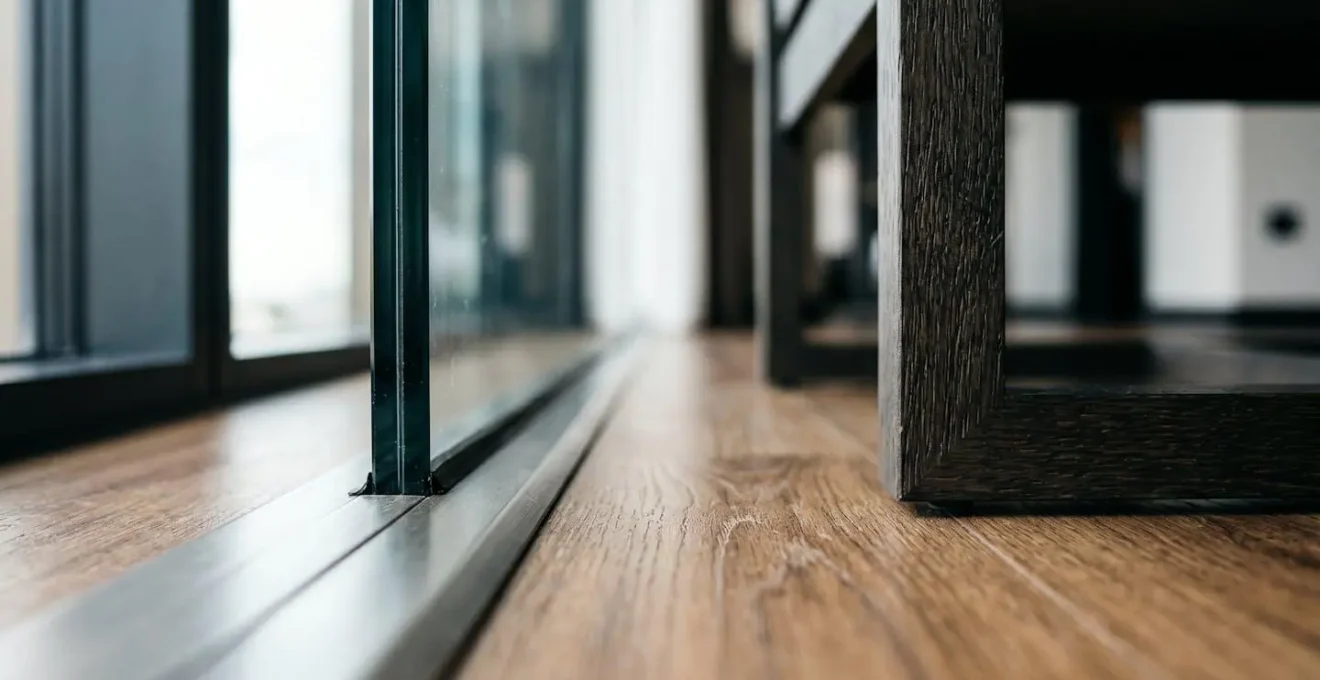
While hotels focus on external noise, the internal environment is often overlooked. Interestingly, research in the hospitality industry has found that adding a consistent, low-level background sound—a technique known as sound masking—can dramatically improve sleep quality. Some leading hotel brands have seen an up to 85% reduction in noise complaints by implementing such systems. For families, this highlights the value of bringing a portable white noise machine. It doesn’t eliminate noises, but it smooths the acoustic landscape, making individual sounds (a cough, a closing door) less jarring and disruptive to a sleeping child.
The ultimate goal is to create « acoustic containment. » In a single room, this is nearly impossible. In an adjoining room setup, a closed door becomes a powerful tool for acoustic separation, allowing for different activities and sound levels in each space.
How to Request Family Room Locations Minimizing Corridor Noise Disturbance
Even with the perfect interior room setup, your family’s peace can be shattered by external noise, particularly from the hotel corridor. The area around the lifts is a constant hub of activity, with whirring machinery, the « ding » of arriving cars, and the chatter of guests waiting. Likewise, rooms near ice machines or housekeeping closets are subject to intermittent but disruptive noise at all hours. As a family traveller, your goal is to secure a room buffered from these high-traffic zones. This requires making proactive, specific requests during the booking process.
Vague requests like « a quiet room » are often ignored because they are subjective. Instead, you need to provide the hotel with concrete, actionable instructions that demonstrate you understand how hotel layouts work. A request for a room « mid-corridor » is far more effective. This position uses the neighbouring rooms as sound buffers on both sides, insulating you from the noise generated at the ends of the hallway, such as stairwell doors or service areas. Similarly, specifying « not an interconnecting room, unless we are booking both » is a crucial detail to prevent noise leakage through a thin, shared door from a stranger next door.
The power of a well-phrased request cannot be overstated. While hotels rarely guarantee a specific room, they will almost always try to accommodate detailed, reasonable requests made at the time of booking. Add your requests to the « special requests » or « notes » field of the online booking form. If that’s not an option, follow up with a direct email or phone call to the hotel immediately after booking, quoting your reservation number. This creates a paper trail and ensures your needs are logged in their system.
Your Action Plan for Requesting a Quieter Room
- Request a room on a high floor, away from street-level bars or patios, to reduce external entertainment noise.
- Ask for a room positioned mid-corridor, buffered by other guest rooms on both sides, rather than a corner position.
- Specify « Room not directly opposite the elevator bank » to avoid constant door noise and foot traffic from waiting guests.
- Request « Not an interconnecting room unless we are the party booking both » to eliminate shared-wall door disturbances from neighbours.
- For maximum quiet, ask for a room on a floor above communal areas (like the lobby or restaurant) rather than directly above another guest room where you might hear their television or conversations.
By thinking like a hotel manager and providing clear, logical location preferences, you shift from a passive guest to an active participant in securing your family’s comfort.
Why Adjoining Rooms Beat Family Suites for Children Over Eight Years Old
Once a child reaches the age of eight, a significant psychological shift occurs. The need for constant parental proximity gives way to a burgeoning desire for independence. It’s at this milestone that the adjoining room configuration truly begins to outperform the family suite. A suite, for all its perceived luxury, is still a single, shared territory under parental control. Adjoining rooms, however, create a powerful illusion of autonomy that is deeply appealing to older children and teens.
This setup provides them with « their own » space. They get their own door, their own bathroom, and control over their own television. This sense of ownership and privacy is a huge factor in their holiday enjoyment. As one parent travelling with older children noted, the adjoining rooms « did give the kids a fun feeling of almost traveling on their own. » This is a crucial element of configuration psychology: the physical layout directly impacts a child’s sense of freedom and respect, leading to fewer power struggles and a more harmonious atmosphere. The internal connecting door, controlled by the parents, maintains safety and supervision while preserving this valuable sense of independence.
Parents traveling with older children reported that adjoining rooms gave kids a fun feeling of almost traveling on their own while maintaining parental proximity and safety…
– Parent experience shared on Daisies & Clovers
Hotels are also beginning to recognise and incentivise this model. Rather than pushing families into a limited number of expensive suites, savvy brands encourage the booking of multiple rooms. For example, some luxury hotel chains have programmes that offer an up to 50% discount on a second room for families. This makes the financially prudent choice also the experientially superior one. It’s a win-win: the hotel fills more standard rooms, and the family gets a more flexible, private, and often more affordable accommodation solution.
By giving older children a taste of independence within a secure framework, you’re not just booking two rooms; you’re booking a more peaceful and respectful family dynamic.
How to Balance Adult Interests With Children’s Needs in Shared Holiday Activities
A successful family holiday requires a delicate balancing act, weaving together activities that appeal to different age groups and energy levels. The ability to « divide and conquer » or operate on staggered schedules is paramount. This is where your hotel room configuration becomes the central pillar of your entire holiday strategy. A poorly chosen layout can actively sabotage your best-laid plans for a balanced itinerary. If the room doesn’t allow for one person to rest while others are active, the entire family is forced to operate in lockstep, often to the lowest common denominator of energy or interest.
This is the concept of schedule decoupling in action. An adjoining room setup is the ultimate enabler of this strategy. It allows one parent to take a tired younger child back for a nap in one room, closing the connecting door, while the other parent stays out with an older child for another hour at the pool. It allows parents to put the kids to bed in their room and then retreat to their own room to watch a movie or have a conversation without whispering. This separation is not about being apart; it’s about giving the family the flexibility to meet individual needs, which ultimately makes the time spent together more enjoyable.
Case Study: The Illusion of the Large Suite
Family travel experts highlight a common pitfall. One parent detailed staying in a suite of over 1,100 square feet that, crucially, lacked a closing door to the main bedroom. This palatial space was functionally useless for schedule decoupling. After their son’s bedtime, the parents were faced with a choice: either go to sleep at the same time as him or decamp to the hotel lobby to talk or work. This experience perfectly demonstrates how the presence of a simple door is more valuable than hundreds of square feet of open-plan space. The room configuration, not the size, determined their ability to execute a balanced itinerary.
Without this ability to decouple schedules, friction is inevitable. One person’s need for rest clashes with another’s desire for activity. Resentment can build as one party feels they are constantly compromising. By choosing a room configuration that facilitates separation, you are investing in flexibility—the single most important currency of a family holiday.
Your room choice should be your first strategic decision, the one that makes all other holiday planning decisions easier and more harmonious.
Key Takeaways
- For children over ten, the need for privacy and a separate sleep schedule makes a single family room a source of friction.
- Two adjoining rooms are often cheaper and provide more flexibility and bathrooms than a single, overpriced family suite.
- Prioritise layouts that allow for acoustic separation and ‘schedule decoupling’ to ensure a peaceful holiday for all family members.
Selecting Optimal Room Configurations for Diverse Guest Compositions and Mobility Needs
The « family » unit is not a monolith. It can include toddlers, teenagers, grandparents with limited mobility, or family members who use mobility aids. The optimal room configuration must therefore be assessed through a lens of accessibility and practicality for every single member of the group. A duplex suite with a stylish internal staircase might look great in photos, but it’s a dangerous obstacle for a toddler and an impassable barrier for an elderly relative. The principle of configuration psychology must extend to the physical capabilities of all guests.
Bathroom accessibility is a critical, often overlooked, factor. A standard tub/shower combination can be difficult for young children to navigate and a serious hazard for anyone with balance or mobility issues. A walk-in shower is a far more versatile and safer option. Accessibility standards, such as the Americans with Disabilities Act (ADA) in the US, provide a useful benchmark. These standards mandate extra space for wheelchair turning circles, which is why accessible bathrooms require an additional 60 to 90 square feet compared to standard ones. When booking, specifically inquiring about rooms with walk-in showers or fully accessible « wet rooms » can make a world of difference for a multi-generational group.
The room’s location relative to hotel facilities is also part of its configuration. For a family with a stroller or a guest using a walker, a room at the far end of a long corridor can turn every trip to the lobby into a tiring expedition. When assessing your group’s needs, consider the following:
- Proximity to Lifts: Request a room near the elevator bank to minimise walking distances for those with limited stamina.
- Corridor Obstacles: Be aware of heavy fire doors, which can be difficult for children or elderly guests to open.
- Room Level: Ground-floor rooms can be ideal for families with strollers or those who want to avoid elevators altogether.
- Layout Type: Always verify if a « suite » is single-level. Avoid multi-story rooms if your party includes very young or very old members.
By expanding your definition of a « good » room to include these accessibility factors, you move from simply booking a space to designing a genuinely inclusive and comfortable holiday experience for the entire family.