
The term « tourist hotel » has no legal weight in the UK; it is a marketing label that can be misleading for holidaymakers.
- Official UK ratings (from the AA or national tourist boards) are voluntary but based on rigorous, public criteria for quality and facilities.
- A hotel’s true priority—leisure or business—is revealed not by its name, but by its physical infrastructure, amenity pricing, and digital footprint.
Recommendation: Learn to « read » a hotel’s structural clues and understand official rating systems to ensure its promises align with your holiday needs.
For the occasional UK holidaymaker, booking accommodation can feel like navigating a minefield of confusing terms. You see labels like « tourist hotel, » « tourist class, » or « city hotel, » but what do they actually mean? Many travellers assume these terms are interchangeable with « budget » or that a hotel’s star rating tells the whole story. This often leads to disappointment when the reality of a stay doesn’t match the expectation, whether it’s a lack of family-friendly spaces or amenities geared entirely towards a corporate clientele.
The common advice is to simply read online reviews, but this only provides a series of subjective snapshots. It doesn’t equip you with the tools to understand the fundamental nature—the very DNA—of a hotel. The real key to avoiding disappointment is not just about sifting through opinions, but about learning to decode the language of hospitality classification itself. It’s about understanding the subtle but crucial differences rooted in legal frameworks, business models, and physical infrastructure that define a hotel’s true purpose.
This guide moves beyond the surface-level labels. Instead of repeating generic advice, we will dissect what « tourist hotel » truly implies within the UK context. We will explore the legal and operational distinctions, show you how to identify a hotel’s genuine priorities, and demystify the classification systems that cause so much confusion. By the end, you’ll be able to look past marketing jargon and choose accommodation with the confidence that it is genuinely built for a leisure visitor’s needs.
This article provides a structured approach to understanding the nuances of hotel classifications. The following sections will break down everything you need to know to make informed decisions for your next trip.
Summary: A Guide to Hotel Classification for Leisure Visitors
- Why Tourist Hotels Differ From Business Hotels in UK Licensing Requirements
- How to Identify if a Tourist Hotel Prioritizes Leisure Over Business Amenities
- What Does « Tourist Class » Legally Mean in British Hotel Classification Systems?
- The Tourist Hotel Infrastructure Gap That Disappoints 50% of Families
- When to Book Tourist Hotels to Avoid Peak-Season 200% Price Surcharges
- The Classification Assumption That Disappoints 55% of International Travelers
- What « Family-Friendly » Actually Means in Destination Marketing Language
- Understanding How Hotel Classification Systems Vary Internationally to Avoid Disappointment
Why Tourist Hotels Differ From Business Hotels in UK Licensing Requirements
The distinction between a hotel geared for tourists and one for business travellers isn’t just about the presence of a swimming pool versus a conference room; it’s rooted in fundamental legal and regulatory frameworks. In the UK, all hotels operate under a baseline obligation. The historic Hotel Proprietors Act 1956 establishes the core function of a hotel, stating they must offer « food, drink and accommodation to anyone who appears willing and able to pay and is in a fit state. » However, beyond this broad definition, the intended clientele dramatically shapes a hotel’s regulatory obligations.
A hotel focusing on leisure visitors will likely have a different set of licenses than a corporate-focused one. For example, a tourist hotel might heavily rely on its license for live music or late-night entertainment under the Licensing Act 2003 to create a vibrant holiday atmosphere. In contrast, a business hotel might prioritise efficient, but less regulated, services. Furthermore, all hotels must adhere to the Health and Safety at Work Act 1974 and the Fire Safety Order 2005, but how they implement these can vary. A tourist hotel with family guests may need more visible and robust safety measures around pools and play areas, leading to different operational procedures and staff training.
Even the building’s planning permission can indicate its primary purpose. Most traditional hotels fall under the C1 planning class. However, the rise of different accommodation types means that a property’s legal permissions can dictate its operational limits, subtly steering it towards either short-stay leisure guests or longer-term business clients. Understanding this regulatory DNA helps explain why two hotels that look similar online can offer vastly different experiences on the ground.
How to Identify if a Tourist Hotel Prioritizes Leisure Over Business Amenities
Beyond the legal framework, a hotel’s true focus is broadcast through its « digital footprint » and on-site service offerings. Marketing materials can be deceptive, but a careful analysis of what a hotel chooses to highlight—and charge for—reveals its genuine priorities. A hotel built for leisure will invest in and promote amenities that enhance the holiday experience, whereas a business-centric hotel will streamline services for efficiency and productivity.
One of the most telling indicators is the hotel’s approach to amenity economics. A business hotel might prominently feature and charge a premium for services like 24/7 dry cleaning, in-room printing, and express checkout. Conversely, a leisure-focused hotel might offer complimentary bike rentals, a detailed tour-booking desk, or a well-stocked games room. The key is to look for what is treated as a core part of the experience versus a costly add-on. Guest-uploaded photos on review sites are another unfiltered source of truth; a gallery dominated by families at the pool tells a very different story than one filled with guests on laptops in a business lounge.
The hotel’s public communications also provide clear clues. Does its social media feed showcase weekend getaway packages and school holiday promotions, or does it advertise mid-week conference blocks and corporate networking events? A truly leisure-oriented property invests in the entire family ecosystem, offering services like certified childcare, pre-arrival questionnaires about children’s needs, and age-specific activity programmes. These are not flashy extras but foundational elements indicating a deep-seated commitment to the leisure traveller.
Your Action Plan: Digital Footprint Analysis for Hotel Focus
- Scan guest-uploaded photos: Look for visual indicators on review platforms—families at pools and play areas versus conference rooms and business lounges.
- Analyze amenity pricing: Check if 24/7 dry cleaning is prominently priced (business focus) versus bike rentals or tour booking services (leisure focus).
- Review social media & events: Identify if content emphasizes holiday promotions and family events over mid-week corporate and conference blocks.
- Examine on-property services: Verify the presence of childcare services, family questionnaires, and age-specific programming, which signal a true leisure priority.
What Does « Tourist Class » Legally Mean in British Hotel Classification Systems?
Here lies one of the biggest sources of confusion for travellers: the term « tourist class » has no legal meaning or official standing in the UK’s hotel classification system. It is a marketing term, often used by tour operators and booking agents to denote a standard, no-frills level of accommodation, but it isn’t tied to any formal inspection or quality criteria. Believing « tourist class » is an official category is a common pitfall that can lead to mismatched expectations.
The official, reliable systems in the UK are voluntary schemes run by independent bodies. Following the withdrawal of the RAC scheme in 2008, the most widely recognised UK hotel rating schemes are those managed by the AA (Automobile Association) and the national tourist boards: VisitEngland, Visit Wales, the Scottish Tourist Board, and the Northern Ireland Tourist Board. When a hotel displays a star rating from one of these organisations, it signifies that it has undergone a rigorous, in-person inspection against a publicly available set of criteria covering cleanliness, quality, hospitality, and range of facilities.
This is fundamentally different from star ratings seen on online travel agent (OTA) websites. OTA ratings are typically generated by an algorithm that considers a hotel’s declared amenities and is heavily influenced by user-generated reviews. While useful, these ratings lack the standardised, objective assessment of a formal inspection. Understanding this difference is crucial for decoding the classification language.
This table, based on an analysis of hotel terminology, clarifies the distinction between official ratings and marketing labels.
| Classification Type | Legal Weight | Criteria Source | Verification Method |
|---|---|---|---|
| Official Star Rating (AA, VisitEngland) | Voluntary but rigorous | Published inspection criteria | Regular inspections |
| ‘Tourist Class’ Marketing Term | No legal standing | Tour operator defined | None required |
| OTA Star Ratings | Commercial algorithm | Amenity checklist + reviews | User-generated data |
The Tourist Hotel Infrastructure Gap That Disappoints 50% of Families
A hotel can market itself as « family-friendly, » but if its physical infrastructure isn’t designed for families, disappointment is inevitable. This « infrastructure gap » is a major source of frustration, particularly in city hotels that may have been designed with solo business travellers or couples in mind. Issues like a lack of connecting rooms, small standard room sizes that can’t comfortably accommodate a cot, and dining areas without easy pram access are common complaints.
The problem is quantifiable. Recent research on city hotels demonstrated that they meet family expectations at about 50% for general child-friendly services. This figure drops to a mere 30% when it comes to specific in-room and restaurant amenities. This highlights a significant disconnect between marketing language and the on-the-ground reality. Families are not just a group of adults; they have specific spatial and logistical needs that many properties fail to meet, despite claiming to welcome them.
The absence of guaranteed connecting rooms is a prime example of this structural mismatch. For families with older children, two separate rooms down a corridor is not a viable or secure solution. Yet, many hotels cannot confirm connecting rooms until check-in, creating immense uncertainty for parents. Other structural failures include bathrooms with only a shower stall (unsuitable for bathing small children) or a lack of soundproofing between rooms, which becomes a major stressor for parents of a crying baby.
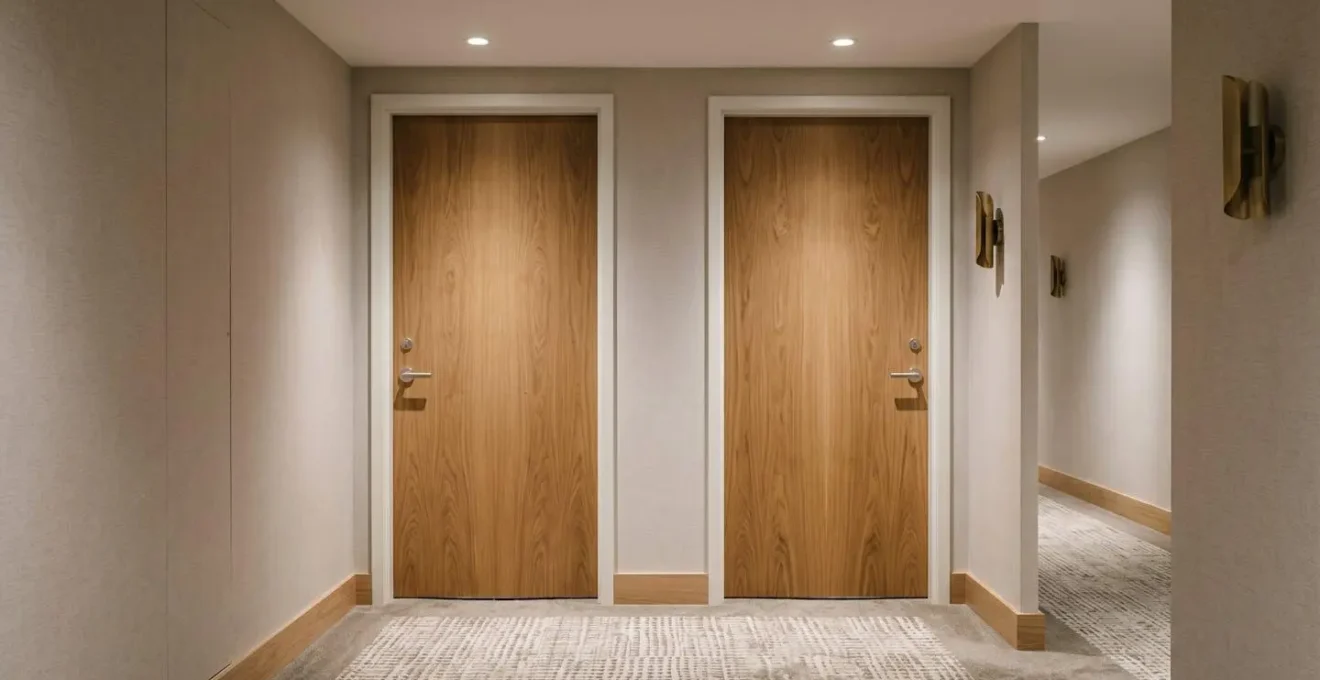
As this image subtly suggests, the physical space between standard rooms can represent a significant divide in functionality for a family. These are not minor inconveniences; they are fundamental design-level issues that determine whether a hotel is merely « family-tolerant » or genuinely « family-focused. » Leisure travellers must learn to ask specific questions about infrastructure before booking, such as « Can you guarantee connecting rooms in writing? » or « What is the square footage of your standard family room? »
When to Book Tourist Hotels to Avoid Peak-Season 200% Price Surcharges
One of the most jarring aspects of booking holidays is the extreme fluctuation in hotel prices, which can often feel arbitrary. It’s not uncommon to see rates double or even triple during peak seasons like school holidays or bank holiday weekends. This isn’t random; it’s the result of a strategy called dynamic pricing. Hotels, particularly those catering to tourists, use sophisticated systems to constantly adjust their rates based on a multitude of factors to maximise revenue.
These dynamic pricing systems allow hotels to respond to real-time changes in demand. The key factors influencing the price you pay include the day of the week, seasonality, special events in the area (like concerts or festivals), the length of your stay, and even the weather forecast. Hotels also constantly monitor their competitors’ pricing, creating a highly fluid market where the price for the same room can change multiple times in a single day.
However, these price changes often follow a predictable « wave » pattern. Typically, rates are high when they are first released (10-12 months in advance). They then tend to dip around 3-4 months before the arrival date as the hotel tries to secure a base level of occupancy. This is often the sweet spot for booking. After this point, as the arrival date gets closer and availability dwindles, prices enter a final surge, especially in the last 6 weeks. While last-minute deals can exist if a hotel is unexpectedly empty, booking in the 3-4 month window generally offers the best balance of price and availability, allowing you to lock in a reasonable rate before the final peak-season surge.
The Classification Assumption That Disappoints 55% of International Travelers
A common and costly assumption for travellers is that a « 4-star » hotel in one country is equivalent to a « 4-star » hotel in another. This is fundamentally untrue and a primary reason for international travel disappointment. There is no globally standardised hotel classification system. The criteria for what constitutes a certain star level can vary dramatically from one country to the next, covering everything from mandatory 24-hour reception to minimum room size.
The scale of this inconsistency is significant. For instance, a UNWTO study comparing international hotel classification systems found that many criteria were so specific to certain regions that any attribute applied to fewer than 60% of national systems had to be excluded from the comparison just to find some common ground. This means a significant portion of what defines a hotel’s quality in one country is completely irrelevant in another. A 3-star rating in a country with a state-mandated, rigorously enforced system might guarantee a higher standard than a 4-star rating in a country where the system is purely market-driven.
One of the most common areas of divergence is minimum room size. A traveller accustomed to the generous room sizes often found in North American hotels might be shocked by the compact dimensions of a similarly-rated hotel in a historic European city centre. Other points of difference include whether a restaurant is required on-site, the ratio of staff to guests, or the provision of amenities like air conditioning. This lack of a universal standard means that relying solely on a star rating when travelling internationally is a gamble.

As this image illustrates, the very concept of measurement and standards can be abstract and vary by location. The most effective strategy for international travellers is to treat star ratings as only one clue. It’s crucial to cross-reference with recent reviews, look at guest photos to gauge room size, and check the specific list of amenities rather than assuming they are included based on the star level.
What « Family-Friendly » Actually Means in Destination Marketing Language
The term « family-friendly » is one of the most overused and ambiguous phrases in travel marketing. With family travel representing a massive economic opportunity, hotels are eager to attract this demographic. However, the label is applied so broadly that it has become almost meaningless without further investigation. For one hotel, « family-friendly » might simply mean they don’t prohibit children. For another, it represents a deep, structural commitment to catering for the needs of all ages.
To cut through the noise, it’s helpful to think of « family-friendly » as a spectrum with three distinct tiers. This framework allows you to decode what a hotel is actually offering, rather than what it’s marketing:
- Tier 1 – Family Tolerant: These are the most basic properties. They legally accept families with children but offer no specific infrastructure or amenities. You can stay there, but you’re on your own. This is the minimum standard.
- Tier 2 – Family Equipped: This is a step up. These hotels can provide foundational amenities upon request, such as travel cots or high chairs in the restaurant. They may also have a few connecting rooms. However, there is no dedicated programming or specialised staff.
- Tier 3 – Family Focused: This is the gold standard. These hotels have a comprehensive family infrastructure. This includes dedicated kids’ clubs with scheduled activities, certified childcare services, a family concierge, and robust safety protocols (e.g., fenced pools). Their restaurants have kids’ menus that go beyond chicken nuggets, and they are well-versed in handling allergies.
Most disappointments arise when travellers expect a Tier 3 experience from a hotel that is, at best, Tier 2. To avoid this, look for specific evidence. Does the hotel website have a dedicated « Family » section with details about its kids’ club staff and activities? Does it mention partnerships with certified childcare providers? Vague statements like « we welcome families » are red flags; specific, detailed information is the hallmark of a genuinely family-focused establishment.
Key Takeaways
- « Tourist Class » is a marketing term with no legal standing in the UK; it does not guarantee a specific standard.
- Official ratings from the AA and national tourist boards (e.g., VisitEngland) are the most reliable indicators of quality in the UK, as they are based on physical inspections.
- A hotel’s true focus is revealed by its infrastructure (like connecting rooms) and amenities (kids’ club vs. business centre), not just its marketing language.
Understanding How Hotel Classification Systems Vary Internationally to Avoid Disappointment
After exploring the nuances of UK-specific terms and international assumptions, it becomes clear that the key to a successful hotel booking is understanding the *type* of classification system at play. Broadly, hotel rating systems around the world fall into three main categories, each with different levels of reliability. In Germany, for example, research showed that when a clear and reliable industry-led classification was introduced, it quickly became a critical factor for guests, with 80% of guests citing hotel stars as the main criterion in their selection process. This demonstrates that when a system is trustworthy, travellers will use it.
The challenge is knowing which system you are looking at. The three primary types are state-mandated, industry-led, and commercial. State-mandated systems, common in countries like France and Italy, are legal requirements with government inspections, offering a high degree of reliability. Industry-led systems, like the UK’s AA/VisitEngland scheme or Germany’s Hotelstars Union, are voluntary but highly rigorous, driven by the need to maintain a reputable standard. The third category, commercial and crowd-sourced ratings from OTAs, is the most variable, based on algorithms and subjective reviews rather than objective inspection.
By understanding these differences, a leisure traveller can become a more discerning consumer. A 3-star rating from a state-mandated system might offer more peace of mind than a 5-star rating from an unverified online source. The ultimate goal is to move beyond simply looking at the number of stars and to start questioning the system that awarded them.
| System Type | Examples | Legal Force | Methodology | Reliability |
|---|---|---|---|---|
| State-Mandated | France, Spain, Italy | Legal requirement | Government inspections with legal criteria | High – regular enforcement |
| Industry-Led | UK AA, VisitEngland, Hotelstars Union (Germany) | Voluntary participation | Rigorous industry-standard inspections | High – reputation-driven |
| Commercial/Crowd-Sourced | OTAs, TripAdvisor algorithms | None | Popularity algorithms + user reviews | Variable – subjective |
By moving beyond marketing jargon and understanding the structural, legal, and international context of hotel classifications, you empower yourself to make choices that truly align with your holiday needs. Start applying this knowledge today to ensure your next trip is free from accommodation-related disappointments.