Securing the right hotel room configuration is not a matter of luck; it is a verifiable process that you control.
- For families with older children, the need for privacy often makes two adjoining rooms a better, more harmonious choice than a single family suite.
- For travellers with disabilities, a room advertised as “accessible” is not a guarantee; its suitability must be proven through a specific verification protocol before arrival.
Recommendation: Shift your approach from making passive ‘special requests’ to executing a proactive, pre-arrival verification and confirmation strategy to guarantee your needs are met.
For many families and travellers with specific mobility needs, the moment of checking into a hotel is filled with unnecessary anxiety. You arrive, hoping the “special request” you made for connecting rooms or a specific accessible layout has been honoured, only to be met with an apologetic “we’ll do our best” or the dreaded news that no such rooms are available. This common frustration stems from a fundamental misunderstanding of the booking process. Relying on the comments box or a quick phone call is often a strategy destined for failure.
The standard advice to simply “call the hotel” or “join a loyalty program for upgrades” overlooks the core of the problem. These are passive measures in a system that requires active engagement. The inventory of specialised room configurations is limited, and their allocation is often a last-minute, manual process. Without a robust strategy, your essential requirements are treated as mere preferences, easily overlooked during a busy check-in period.
But what if the key was not to simply request, but to actively verify and confirm? The true solution lies in shifting from a hopeful traveller to a strategic planner. It involves understanding precise hotel terminology, leveraging your rights under legislation like the UK’s Equality Act 2010, and implementing a communication protocol that turns your request into a guaranteed part of your booking contract. This is not about being demanding; it is about ensuring the safety, comfort, and harmony of your trip.
This guide provides that strategic framework. We will deconstruct the common pitfalls of hotel bookings and provide a clear, actionable path to secure the exact room configuration you need, transforming uncertainty at the check-in desk into a confirmed and stress-free welcome.
Summary: A Strategic Guide to Booking the Right Hotel Room
- Why Adjoining Rooms Beat Family Suites for Children Over Eight Years Old
- How to Request Accessible Hotel Rooms Meeting UK Equality Act 2010 Standards
- What Does “Connecting Room” Legally Mean in British Hotel Terminology?
- The Room Configuration Mistake That Separates Families Across Floors
- How to Secure Room Upgrades by Strategically Leveraging Loyalty Program Status
- Why Family Rooms Create Friction When Children Exceed Ten Years Old
- How to Verify Accessible Rooms Through Ten Specific Pre-Booking Questions
- Preventing Friction in Shared Family Rooms Through Strategic Configuration Selection
Why Adjoining Rooms Beat Family Suites for Children Over Eight Years Old
The conventional wisdom for family travel has long favoured the “family suite” as the ultimate solution for space and convenience. However, as children transition from toddlers to pre-teens and beyond, the dynamics of a shared space change dramatically. For families with children over the age of eight, the supposed benefit of a single large room can quickly become a source of friction. The pursuit of harmony often leads to a counter-intuitive conclusion: two smaller, adjoining rooms provide a significantly better experience than one large suite.
The primary advantage lies in privacy and functionality. A case study of a family with older children revealed a critical benefit: connecting rooms provided them with two full bathrooms. This simple feature drastically reduced morning and evening congestion when multiple people needed to get ready simultaneously. Furthermore, with children old enough to use the bathroom independently during the night, parents could enjoy an uninterrupted night’s sleep without their children having to walk through the master sleeping area. This separation of space provides a much-needed sense of autonomy for older kids and peace for parents.
Beyond bathrooms, the sleeping arrangements themselves are superior. Adjoining rooms offer proper beds with quality mattresses in both spaces. In contrast, family suites often rely on rollaway beds or sofa beds for the children, which typically feature less comfortable mattresses and can lead to poor sleep quality. While family suites can seem like a luxurious option, they often cost considerably more than booking two standard rooms, making adjoining rooms a more practical, comfortable, and cost-effective choice for families with older, more independent children.
How to Request Accessible Hotel Rooms Meeting UK Equality Act 2010 Standards
For travellers with disabilities in the United Kingdom, securing a genuinely accessible hotel room is a legal right, not a mere preference. The Equality Act 2010 mandates that service providers, including hotels, must make “reasonable adjustments” to ensure that disabled individuals are not at a substantial disadvantage. However, a gap often exists between a hotel’s legal obligation and a guest’s actual experience. Simply ticking a box for an “accessible room” during an online booking is insufficient and often leads to disappointment and unsafe conditions upon arrival.
The key to bridging this gap is a proactive and documented communication strategy. Rather than making a vague request, the traveller must clearly articulate their specific needs and create an evidence trail. This involves moving beyond the term “accessible” and detailing exact requirements, such as the need for a roll-in shower, specific bed height for transfers, or a clear floor space of 1.5 metres by 1.5 metres for wheelchair turning. Creating a “Personal Accessibility Profile” document that lists these non-negotiable requirements can be an invaluable tool to send to the hotel.
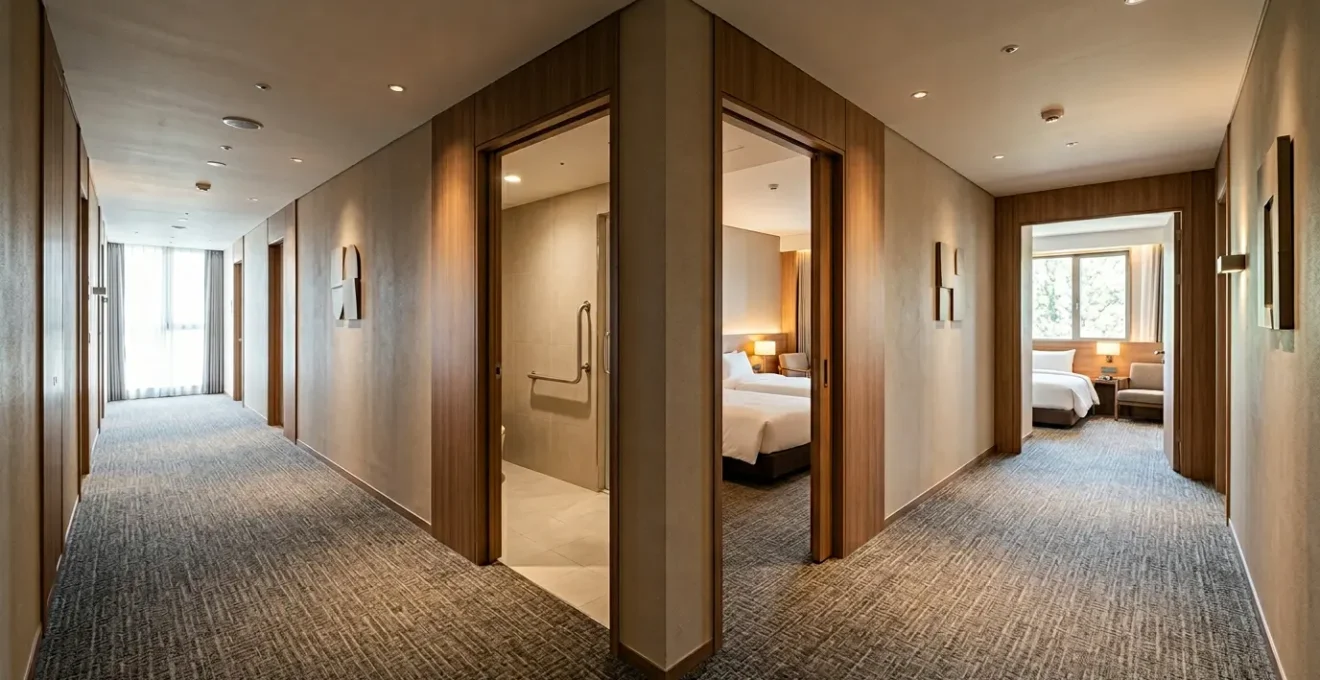
This paragraph introduces the concept of an accessible room. The illustration below highlights the kind of spacious and feature-rich environment a properly designed accessible room should provide.

As this image suggests, true accessibility is in the details. It is about having the correctly specified space and equipment, not just a grab rail added to a standard bathroom. To ensure the room you book matches your needs, you must transform your request into a formal verification process. This holds the hotel accountable and ensures they have made the necessary ‘reasonable adjustments’ as required by law.
Your action plan: Securing an accessible room under the Equality Act 2010
- Reference the Law: Explicitly state in your email that under the Equality Act 2010, the hotel is required to make reasonable adjustments for disabled guests.
- Provide a Profile: Create and attach a detailed Personal Accessibility Profile listing specific, measurable requirements (e.g., ‘bed height of 55cm,’ ‘1.5m turning circle for power chair’).
- Document Everything: Keep a record of all communications, including the date, time, and name of the agent you spoke with, to build a clear evidence trail of promises made.
- Demand Written Confirmation: Request an email from the hotel confirming that your specific, listed accessibility requirements have been noted and will be met.
- Re-confirm Before Arrival: Follow up with the hotel 3-4 days before your stay to reconfirm that the specific accessible room has been blocked and assigned to your booking.
What Does “Connecting Room” Legally Mean in British Hotel Terminology?
In the world of hotel bookings, precise language matters. The terms “adjoining” and “connecting” are often used interchangeably by guests, but they have distinct meanings for hoteliers that can drastically impact your stay. Understanding this difference is the first step in preventing your family from being separated by a hallway. An adjoining room simply means a room that is located next to another. A connecting room, however, is the one that most families actually need.
The industry definition is clear and specific. As defined by hospitality experts, the critical feature of this configuration is the ability to move between rooms without re-entering the public corridor. A leading industry glossary puts it this way:
Connecting rooms in a hotel are two or more guest rooms located next to each other with an interior door that allows guests to pass between them without entering the hallway.
– Hotel industry terminology definition, AltexSoft Hotel Glossary
Despite this clear definition, securing a connecting room is not contractually guaranteed by a standard booking. A UK Parliament petition highlighted this very issue, where families with disabled members were unable to get hotels to guarantee connecting rooms, forcing them into booking more expensive or unsuitable accommodations. The government’s response clarified a crucial point: under the Equality Act 2010, the request for a connecting room as a ‘reasonable adjustment’ is a valid claim, but its guarantee is a civil matter. This means a simple request is not legally binding unless the hotel explicitly confirms it in writing, making that written confirmation an essential piece of evidence.
The Room Configuration Mistake That Separates Families Across Floors
The single most common mistake that leads to families being allocated rooms on different floors, or even in different buildings, is assuming that a note in the “special requests” section of an online booking is a guarantee. It is not. This field is often treated as a low-priority preference, not a contractual requirement. The reason for this is logistical: according to hotel industry standards, often less than 10 percent of a hotel’s total room inventory can be connected. With such a limited supply, these rooms are a precious commodity, and their assignment is a complex puzzle solved by the front office team, usually only a day or two before arrival.
To avoid being a victim of this logistical shuffle, you must move from a passive request to an active confirmation strategy. Relying on a third-party booking site further dilutes your request, as the information may not be transmitted accurately or with the required urgency. The most effective approach involves direct, multi-stage communication with the property itself, ensuring your need is documented and prioritized within the hotel’s internal system.
The goal is to have your rooms “pre-blocked” by a manager. This means they are taken out of the general inventory and assigned to your reservation well in advance of the standard check-in rush. A simple phone call can elevate your request from a line of text on a screen to a priority task for the front office manager. This strategic communication transforms your preference into a confirmed arrangement.
- Strategy 1: Always book all rooms directly with the hotel under a single reservation number, avoiding third-party aggregators.
- Strategy 2: Follow up your online booking with a direct phone call to the hotel to ensure the request for connecting rooms was received and documented in their system.
- Strategy 3: A few days before arrival, call the hotel and ask to speak with the Front Office Manager or Reservations Manager to personally confirm the room assignment.
- Strategy 4: During the call, politely ask the manager to “pre-block” the connecting rooms and add a “trace” or note in their Property Management System for the check-in team.
How to Secure Room Upgrades by Strategically Leveraging Loyalty Program Status
Many travellers collect hotel loyalty points with the vague hope of receiving a complimentary upgrade to a better room or a suite upon arrival. While elite status in programs like Hilton Honors, Marriott Bonvoy, or IHG One Rewards can certainly increase your chances, relying on luck at the check-in desk is a flawed strategy, especially when you have a specific need like connecting rooms. The most effective way to leverage your loyalty is not by hoping for a discretionary upgrade, but by using the concrete booking tools and benefits that these programs provide to their members.
The real power of loyalty status lies in guaranteed benefits and preferential access. Instead of just showing up and asking, a strategic traveller uses their status to engage with the hotel pre-arrival. A polite email to the hotel manager a week before your stay, mentioning your elite status and clearly reiterating your need for a specific configuration, can work wonders. This personal touch flags your reservation as one belonging to a valued, repeat customer, significantly increasing the likelihood that your request will be prioritized.
Case Study: Hilton’s Game-Changing ‘Confirmed Connecting Rooms’
A prime example of a strategic tool is Hilton’s ‘Confirmed Connecting Rooms’ booking feature. This system, available through Hilton’s website and app, allows guests to select and instantly confirm connecting rooms during the initial booking process. This completely eliminates the uncertainty and stress of waiting until check-in. For families and groups, this feature is a game-changer. Travel experts have noted that because of this guaranteed capability, they now check Hilton properties first whenever connecting rooms are a necessity, as it provides a level of peace of mind that a simple “request” cannot match. This demonstrates that the best use of brand loyalty is to seek out systems that offer guarantees, not just possibilities.
Therefore, the savvy traveller’s strategy is twofold: first, choose brands that offer tools for guaranteed configurations, and second, use your elite status not as a lottery ticket for an upgrade, but as a way to open a direct line of communication with hotel management to ensure your pre-defined, essential needs are met and prioritized.
Why Family Rooms Create Friction When Children Exceed Ten Years Old
The concept of a “family room” evokes a cozy image of togetherness, but for families with tweens and teenagers, this enforced proximity can become a significant source of holiday friction. Once children pass the age of ten, their need for personal space, privacy, and a degree of autonomy grows exponentially. A single, shared room, no matter how large, often fails to meet these evolving psychological needs, leading to conflicts over everything from bathroom time to television choices and a simple desire for quiet time.
This need for separation is not about being anti-social; it is a natural part of adolescent development. As one parent of teenagers noted when considering accommodation options, having a separate but connected room provides older children with a space to “chill out and have some quiet time away from everyone.” This sentiment is widely shared. Another parent travelling with a 14 and 16-year-old specifically sought adjoining rooms to provide “a little more space,” acknowledging that the dynamics of sharing a single room with near-adults are fundamentally different.
The image below captures this common scenario: a shared space where a teenager is trying to carve out a moment of personal solitude, highlighting the inherent challenge of privacy in a single-room setup.

This visual underscores the emotional reality of the situation. The friction arises from a mismatch between the room’s physical layout and the family’s social and developmental needs. Providing a separate, but connected, space respects a teenager’s growing independence while still maintaining parental oversight and family cohesion, ultimately leading to a more harmonious trip for everyone.
How to Verify Accessible Rooms Through Ten Specific Pre-Booking Questions
The term “accessible” can mean vastly different things to different hotels. For some, it may mean a purpose-built room that complies with the highest standards; for others, it could be a standard room with a few grab rails added as an afterthought. This ambiguity is a significant risk for travellers with disabilities. To eliminate this risk, you must shift from being a passive recipient of information to an active investigator. The only way to be certain a room meets your specific needs is to ask direct, measurable questions and demand photographic evidence before you finalize your booking.
Under UK Part M Building Regulations, it is a requirement that one in every 20 (5%) of hotel bedrooms should be wheelchair-accessible, but the quality and features of these rooms can vary. Your task is to verify that the room assigned to you is not just designated as accessible, but is genuinely functional for you. This verification protocol empowers you and holds the hotel accountable, ensuring there are no surprises on arrival. Do not accept vague assurances like “yes, the room is accessible.” Demand specific answers and data.
The following questions form a comprehensive verification checklist. Posing these questions in an email to the hotel’s reservations manager or accessibility coordinator creates a written record and forces the hotel to confirm specifics, not generalities.
- Can you please email me 3-5 current, time-stamped photos of the exact bathroom in the accessible room being held for my booking?
- What is the precise clear opening width of the bedroom entrance door, measured in centimetres?
- What is the exact height from the floor to the top of the mattress, in centimetres?
- Can you confirm in writing that the room provides a clear floor space of at least 1.5 by 1.5 metres for a wheelchair turning circle?
- Does the bathroom feature a roll-in shower, and if so, what is the height of the threshold, if any?
- Is this a purpose-built accessible room from the hotel’s initial construction, or is it a retrofitted standard room?
- What assistive technologies, such as visual fire alarms or bed shakers for deaf or hard-of-hearing guests, are installed?
- Are power outlets and light switches positioned at accessible heights? Please provide the exact height from the floor.
- Can you please provide the name of the staff member who will take ownership of ensuring these requirements are met for my reservation?
- Will you confirm that this staff member’s name and all of my specific requirements are added to the notes for the check-in team’s attention?
Key takeaways
- For families with children over eight, two adjoining rooms often provide more privacy, functionality (e.g., two bathrooms), and comfort than a single, more expensive family suite.
- A “request” for a connecting or accessible room is not a guarantee. You must obtain explicit, written confirmation from the hotel to make it a binding part of your booking.
- For accessible travel, create a “Personal Accessibility Profile” with specific, measurable needs and use a verification checklist to ensure the room is genuinely suitable before you arrive.
Preventing Friction in Shared Family Rooms Through Strategic Configuration Selection
The ultimate goal of any family holiday is to create positive, lasting memories. However, the wrong hotel room configuration can inadvertently create an environment of constant, low-level friction that undermines the entire experience. The conflict over a single bathroom, the lack of personal space for a teenager, or the stress of an unsuitable accessible room can overshadow even the best-laid plans. The most effective way to prevent this friction is to make a strategic, informed choice about your room layout from the very beginning.
This means moving beyond simplistic labels like “family room” and analysing your group’s specific needs. A family with two young children has vastly different requirements from a family with two teenagers. A guest using a power wheelchair has different needs from a guest with limited mobility who can walk short distances. The choice is not just about the number of beds; it is about balancing togetherness with autonomy and ensuring the physical space supports the social dynamics of your group.
The following table provides a clear comparison between the two most common options for families, helping you to weigh the trade-offs and select the configuration that best matches your specific priorities.
| Feature | Family Suite | Two Adjoining Rooms |
|---|---|---|
| Bathrooms | 2 full bathrooms | 2 full bathrooms |
| TVs | 2 TVs (living area + bedroom) | 2 TVs (one per room) |
| Total Square Footage | Moderate (single larger space) | Greater (two separate full rooms) |
| Kitchenette | Yes (microwave, full fridge, utensils) | Basic (mini fridge, coffee maker only) |
| Location | Preferred building areas (closer to amenities) | Standard areas (potentially longer walk) |
| Guarantee | 100% guaranteed configuration | Request-based (not guaranteed) |
| Privacy Level | Moderate (shared living space) | High (two completely separate rooms) |
As the comparison shows, if a kitchenette is your top priority and you are booking with a brand that guarantees the suite, it can be a good option. However, if privacy and having a guaranteed second proper bedroom are paramount, the path of securing two confirmed connecting rooms is often superior. The key is to make this decision consciously, armed with the right information, rather than defaulting to a standard option.
By adopting a proactive and strategic mindset, you can take control of your hotel booking process. Start today by transforming your next ‘special request’ into a ‘verification protocol’ and ensure your accommodation contributes to your travel enjoyment, rather than detracting from it.