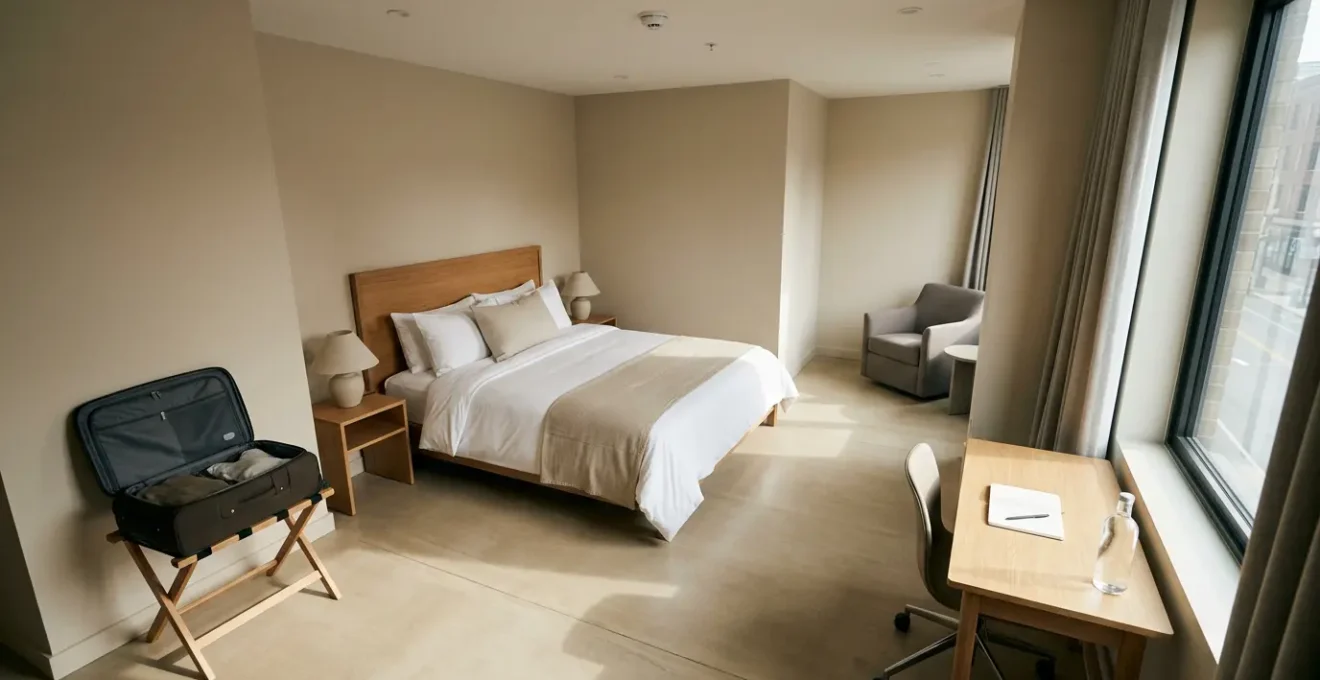
The advertised square footage of a hotel room is a misleading metric; your comfort depends on the ‘livable area’ which is often 40% smaller.
- Professional hotel photos use wide-angle lenses to distort space; use fixed objects like doors and beds as a true scale reference.
- Hidden ‘space thieves’ like low ceilings (under 8 feet) and poor layouts (no luggage space) are more critical than the total room size.
Recommendation: Adopt a ‘spatial forensics’ approach. Scrutinise guest photos, verify circulation paths, and prioritise rooms with higher ceilings for any stay longer than three nights.
You’ve likely felt it: the slow-creeping sense of confinement that sets in by day three of a week-long stay. The two suitcases that live permanently open on the floor, creating an obstacle course. The daily dance around your partner just to get to the bathroom. For many UK travellers, especially when booking on the continent, this experience is frustratingly common. The initial thrill of a holiday can be quickly eroded by a room that feels more like a storage locker than a sanctuary. The common advice is to simply check the square meterage or read guest reviews.
However, this approach is fundamentally flawed. Hotels are masters of spatial illusion, and relying on their listed dimensions is like trusting a fox to guard the henhouse. Reviews are subjective and often fail to articulate the specific design flaws that lead to discomfort. The real issue isn’t just about size; it’s about usability. A large room with a terrible layout is far less comfortable than a smaller, intelligently designed one. The key to securing a comfortable space is not to look for the biggest number, but to develop an expert eye for spatial analysis.
But what if the true key was not in finding more space, but in understanding it better? This guide introduces the concept of spatial forensics—a methodology for assessing a hotel room’s true ‘livable area’. It’s about learning to decode misleading photography, identify the hidden ‘space thieves’ that shrink a room’s feel, and make informed decisions based on layout and dimension, not just a single, often-inflated number. We will equip you with the assessment tools of a hospitality consultant to ensure your next extended stay is genuinely comfortable, not just technically large enough.
In this guide, you will learn to analyse hotel room dimensions like a professional. We’ll explore why rooms often feel smaller than advertised, how to verify true size, and what specific layout mistakes to watch for to guarantee a comfortable and relaxing stay.
Summary: A Consultant’s Guide to Hotel Room Space Assessment
- Why British Hotel Rooms Average 30% Smaller Than Continental European Equivalents
- How to Verify Real Room Size From Hotel Photos and Floor Plans
- 15m² or 25m²: Which Minimum Room Size for a Couple’s Seven-Night Stay?
- The Room Dimension Hotels Hide That Makes Spaces Feel 40% Smaller
- When to Upgrade Room Size Rather Than Book Longer Stays in Smaller Rooms
- The Room Size Mistake That Makes 70% of Standard Rooms Unusable for Couples
- How to Verify Family Rooms Offer Adequate Square Footage for Four People
- Ensuring Adequate Comfort in Standard Rooms Without Overpaying for Unnecessary Luxury
Why British Hotel Rooms Average 30% Smaller Than Continental European Equivalents
The feeling that UK and European hotel rooms are tighter is not just your imagination; it’s a documented reality. The core reason lies in a combination of history and economics. Many charming city-centre hotels across Europe are housed in centuries-old buildings, where space was always at a premium and modern expansion is restricted by protected architectural status. This contrasts sharply with the US model, where hotels are often newer constructions with more generous land plots. Detailed research highlights this discrepancy, estimating that the average European hotel room is about 215 square feet (20m²), significantly smaller than the typical 325 square feet (30m²) found in America.
This spatial constraint has shaped a different economic model. European hotels often focus on maximising Revenue Per Available Room (RevPAR) by optimising the number of rooms within a valuable, and finite, footprint. This business logic incentivises compact, efficient designs over spacious, sprawling ones. For the UK traveller, this means that even a « standard » room can feel surprisingly small, and booking a room for a week-long stay based on US or broader international expectations can lead to significant disappointment and discomfort.
Understanding this context is the first step in your spatial forensics work. It means you must approach booking with a more critical eye, acknowledging that the baseline size is inherently smaller. You cannot assume a « double room » in London or Paris will offer the same level of personal space as one in Orlando. Therefore, the skills to accurately assess the *quality* and *layout* of that smaller space become paramount to ensuring comfort during an extended stay. It is not about finding a large room, but about finding a well-proportioned and functional one.
How to Verify Real Room Size From Hotel Photos and Floor Plans
Hotel photography is an art of illusion, designed to sell a fantasy of space and light. Hoteliers frequently use ultra-wide-angle lenses (anything wider than 24mm) that stretch corners and create a false sense of depth, making cramped quarters appear palatial. To counter this, your first forensic task is to ignore the overall impression of a photo and instead look for scale references. A standard king-size bed is a reliable yardstick, measuring approximately 1.9m by 2m. A standard interior door is about 0.8m wide. By comparing these known objects to the surrounding space—like the gap between the bed and the wall—you can begin to deduce the room’s true proportions.
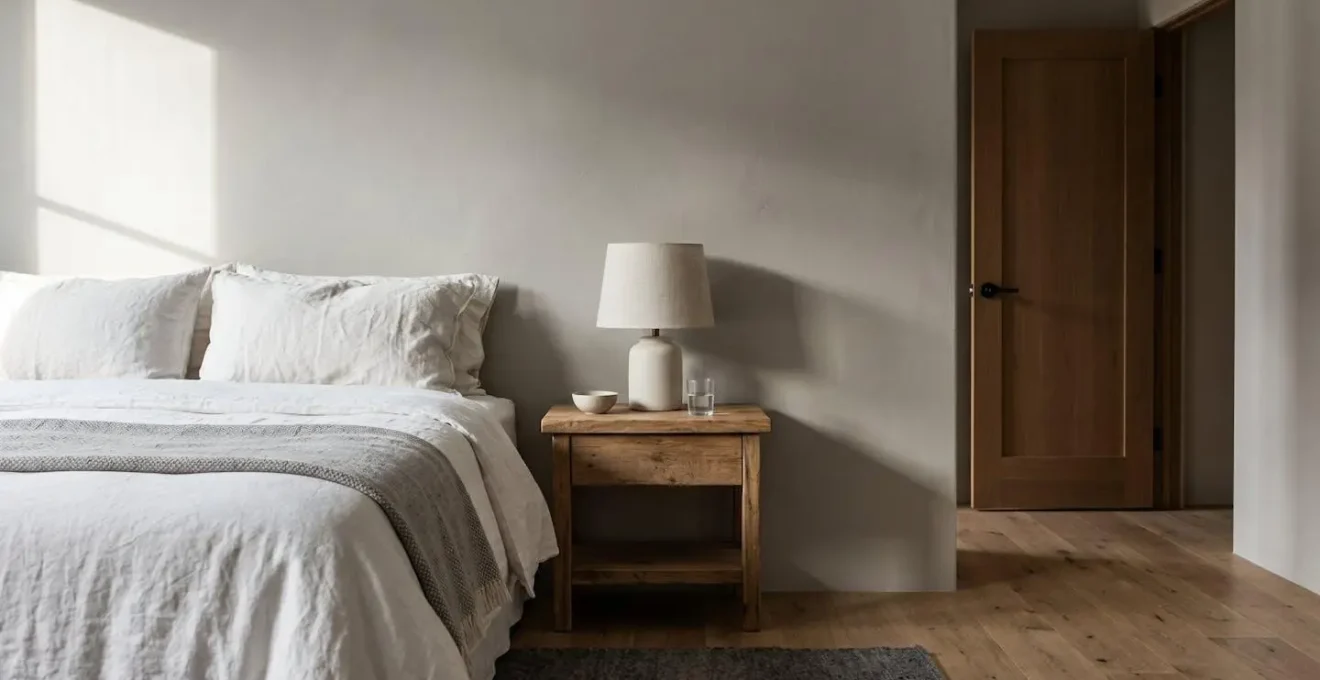
As the image above demonstrates, perspective is everything. The most telling photos are often the ones the hotel *doesn’t* show. Look for what’s missing. Is there no clear shot of where you would place two open suitcases? Are all photos taken from a corner, a classic trick to maximise perceived size? These omissions are red flags. The most powerful tool at your disposal is to cross-reference the hotel’s professional shots with candid photos from actual guests on review sites. These unvarnished images reveal the reality of the space, complete with luggage, clutter, and an absence of flattering lighting and camera angles. This comparison is the single most effective way to see past the marketing and understand the functional reality of the room.
If a floor plan is available, treat it like a blueprint for your stay. Measure the circulation paths—the walkways around the bed and furniture. If you can’t see a clear path of at least 60cm (24 inches) around the primary furniture, the room will feel claustrophobic, regardless of its total square meterage. This analytical approach moves you from a passive viewer to an active investigator of space.
15m² or 25m²: Which Minimum Room Size for a Couple’s Seven-Night Stay?
When booking for a week, the question of minimum size becomes critical. A room that is perfectly adequate for a one-night stopover can become a source of significant stress and friction for a couple over seven days. As a hospitality consultant, my guidance is unequivocal: for a couple on an extended stay, the primary metric is not just sleeping space, but ‘livable area’. This includes room for two open suitcases, a comfortable place for the second person to sit that isn’t the bed, and clear circulation paths.
So, where is the tipping point? A room of 15m² (approx. 160 sq ft) is functional for a solo traveller for a short period but is simply insufficient for a couple for a week. At this size, you are guaranteed to be tripping over luggage and each other. The space lacks the capacity to create any psychological separation, leading to a feeling of being constantly on top of one another. Moving up to the 20-22m² range offers a noticeable improvement, but it often still fails the ‘two-suitcase’ test.
For a truly comfortable week-long stay for two people, the target minimum should be 25m² (approx. 270 sq ft), but with a major caveat: the layout must be efficient. Industry analysis confirms that for stays of this length, comfort levels increase dramatically once you exceed this threshold. Indeed, standard hotel rooms range between 23-32 square meters, with couples reporting significantly higher satisfaction in rooms of 30m² (325 sq ft) or more. This extra space isn’t a luxury; it’s what allows for proper luggage storage, a small seating area, and the ability for two people to move freely without constant negotiation. Below this, the risk of claustrophobia and interpersonal friction rises sharply after the third day.
The Room Dimension Hotels Hide That Makes Spaces Feel 40% Smaller
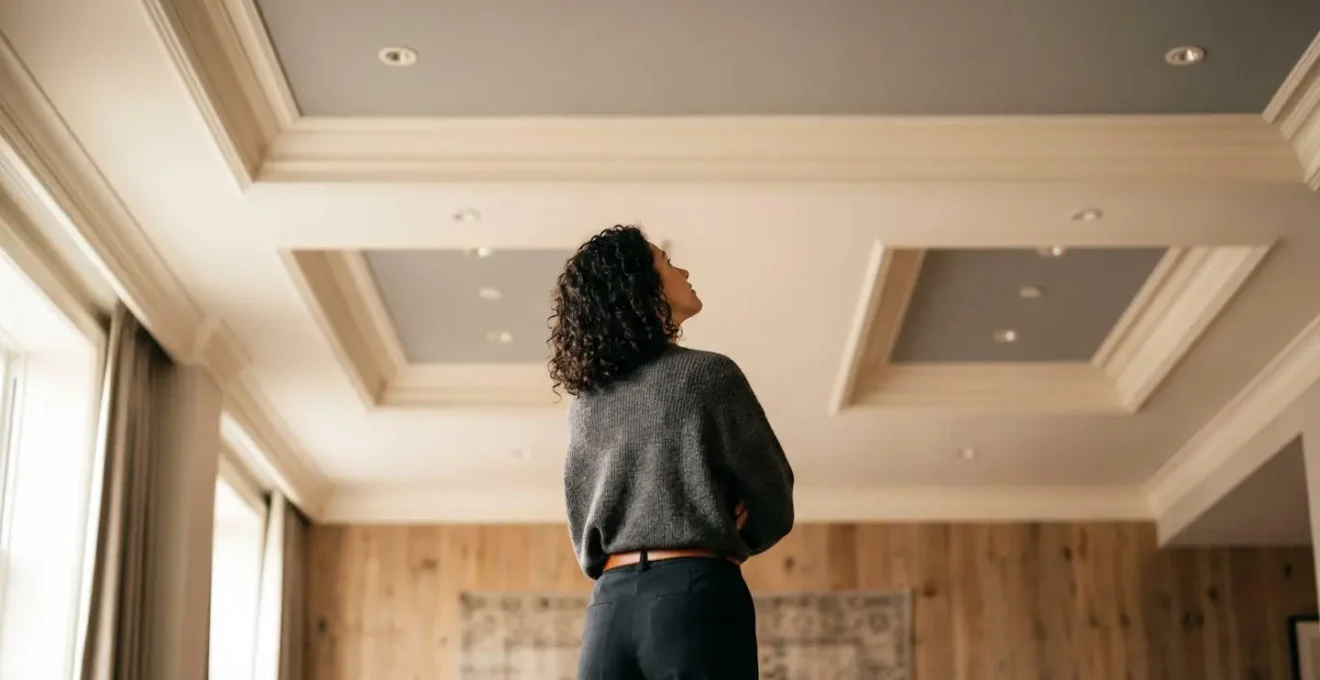
The most significant ‘space thief’ in a hotel room is a dimension rarely, if ever, listed on a booking site: ceiling height. We are conditioned to think about space in two dimensions—length and width (square footage). However, our psychological perception of space is profoundly influenced by the third dimension: the vertical axis. A low ceiling can make a generously-sized room feel oppressive and confining, while a high ceiling can make a smaller room feel airy and expansive. This is not just a feeling; it’s a documented psychological phenomenon.
Research in the field of neuroarchitecture provides clear evidence. As Joan Meyers-Levy, a professor at the University of Minnesota, discovered in her research on spatial perception:
When a person is in a space with a 10-foot ceiling, they will tend to think more freely, more abstractly… whereas a person in a room with an 8-foot ceiling will be more likely to focus on specifics.
– Joan Meyers-Levy, University of Minnesota Carlson School of Management research on ceiling height psychology
This « focus on specifics » in a low-ceilinged room translates to a heightened awareness of confinement. Over a week-long stay, this can manifest as irritability and a feeling of being ‘closed in’. Studies show that ceilings below 2.44 meters (8 feet) induce feelings of compression over time. Conversely, a ceiling of 3 meters (approx. 10 feet) or more can make an identically sized room feel substantially larger and more comfortable. Hotels in older, historic buildings may have grand, high ceilings, while modern, budget-focused constructions often minimise ceiling height to 8 feet to reduce costs and fit more floors into a building. When you see photos, look for the top of the window and door frames—if they are very close to the ceiling, it’s a sign of a low, potentially oppressive space.
When to Upgrade Room Size Rather Than Book Longer Stays in Smaller Rooms
A common dilemma for travellers on a week-long trip is whether to spend their budget on a longer stay in a standard room or a shorter stay in a larger, upgraded one. From a spatial comfort perspective, for any stay exceeding three nights, the answer is almost always to prioritise space over duration. The cumulative stress of a cramped environment can negate the benefit of an extra day or two. The decision to upgrade, however, should be a calculated one based on the functional benefits offered by each room category.
Upgrading from a ‘Standard’ to a ‘Deluxe’ or ‘Junior Suite’ is not about luxury; it’s about acquiring specific spatial features that are critical for long-stay harmony. The primary benefit is often the introduction of a ‘third place’—a comfortable armchair or small sofa with a coffee table. This separate seating zone is vital for a couple, as it provides a place for one person to relax, read, or work without having to sit on the bed, preserving the bed as a dedicated space for rest. This simple zoning drastically improves the psychological comfort of a room.
To make an informed decision, you need to understand what you are paying for with each upgrade. The following matrix, based on common hotel categories, outlines the typical trade-offs. As an analysis of hotel room types shows, the jump from Standard to Deluxe often provides the best value in terms of increased livable area for couples.
| Room Category | Typical Size (sq ft / sq m) | Best For | Week-Long Stay Suitability |
|---|---|---|---|
| Standard Room | 250-400 sq ft / 23-37 sq m | Solo travelers, 1-2 night stays | Marginal for couples; high stress risk after day 3 |
| Deluxe Room | 400-600 sq ft / 37-56 sq m | Couples, 3-7 night stays | Good; adequate zoning for luggage and relaxation |
| Junior Suite | 430-600 sq ft / 40-56 sq m | Extended stays, work-cations | Excellent; separate sitting area creates ‘third place’ |
| One-Bedroom Suite | 500-800 sq ft / 46-74 sq m | Families, long stays, resort experiences | Optimal; physical separation of sleeping and living zones |
The Room Size Mistake That Makes 70% of Standard Rooms Unusable for Couples
The single greatest mistake that renders many standard rooms unfit for a couple’s extended stay is the complete failure to account for luggage and circulation. Advertised square footage is an empty number; the ‘livable area’ is what remains after you subtract the space occupied by furniture and the essential, non-negotiable footprint of two open suitcases. Many rooms, even those exceeding 20m², become an impassable jumble once luggage is deployed. This is a critical design failure that your forensic eye must be trained to spot.
A key diagnostic is the ‘Pass-Through Failure Test’: in a photo or floor plan, can you visualise two adults being able to walk past each other between the foot of the bed and the wall or TV console without one having to turn sideways or wait? If the clearance is less than about 60cm (24 inches), the room fails this test. For a week, this tiny inconvenience multiplies into a constant source of friction and physical awkwardness, making the space feel cramped and poorly considered.
This primary mistake is compounded by several other common design flaws that effectively shrink a room. These are the choke points and bottlenecks that your spatial analysis should identify before you book:
- The Two-Suitcase Problem: Most standard rooms provide a single luggage rack and zero dedicated floor space for a second large suitcase. This forces one bag to live on the floor, blocking walkways. A well-designed room will have a wide bench or a deep closet that can accommodate stowing luggage.
- Single-Person Bathroom Bottleneck: A bathroom with a single small sink and minimal counter space is a daily point of conflict for a couple trying to get ready simultaneously. It’s a classic sign that the room was designed for a single business traveller, not a couple on holiday.
- Missing ‘Third Place’: As mentioned, a room with only a bed and a single desk chair offers no comfortable spot for the second person. This lack of a secondary relaxation zone forces constant, draining proximity.
- Furniture Choke Points: Poorly placed wardrobes with doors that open into a walkway, or a desk that juts out and blocks access to the window, create invisible walls that reduce the navigable area and make the advertised room size functionally irrelevant.
How to Verify Family Rooms Offer Adequate Square Footage for Four People
When booking for a family of four, the stakes are even higher. The potential for spatial conflict multiplies, and the term « family room » can be dangerously ambiguous. It can range from a spacious, well-designed suite to a standard double room with a lumpy, uncomfortable sofa bed crammed into the corner. Verifying true adequacy requires moving beyond the simple « sleeps four » description and applying a rigorous forensic analysis. The baseline size is a starting point; hospitality industry standards show that rooms suitable for four, such as double-double or family rooms, typically require 50-70 square meters to be truly comfortable for a week-long stay.
However, size alone is not enough. The layout and features are what determine functionality. For a family, acoustic and visual separation is paramount. A « separate » sleeping area for children that is only divided by a curtain is inadequate for parents who want some privacy after the kids are asleep. A real door is the gold standard. Furthermore, a family of four arrives with an enormous amount of gear—strollers, car seats, multiple bags. A critical feature to look for is a dedicated ‘dump zone’ or entryway staging area where this equipment can live without impeding access to the bathroom or main living space.
To ensure a family room will actually work for your family for an extended stay, you must verify several key points beyond the advertised square footage. The following checklist provides a concrete action plan for your investigation.
Your Action Plan: Verifying True Family Room Space
- Test for Separation: Don’t just accept « separate area. » Ask the hotel directly or scrutinise floor plans: is the separation a real door (optimal), a sliding panel (acceptable), or just a curtain (inadequate for privacy)?
- Locate the Gear Staging Area: Examine photos for a clear entryway or nook. If all photos show a tight entrance directly into the sleeping area, the room will fail to manage family gear, leading to constant clutter.
- Verify Bed Configuration: « Sleeps four » is not a clear term. Confirm the exact layout. Is it two queen beds (good for all ages) or one king plus a sofa bed (often unsuitable for teenagers or a week-long stay)? Request the floor plan.
- Prioritise a Two-Sink Bathroom: For a family, a double vanity or a separated toilet/shower area is not a luxury, it’s a critical feature for avoiding morning bottlenecks and maintaining harmony. Specifically look for this in photos.
- Audit the Storage: A standard wardrobe is designed for one or two people. For a family of four, you need significantly more. Look for at least two separate closets or a large, multi-sectioned wardrobe system to avoid living out of suitcases.
Key Takeaways
- The comfort of a hotel room is determined by its ‘livable area’—the functional space left after accounting for furniture, circulation paths, and luggage—not its advertised square footage.
- Become a ‘space detective’: use fixed-scale objects (beds, doors) to judge true proportions in misleadingly wide-angle hotel photos and always cross-reference with candid guest pictures.
- Prioritise layout over size. A room fails a long-stay test if it lacks a ‘third place’ for relaxation, has bathroom bottlenecks, or fails the ‘pass-through’ test (two people can’t pass by the bed).
Ensuring Adequate Comfort in Standard Rooms Without Overpaying for Unnecessary Luxury
Even armed with the best assessment skills, sometimes budget or availability constraints mean you land in a standard room that is, on paper, smaller than ideal. However, a smaller space does not have to mean a claustrophobic experience. By employing a few strategic ‘room hacking’ techniques, you can maximise the perceived and functional space, ensuring comfort without paying for an expensive upgrade you don’t truly need. The goal is to take control of the environment from the moment you arrive.
The first opportunity comes before you even book. Use the ‘special requests’ box during reservation. Politely requesting a « corner room » or a « room on a higher floor with high ceilings, if available » can sometimes yield a space that is 10-15% larger or feels significantly more open, at no extra cost. This signals you are a considerate guest, which can influence room allocation. Upon arrival, perform an immediate declutter. Unused decorative pillows, bulky throws, and promotional materials should be stowed in the closet to free up surfaces and visual space. A clean, uncluttered room instantly feels larger.
Finally, think creatively about the furniture and your own items. A luggage rack can double as a flexible side table. Using packing cubes allows you to keep suitcases zipped and stowed vertically against a wall instead of open on the floor. If the layout feels awkward, don’t be afraid to (respectfully) reposition a small table or chair to create better flow and more defined ‘zones’ within the small space. These small, proactive adjustments can transform a potentially stressful environment into a comfortable and functional home base for your extended stay.
Now that you are equipped with the forensic tools to analyse and select the right space, you can book your next extended stay with the confidence that it will be a source of relaxation, not stress. Apply these principles to your next search and transform your travel experience.