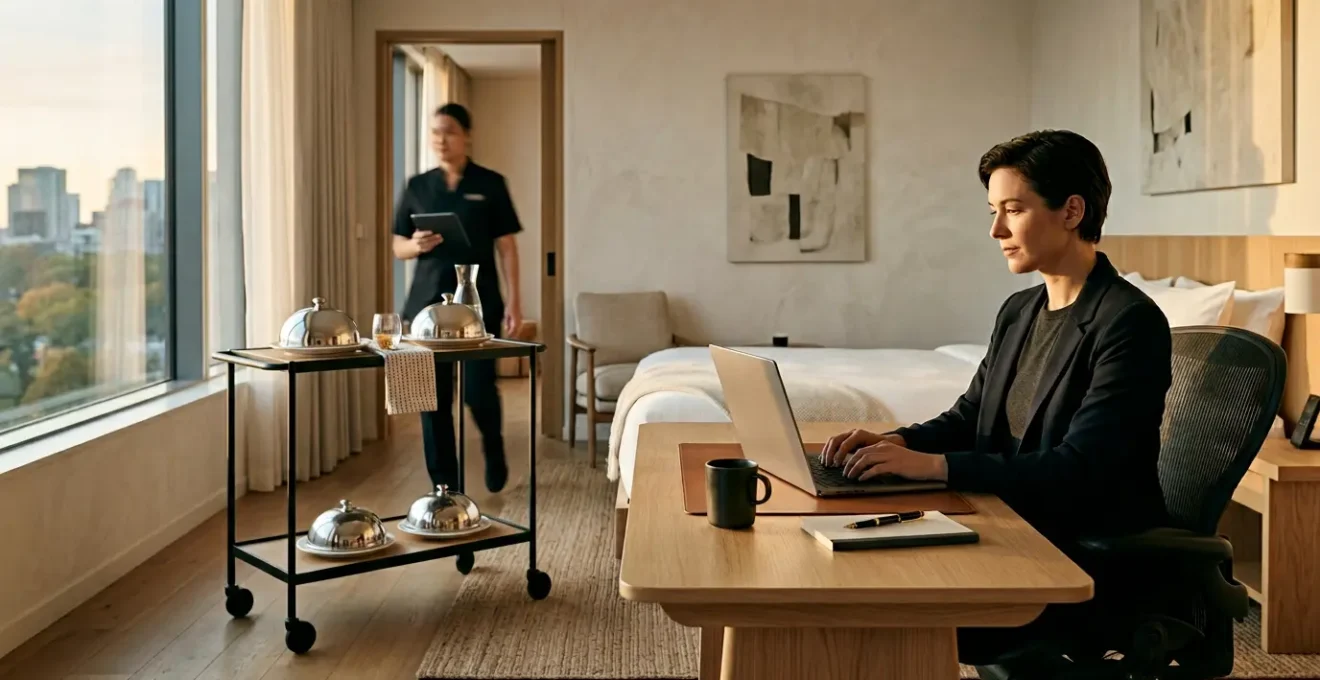
For the time-crunched professional, viewing hotel services as mere amenities is a strategic failure. The real advantage lies in treating them as operational assets.
- Mastering hotel logistics—from kitchen peak hours to laundry cut-offs—transforms unpredictable travel into a controlled, productive environment.
- Strategic communication with the right staff (like the Head Concierge) unlocks service levels unavailable to the average guest.
Recommendation: On your next trip, stop being a guest and start acting like a temporary CEO of your hotel space. This guide shows you how.
The scenario is grimly familiar. You check into your hotel at 10 PM after a day of back-to-back meetings and travel delays. An critical presentation looms at 8 AM tomorrow. Your options for dinner are a sad, overpriced sandwich from the minibar or a 90-minute game of roulette with room service. For most business travellers, this is an accepted, if frustrating, part of life on the road. The common advice is to either grudgingly accept the high costs and long waits or resort to third-party delivery apps, adding another layer of coordination to an already exhausting day.
But what if this entire framework is flawed? What if room service and other hotel amenities weren’t a gamble, but a strategic tool you could leverage for peak performance? The key isn’t just about choosing what to eat; it’s about understanding the hidden operational mechanics of the hotel itself. It’s about moving from a passive guest to an active operator who can command resources to maximise that most precious of commodities: time.
This is not another guide about saving a few pounds on a hotel meal. This is a playbook for time-value arbitrage. It’s for the professional who understands that an extra hour of focused work or high-quality rest is worth far more than the premium on a well-timed, well-ordered meal. By mastering the hotel’s internal systems, you can transform your stay from a cost centre of time and energy into a high-performance productivity infrastructure.
This guide deconstructs the core hotel services that impact a business traveller’s efficiency. We will explore the real reasons behind premium pricing and service variance, providing you with the tactical knowledge to navigate the system to your advantage.
Summary: The Executive’s Playbook: Turn Hotel Room Service into a Productivity Engine
- Why Room Service Typically Costs 60% More Than Hotel Restaurant Dining
- How to Order Room Service That Arrives Within 20 Minutes Guaranteed
- What Does « 24-Hour Room Service » Actually Mean in British Budget Hotels?
- The Room Service Ordering Mistake That Doubles Your Food Bill
- How to Request Full Restaurant Menu Options via Room Service
- Why « Round-the-Clock Concierge » Doesn’t Guarantee Genuinely Helpful Service
- Why Same-Day Dry Cleaning Is Impossible at 70% of British Hotels
- Securing Operational Services Enabling Productive Long-Term Hotel Living
Why Room Service Typically Costs 60% More Than Hotel Restaurant Dining
The immediate sticker shock of a room service menu can be jarring. A club sandwich that costs £15 in the hotel’s brasserie is suddenly £25 when delivered to your door. This isn’t arbitrary price gouging; it’s a reflection of a completely different, and more expensive, service model. Understanding this cost structure is the first step to evaluating its true worth not as a meal, but as a time-saving tool.
The premium price is a composite of several operational factors. First is the dedicated labour cost. Room service requires a separate team of order-takers, runners, and sometimes dedicated chefs during off-peak hours. Second is the logistical complexity; trays, hot boxes, and service carts must be maintained, staged, and deployed across a multi-storey building. This is far more resource-intensive than serving a fixed dining room.
Finally, there’s the cost of 24/7 availability. The hotel must staff the service even if only three orders come in between midnight and 6 AM. The price you pay at 8 PM helps subsidise the availability you might desperately need at 2 AM. The bill itself often contains a breakdown of these costs, though they can be opaque:
- Base Menu Price: Often identical to the restaurant.
- Delivery or Tray Charge: A flat fee for the logistics of getting the food to your room.
- Service Charge/Gratuity: Often an automatic 15-20% is added to the bill before you even see the signature line.
For the productive traveller, the question isn’t « Is this sandwich worth £25? » but rather, « Is one hour of uninterrupted, focused work in the quiet of my room worth the £10 premium? » In most high-stakes business scenarios, the answer is a resounding yes.
How to Order Room Service That Arrives Within 20 Minutes Guaranteed
The most common complaint about room service isn’t the cost, but the time. A vague promise of « 45 to 60 minutes » is a productivity killer for a traveller on a tight schedule. Whilst there is no magic spell, there is a strategy. Beating the clock requires understanding the hotel kitchen’s rhythm, as most operate within predictable peak and off-peak cycles.
The industry standard for delivery is a wide window; industry professionals note that a 20-60 minute delivery time is considered normal. Your goal is to always be at the 20-minute end of that spectrum. This is achieved through strategic timing. The hotel kitchen is a high-pressure environment, with massive waves of orders coming in during predictable times: the breakfast rush (7:30-9:00 AM) and the dinner rush (7:00-8:30 PM). Ordering during these windows puts you in a long queue.

The solution is to order during the « shoulder hours. » By placing your dinner order at 6:15 PM, you get ahead of the main rush. Your ticket arrives in a calm kitchen, where it receives immediate attention. Another powerful technique is pre-ordering. When you check in, or even before you arrive, you can call and place a standing order for a specific time. Requesting a simple salmon and salad to be delivered at 7:00 PM sharp allows the kitchen to schedule your meal efficiently. This transforms room service from a reactive gamble into a predictable, scheduled part of your workflow.
What Does « 24-Hour Room Service » Actually Mean in British Budget Hotels?
The promise of « 24-Hour Room Service » on a hotel website can be a powerful lure for the late-arriving business traveller. However, in the context of many UK hotels, especially at the budget or mid-range level, this term often requires careful translation. The reality of the service can be drastically different post-midnight compared to what’s available during standard operating hours.
For most hotels, the main kitchen, with its full brigade of chefs and fresh ingredients, closes around 10 or 11 PM. After this time, the « 24-hour » service transitions to a completely different operational model. A single night staff member, who may also be handling the front desk and other duties, is typically responsible for fulfilling late-night orders. Their resources are limited to a small pantry and a microwave.
This operational shift is confirmed by hospitality experts. As the Prostay hospitality guide notes:
24-hour room service typically means a single night staff member with access to a limited ‘after-hours menu’ consisting of microwavable items, pre-made sandwiches, and instant snacks.
– Prostay hospitality operations guide, Hotel Room Service Comprehensive Guide for Hoteliers
This means your dream of a freshly grilled steak at 2 AM is likely to manifest as a pre-packaged lasagne or a cellophane-wrapped sandwich. Understanding this distinction is crucial for managing expectations and planning accordingly. If you know you’ll be arriving late and require a substantial meal, it’s far better to eat before you get to the hotel than to rely on a « 24-hour » service that is, in reality, a limited snack service.
The Room Service Ordering Mistake That Doubles Your Food Bill
Even with its continued popularity, room service billing remains a minefield of hidden charges and easy-to-make mistakes. The most common error isn’t over-ordering food, but failing to scrutinise the bill and inadvertently paying for the same thing twice. The most frequent culprit is the automatic gratuity. Many travellers, accustomed to tipping, add another 15-20% on the « tip » line of the bill, not realising a service charge of the same amount has already been included.
This single oversight can instantly inflate your bill by a significant margin. Beyond double-tipping, other traps await the unwary. Ordering multiple main courses for two people on a single order can sometimes trigger a « per-person » or second tray charge. Similarly, ordering a bottle of water with your meal can cost three times as much as the same bottle sitting in your minibar. It’s a game of micro-charges that add up quickly.
To avoid these pitfalls, a pre-order audit is essential. By treating the order like a business expense claim, you can maintain control over the final cost without sacrificing convenience. This proactive approach ensures you’re paying for the service you want, not for billing mistakes.
Your Pre-Order Billing Checklist: 4 Traps to Avoid
- Check for Pre-Added Gratuity: Before signing, always look for line items like « Service Charge » or « Gratuity. » Assume it’s included and only add an extra tip for truly exceptional service.
- Confirm Per-Item Charges: When ordering for more than one person, ask the order-taker: « Is there an additional tray charge or per-person fee for a second main course? »
- Compare Beverage Prices: Before ordering a soft drink or water, quickly check the minibar price list. The minibar is often, surprisingly, the cheaper option.
- Clarify Modification Costs: If you request a change (e.g., « salad instead of fries »), ask upfront: « Is there an upcharge for that substitution? » This avoids being charged for both items.
How to Request Full Restaurant Menu Options via Room Service
You scan the room service menu: a predictable list of burgers, salads, and pasta. Meanwhile, the hotel’s acclaimed ground-floor restaurant offers a diverse, more appealing menu. The common assumption is that these are two separate worlds. This is rarely the case. In most hotels, a single kitchen serves both the restaurant and room service, creating an opportunity for the strategic traveller.
The key to unlocking the full restaurant menu is understanding two things: timing and channels. Attempting a special request during the 7:30 PM dinner rush is futile; the kitchen is in « battle mode, » and the order-taker on the phone likely has no authority to deviate from their script. Success lies in a more nuanced approach.
This is where « Service Leverage » comes into play. Instead of using the standard room service line, you take a different route. The strategy involves making a polite, well-timed request to someone with the authority to grant it. This is a classic case of bypassing the standard process to get a superior result.
Case Study: Strategic Timing for Special Requests
As insights from luxury hospitality experts reveal, high-end hotels are increasingly willing to accommodate off-menu requests when approached strategically. The optimal window is during the « shoulder hours » (e.g., 5:30-6:30 PM), before the main dinner rush begins. The most effective method is to bypass the standard order-taker and instead call the Head Concierge. A polite request such as, « I know this is a special request, but would it be at all possible to have the sea bass from the restaurant menu sent up to my room around 7 PM? » gives the concierge the opportunity to speak directly with the Food & Beverage Manager or Head Chef on your behalf. Items that travel well and are already part of the kitchen’s workflow have the highest chance of success.
This technique transforms your relationship with the hotel from a simple guest to a respected patron. It demonstrates an understanding of their operations and is almost always met with a greater willingness to accommodate.
Why « Round-the-Clock Concierge » Doesn’t Guarantee Genuinely Helpful Service
The image of the all-knowing, magically efficient concierge is a cornerstone of hotel marketing. For the business traveller, this person should be a productivity force multiplier, securing last-minute dinner reservations or finding a 24-hour printer. Yet, the reality is often a « concierge lottery, » where the quality of service is wildly inconsistent, especially at night.
The term « round-the-clock concierge » can be misleading. While someone might be physically present at the desk, the night-shift employee is often a junior staffer with limited authority, experience, and local connections. They can check you in or call you a taxi, but complex requests are often met with a polite but unhelpful, « I’m sorry, you’ll have to speak to the Head Concierge in the morning. » This service variance isn’t a sign of bad employees; it’s a systemic issue. The hospitality industry has been facing significant challenges, and a 2024 survey highlighted the core of the problem: 67% of hotels reported staffing shortages, making it difficult to maintain deep expertise across all shifts.
To bypass this lottery, the strategic traveller must act proactively. Don’t wait until you arrive at 11 PM with an urgent need. The most effective strategy is the pre-arrival batch request. Forty-eight hours before your check-in, identify the email for the Head Concierge (or the general hotel info address) and send a single, clear, and organised email listing all your potential needs: « I will require a dinner reservation for two at 8 PM on Tuesday, » or « Could you please arrange for a car to take me to my 9 AM meeting on Wednesday? » This allows the experienced day-time team to leverage their full resources and connections on your behalf, ensuring everything is confirmed and waiting for you upon arrival.
Why Same-Day Dry Cleaning Is Impossible at 70% of British Hotels
For a business traveller on a multi-day trip, hotel laundry and dry cleaning services are a critical piece of their productivity infrastructure. The ability to refresh a suit or a shirt is essential. However, many travellers have been burned by the hotel laundry system, submitting a suit in the morning only to find it won’t be back before their flight the next day. The term « laundry service » implies an in-house operation, but this is a rarity.
The vast majority of British hotels, likely more than 70%, do not have their own on-site dry cleaning facilities. The service they offer is merely a logistical coordination with an off-site, third-party vendor. This is the critical « hidden mechanic » that dictates the entire timeline. The hotel acts as a simple collection and drop-off point.

The entire system hinges on the vendor’s daily pickup and delivery schedule. In almost all cases, the laundry van arrives at the hotel once a day, typically between 8 and 9 AM. Any items not in the « laundry bag » and at the front desk before this single pickup will sit in the hotel for 24 hours until the next van arrives. This is why hotels have a strict 9 AM cut-off time for same-day service. An item collected at 9 AM will be returned by the vendor in their evening drop-off, usually around 6-7 PM. An item submitted at 9:05 AM misses the window and will not even leave the hotel until the following morning.
This isn’t a lack of service; it’s a logistical reality. Understanding this cut-off allows for precise planning. If you know you’ll need a suit cleaned for a dinner meeting, you must ensure it’s in the system before that 9 AM deadline, or make alternative arrangements.
Key Takeaways
- Time is the Currency: The premium on hotel services is not for the item itself, but for the on-demand convenience that buys you back productive time.
- Master the System: Hotels run on predictable schedules. Ordering, requesting, and planning around their peak and off-peak times is the key to efficient service.
- Leverage the Right Channels: Bypassing junior order-takers and communicating directly with authorised staff like the Head Concierge unlocks a higher tier of service.
Securing Operational Services Enabling Productive Long-Term Hotel Living
For a stay extending beyond a few nights, the traveller’s mindset must shift from short-term guest to long-term resident. This means optimising the hotel’s services into a sustainable and productive living environment. It’s no longer about single transactions but about building an efficient, cost-effective routine by blending hotel services with local alternatives and pre-negotiated packages.
Relying solely on room service for every meal is a quick path to a bloated expense report. A hybrid approach is more strategic. Use room service for time-critical breakfasts before a big meeting, but leverage third-party delivery apps like Uber Eats or Deliveroo for more variety and better value for lunch and dinner. For laundry, use the hotel’s expensive service for a single emergency item, but find a local laundromat for bulk weekly needs. As hotel revenue management research shows, guests perceive bundled services as higher value; a pre-negotiated Business Traveller Package that includes breakfast can feel more worthwhile than paying à la carte each day.
The table below outlines a strategic matrix for optimising services during an extended stay:
| Service Type | Hotel Room Service | Third-Party Delivery | Local Services | Optimal Use Case |
|---|---|---|---|---|
| Breakfast | ✓ Recommended | ✗ Not ideal | ✗ Not practical | Time-critical mornings before meetings |
| Lunch | ~ Expensive | ✓ Cost-effective | ~ Variable | Working in-room; use delivery apps for variety |
| Dinner | ✗ Overpriced | ✓ Best value | ✓ Local experience | Use Uber Eats/Deliveroo for variety and savings |
| Laundry | ✗ Unreliable/expensive | ✗ Not applicable | ✓ Local laundromat | Bulk weekly laundry for extended stays |
| Workspace Items | ✓ Negotiate package | ✗ Not applicable | ~ One-time purchase | Request ergonomic chair, extra table at check-in |
Furthermore, upon check-in for a long stay, you have significant negotiation leverage. Proactively request a « long-stay package » that might include a fixed-price breakfast plan, a weekly laundry credit, pre-scheduled housekeeping to avoid interrupting your work, and essential productivity equipment like an ergonomic chair or extra power strips.
Start implementing this strategic mindset on your next business trip. By understanding and leveraging the hidden mechanics of hotel operations, you can convert what was once a source of friction and expense into your greatest productivity asset.