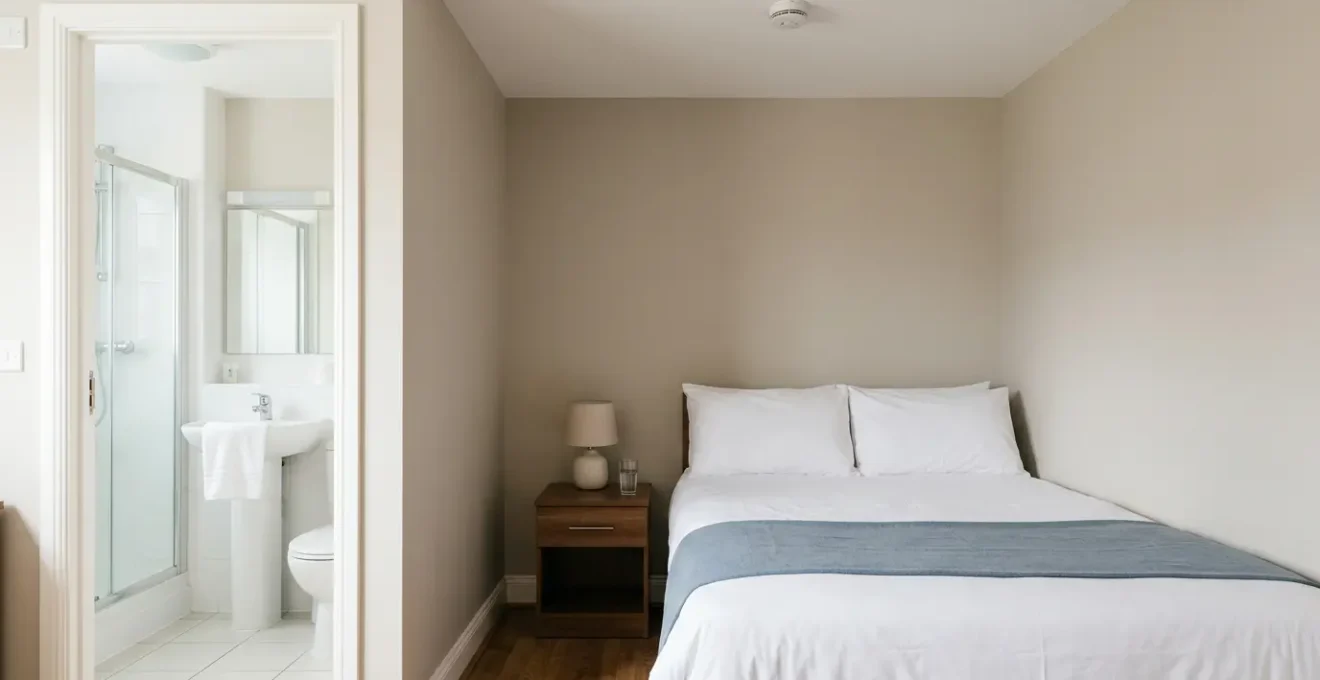
Contrary to popular belief, booking a UK hotel for under £80 doesn’t mean you have to gamble with your safety or hygiene; it means you need to be smarter than the average booker.
- UK law provides a robust baseline of non-negotiable standards for cleanliness and safety that apply to all hotels, regardless of price.
- The key is knowing these rights and spotting the operational shortcuts some hotels take, from hidden fees to rushed cleaning schedules.
Recommendation: Shift from being a price-hunter to a value-auditor by using the legal frameworks and checklists in this guide to secure safe, clean, and genuinely affordable accommodation.
For the budget-conscious UK traveller, the search for accommodation can feel like a high-stakes game. You scroll through endless listings, your eyes scanning for that magic number—a price under £80 a night. But with every promising-looking deal comes a nagging doubt, fuelled by horror stories and cryptic reviews. Do you book the bargain and risk a sleepless night worrying about hygiene and security, or do you reluctantly stretch the budget? It’s a frustrating compromise that millions of travellers face.
The common advice is to « read the reviews » or « stick to big brands, » but this approach is reactive and often unreliable. It treats safety and cleanliness as a matter of luck. This guide proposes a fundamental shift in strategy. The real key to unlocking genuinely good, affordable accommodation isn’t about deciphering ambiguous guest comments; it’s about understanding the powerful legal and operational realities that govern the UK hospitality industry. It’s about knowing your rights, which are far more extensive than most people realise.
This guide is built on a quality-protective principle: affordability should never require you to accept risk. We will move beyond generic tips to provide a specialist’s view on the structural reasons for price differences, the legal guarantees you are entitled to under British law, the specific red flags to watch for, and the actionable steps you can take—before, during, and after your stay—to ensure your sub-£80 hotel is not just cheap, but safe and clean. You will learn to see a hotel listing not just for its price, but for what it is legally obligated to provide.
To empower your search for the best value, this article breaks down the essential knowledge you need. We’ll explore everything from the structural cost advantages of suburban hotels to the specific fire safety checks you should perform the moment you enter your room, ensuring you can book with the confidence of an insider.
Summary: The Insider’s Guide to Safe and Affordable UK Hotels
- Why Suburban Budget Chains Save £60 Nightly Compared to City Centre Budget Hotels
- How to Spot Truly Affordable Hotels Versus Hidden-Fee Budget Traps
- What Does « Budget Hotel » Legally Guarantee Under British Hospitality Regulations?
- The Safety Shortcut That 30% of Budget Hotels Take to Cut Operational Costs
- How to Negotiate Corporate Rates for Personal Leisure Stays at Budget Chains
- Why Fire Safety and Emergency Exits Are Non-Negotiable in Every UK Hotel
- What British Hospitality Law Defines as Minimum Acceptable Accommodation Standards
- Knowing Which Essential Services Every UK Hotel Must Legally Provide
Why Suburban Budget Chains Save £60 Nightly Compared to City Centre Budget Hotels
The stark price difference between a city centre hotel and its suburban counterpart is not merely a reflection of convenience; it’s rooted in fundamental operational economics. For a traveller on a tight budget, understanding this cost structure is the first step to unlocking significant savings without compromising on the quality of the brand. The core of the issue lies in property and construction costs.
For instance, industry data reveals the dramatic gap in average room rates, with central London hotels commanding prices around £158 per night, while cities just outside the main metropolitan hubs, such as Aberdeen or Milton Keynes, consistently offer rates under the £80 threshold. This isn’t because the beds are less comfortable or the rooms are inherently dirtier; it’s because the cost to build and operate the hotel is vastly lower.
A deeper analysis of hotel construction costs shows that building a basic 3-star hotel in London can be more expensive per square meter than constructing a luxury 5-star property in a regional city like Leeds. This staggering initial investment in real estate and construction for city-centre locations creates immense pressure on operators to maximise their revenue per room. In contrast, a suburban budget hotel benefits from lower land values, reduced construction expenses, and often lower business rates. This leaner cost base is what enables chains like Premier Inn or Travelodge to offer a consistent, standardised product at a much lower price point while remaining profitable. Choosing a suburban location with good transport links is not a compromise on quality; it’s a strategic decision to bypass the « location premium » and pay for the room, not the postcode.
How to Spot Truly Affordable Hotels Versus Hidden-Fee Budget Traps
You’ve found it: a room advertised at a tantalising £69. But by the time you reach the final payment screen, the total has mysteriously crept up to £85. This practice, known as « drip pricing, » is a classic hidden-fee budget trap. It preys on the psychological commitment a customer makes during the booking process. Research commissioned by the UK government revealed that these deceptive practices cost UK consumers an estimated £2.2 billion annually from dripped pricing alone. Fortunately, recent UK legislation is cracking down hard on these tactics.
The new Digital Markets, Competition and Consumers (DMCC) Act 2024 makes it illegal for hotels and booking sites to exclude mandatory fees from the headline price. This means the price you see first must be the price you can actually pay. However, vigilance is still required. Unscrupulous operators may still try to bury optional charges or use misleading language. A truly affordable hotel is transparent from the start.

The visual contrast between a clear, upfront price and one obscured by hidden costs is stark. Your goal is to find providers who present their costs with the clarity of the left side of this image. Scrutinise what’s included. Is Wi-Fi free in the room or just the lobby? Is breakfast a set price or a vague « add-on »? These are the details that separate a genuine bargain from a hidden-fee trap. Being a savvy budget traveller means looking for honesty in pricing as much as a low number.
What Does « Budget Hotel » Legally Guarantee Under British Hospitality Regulations?
The term « budget hotel » is a marketing category, not a legal one. This is a critical distinction that empowers the consumer. In the eyes of UK law, there is no lower class of service that permits substandard conditions. Whether you pay £50 or £500 for a room, you are protected by powerful consumer legislation, chiefly the Consumer Rights Act 2015. This act is your most important shield against poor quality.
The core principle is that any service must be carried out with ‘reasonable care and skill’. This is not a vague aspiration; it’s a legal requirement. As the consumer champions at Which? explain regarding hotel stays, this principle is foundational. As they note in their guidance on the Consumer Rights Act 2015:
The supplier – in this case the hotel – must carry out the service of providing a hotel room with ‘reasonable care and skill’.
– Which? Consumer Rights, Consumer Rights Act 2015 Application to Hotel Accommodation
This means a « budget » price tag is not a legal excuse for a dirty room, a broken shower, or a failed heating system. Furthermore, the Act states that accommodation must be ‘fit for purpose’ and ‘as described’. If a hotel’s website shows a clean, bright room and you are given one with stained carpets and mould in the bathroom, the hotel is in breach of contract. Your right is not just to complain, but to seek a remedy, which can include a partial or full refund. This legal baseline ensures that fundamental standards of habitability are non-negotiable, providing a safety net for every traveller, regardless of their budget.
The Safety Shortcut That 30% of Budget Hotels Take to Cut Operational Costs
The most common and impactful shortcut in the hotel industry isn’t about using cheaper cleaning products; it’s about time. Specifically, the amount of time allocated to housekeeping staff to turn a room over for the next guest. While the title’s « 30% » is a hook to highlight a widespread issue, the reality is a systemic pressure that affects hygiene standards across the board, from budget to premium brands.
The critical factor is the time pressure placed on housekeeping. Industry analysis reveals that housekeepers are often expected to clean between 12 and 20 rooms per shift, allocating a mere 20-30 minutes per room. In this limited window, staff must strip and remake beds, clean the bathroom, vacuum, dust, and restock supplies. It’s an immense task, and when time is the enemy, corners are inevitably cut. High-touch, low-visibility items are the first to be neglected: TV remotes, light switches, thermostats, and kettle handles.
This isn’t just a problem in the sub-£80 bracket. It demonstrates a systemic issue of operational pressure versus quality delivery. The following account shows how even top-tier establishments can fail basic hygiene tests:
An Inside Edition investigation found that even the prestigious 5-star Trump International Hotel in New York had not washed pillowcases between guests, while other premium hotels in the city failed to wipe down common high-touch items like TV remotes and thermostats. This demonstrates that budget constraints and time pressures affect hygiene compliance across all price points, not just economy hotels.
– Profmgroup, Decoding the Hygiene Standards of Hotel Rooms
For the budget traveller, this means you cannot assume a lower price automatically means a dirtier room than a more expensive one. Instead, you must adopt a mindset of proactive personal verification. Bringing a small pack of antibacterial wipes to quickly wipe down high-touch surfaces upon arrival is not an overreaction; it’s a smart, simple, and evidence-based precaution against the most common operational shortcut in the entire industry.
How to Negotiate Corporate Rates for Personal Leisure Stays at Budget Chains
One of the best-kept secrets of budget travel is that the « corporate rate » isn’t always exclusively for business travellers. Many large budget hotel chains have pre-negotiated discount schemes with large organisations, and you may already be eligible for them without realising it. This is not about aggressive haggling but about intelligently accessing existing discounts.
The first step is to check your affiliations. Many UK organisations have secured deals for their members. This includes:
- Public sector employees: NHS, Civil Service, and local council staff often have access codes for chains like Premier Inn and Travelodge.
- Trade union members: Unions frequently negotiate travel and leisure benefits for their members.
- Professional bodies: Institutes for engineers, accountants, or teachers may have similar arrangements.
- Large private companies: If you or a family member works for a large national company, check their employee benefits portal.
If you don’t have access to a pre-set code, direct negotiation is still possible, especially if you offer the hotel something valuable in return. Bypassing central reservations and calling the property’s general manager directly can be effective, particularly for longer stays (5+ nights). Frame your request not as a demand for a discount, but as a mutually beneficial arrangement. Offering to book directly (saving the hotel a 15-20% commission from online travel agents) or paying in full upfront can be powerful leverage. Similarly, targeting business-focused hotels on weekends or during holiday periods when their usual corporate clientele is absent can make them much more receptive to negotiating a lower rate to fill empty rooms.
Why Fire Safety and Emergency Exits Are Non-Negotiable in Every UK Hotel
Of all the standards a hotel must meet, fire safety is the most rigorously enforced and carries the most severe penalties for failure. Under the Regulatory Reform (Fire Safety) Order 2005, the responsibility to ensure guest safety is an absolute duty placed upon the hotel operator. This is one area where the price of the room is utterly irrelevant; the legal requirements are identical for a £40 hostel and a £4,000-a-night suite.
The potential consequences for non-compliance are a powerful motivator for hotels to get it right. Failures are not treated as a civil matter but can lead to criminal charges. As legal experts at Sprintlaw UK point out, the stakes are incredibly high for operators:
Health and safety or fire safety failures can attract criminal prosecution, fines and, in serious cases, custodial sentences.
– Sprintlaw UK, Understanding Hotel Laws and Regulations in the UK
While the hotel has the legal responsibility, you have the power to perform your own quick audit for peace of mind. Upon entering your room, you are in the best position to spot immediate, on-the-ground compliance failures that a periodic inspection might miss, such as a blocked fire exit or a faulty smoke detector.

Details like the intumescent seals around a fire door, the tension of a self-closing mechanism, and clear, unobstructed signage are not just features; they are critical components of a life-saving system. Taking two minutes to familiarise yourself with your surroundings is the most sensible and empowering action you can take upon check-in.
Your 2-Minute Room Safety Check
- Test the Smoke Detector: Press the ‘test’ button as soon as you enter the room. You should hear a loud, clear alarm. If not, report it immediately.
- Locate the Exit Route: Find the fire safety notice on the back of your door and walk the primary escape route to the nearest fire exit so you know it by memory.
- Check the Fire Door: Ensure your room door is heavy, closes firmly by itself, and has ‘Fire Door Keep Shut’ signage. Check for intumescent strips (heat-sensitive seals) around the frame.
- Verify Exit Paths are Clear: Glance down the corridor. Fire exit routes must be completely free of obstruction—no linen carts, trays, or furniture. This is a major red flag if violated.
- Note Assembly Point: Memorise the designated fire assembly point shown on the safety notice. In an emergency, this is where you will be accounted for.
What British Hospitality Law Defines as Minimum Acceptable Accommodation Standards
Beyond the critical issue of fire safety, British law establishes clear minimum standards for the general condition of your hotel room. The post-pandemic consciousness has made travellers hyper-aware of hygiene, and the data backs this up. Studies have found that 77% of UK holidaymakers now research hotel hygiene before booking, a significant jump from pre-2020 levels. This increased scrutiny is supported by robust legal protections.
The Health and Safety at Work Act 1974, while primarily for employees, extends protections to guests by requiring businesses to manage their environment to prevent harm. This covers a multitude of potential issues. For example, significant visible mould is not just unsightly; it can be a sign of a ventilation failure and a health hazard that the hotel has a duty to address. Similarly, a pest infestation (such as bed bugs or rodents) or a prolonged lack of hot water are not mere inconveniences—they represent a failure to provide a habitable environment and are a clear breach of the hotel’s duty of care.
Most issues can be resolved with the hotel manager, but for serious health and safety failings, you have a powerful escalation path: the local council’s Environmental Health department. These officers have the authority to inspect properties and enforce standards. You should consider escalating an issue if you encounter:
- Suspected Legionella risk from stagnant water systems.
- Widespread visible mould or dampness.
- Clear evidence of a pest infestation that the hotel is failing to manage.
- Prolonged loss of hot water or heating.
- Structural dangers like exposed wiring or broken flooring.
Knowing when a problem transcends from ‘poor service’ to a ‘public health issue’ is key to protecting yourself and ensuring accountability. Your stay, no matter how inexpensive, should never come at the cost of your health.
Key takeaways
- Your legal rights to a clean, safe room under the Consumer Rights Act 2015 are the same whether you pay £40 or £400.
- The biggest cost-cutting shortcut is time pressure on housekeeping; take 30 seconds to wipe down high-touch surfaces yourself.
- Fire safety is non-negotiable. A two-minute personal room check upon arrival is the single most important habit for a budget traveller.
Knowing Which Essential Services Every UK Hotel Must Legally Provide
A common source of frustration for travellers is the gap between what they expect a hotel to provide and what it is legally required to offer. Is 24/7 reception a right? Is free Wi-Fi mandatory? Understanding the distinction between a legal requirement and an amenity is the final piece of the budget travel puzzle. The law focuses on the essentials of safety and habitability, not the niceties of service.
There is no UK law that mandates a hotel must have a 24-hour front desk, provide daily room cleaning, or offer free internet access. These are operational choices. However, the moment a hotel advertises these services, it is contractually bound to provide them under the ‘as described’ principle of the Consumer Rights Act 2015. If they fail to deliver on an advertised promise, you are entitled to compensation.
So, what are the absolute, non-negotiable legal minimums? Every UK hotel, regardless of its star rating or price point, must provide:
- A secure, lockable room that respects your right to privacy.
- Access to potable drinking water (this can be from a bathroom tap).
- Safe electrical installations and appliances.
- Full compliance with all fire safety regulations.
As succinctly put by Which? Consumer Rights, the principle is clear and universal: « Even the cheapest room must meet basic levels of cleanliness. » This is the core truth for the savvy budget traveller. Focus your attention on verifying these non-negotiable essentials, and view everything else as a bonus. This approach allows you to confidently book low-cost accommodation, secure in the knowledge that your fundamental safety and well-being are protected by law.
Now equipped with this knowledge of legal standards, operational realities, and personal verification checks, you are prepared to navigate the UK’s budget hotel market not as a hopeful tourist, but as an informed and protected consumer.
Frequently Asked Questions on UK Hotel Standards
Must UK hotels legally provide 24/7 reception service?
No. There is no UK law requiring hotels to staff a 24-hour front desk. The legal baseline focuses on safety and habitability, not continuous reception coverage. However, properties must ensure guests can access their rooms and contact management for emergencies.
Are hotels legally required to provide free Wi-Fi to guests?
No. Free Wi-Fi is not a legal requirement under UK hospitality law. However, if a hotel advertises free Wi-Fi during booking, the Consumer Rights Act 2015 requires them to provide it as part of the ‘as advertised’ principle or offer appropriate compensation.
What are the absolute non-negotiable safety requirements for all UK hotels?
Every UK hotel, regardless of budget category, must provide: a secure, lockable room; safe electrical installations (verified by PAT testing); full compliance with fire safety regulations including working smoke detectors and unobstructed emergency exits; and potable water access. These are legal minimums, not optional amenities.
Can budget hotels legally limit their liability for lost guest property?
Under the Hotel Proprietors Act 1956, hotels can limit liability for guest property loss to prescribed amounts (£50 per item, £100 total, or higher in some London boroughs) only if they display the statutory notice prominently. However, this limitation does not apply to property deposited for safe custody or losses caused by hotel negligence.