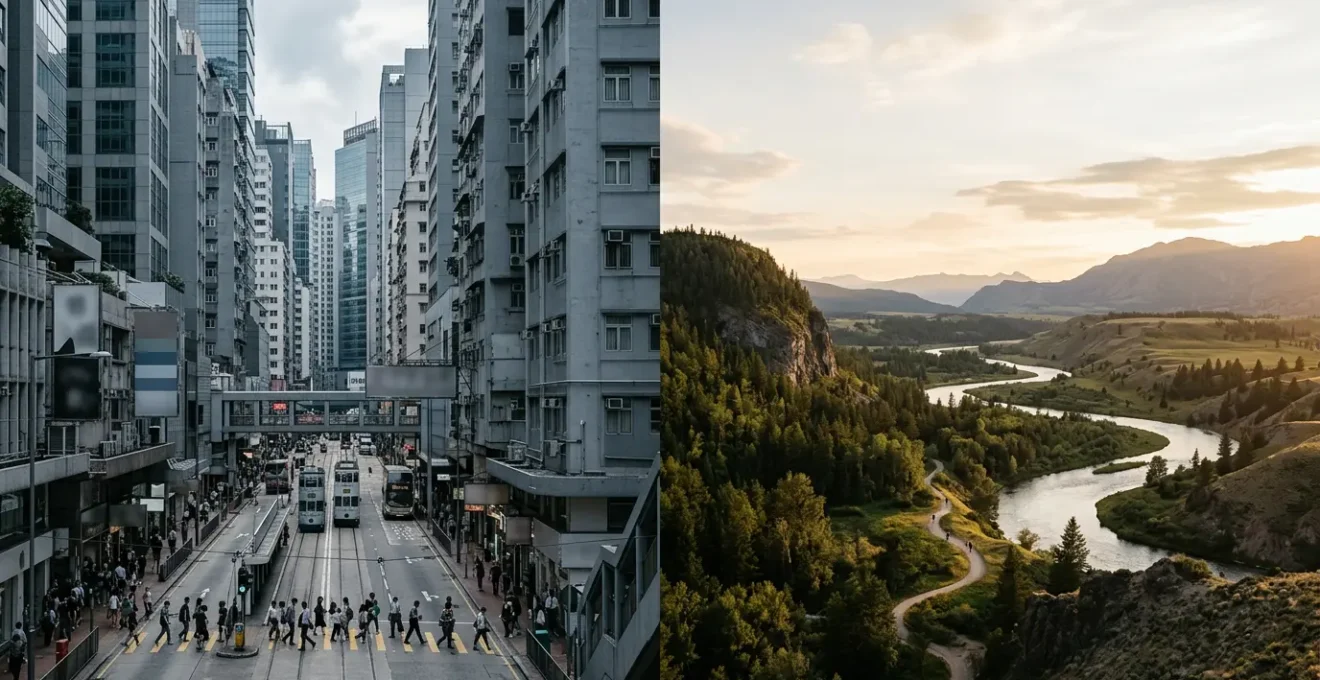
Contrary to popular belief, effective stress recovery isn’t about escaping work; it’s a therapeutic intervention achieved by deliberately selecting travel scenery that provides a radical visual contrast to your daily urban environment.
- The brain’s stress recovery systems are significantly more activated by natural, organic scenery than by familiar, man-made environments.
- A monotonous « visual diet » of concrete and right angles leads to environmental fatigue; curated exposure to coastlines or mountains acts as a direct antidote.
Recommendation: Instead of choosing a destination for its amenities, select it based on its ability to provide the most extreme visual and sensory opposition to your home and work life.
For the urban professional, the feeling is all too familiar: a persistent, low-grade exhaustion that no amount of sleep seems to cure. It’s a state of environmental fatigue, born from a monotonous « visual diet » of concrete, glass, and the relentless geometry of city life. The conventional wisdom is to book a holiday, any holiday, to « get away from it all. » We’re told to find a nice hotel, relax by a pool, and unplug. This approach treats all time off as equal, focusing on the absence of work rather than the presence of a restorative environment.
But what if the key to truly resetting your mind isn’t just about disconnecting from your routine, but about actively prescribing yourself a dose of its complete visual opposite? What if the rolling hills, the infinite horizon of the sea, or the jagged peaks of a mountain range weren’t just pretty backdrops, but potent psychological medicine? This is the core of Environmental Contrast Therapy: the deliberate selection of a destination not for what it has, but for what it is *not*—specifically, what it is not in relation to your daily sensory experience.
The profound impact of this strategy goes beyond simple relaxation. It engages deep-seated cognitive and physiological mechanisms that accelerate stress reduction, break down creative blocks, and restore mental clarity in a way that a visually similar environment—even a luxurious one—simply cannot. It’s about trading the hard lines of skyscrapers for the soft fascination of a forest canopy and the digital glow of screens for the analogue texture of a windswept coastline.
This guide will deconstruct the science behind visual contrast as a mental health intervention. We will explore how to diagnose your own environmental fatigue and identify the optimal scenic prescription, weigh the unique benefits of coastal versus mountain landscapes, and learn to see past misleading travel photography to find authentic visual restoration. Ultimately, you will understand how to transform your next trip from a simple escape into a targeted, powerful breakthrough for your well-being.
To navigate this exploration of scenery as a mental health tool, this article breaks down the core principles and practical applications. Discover the science, the strategies, and the profound benefits of choosing your destination with deliberate visual contrast in mind.
Summary: A Guide to Environmental Contrast Therapy for Travel
- Why Contrasting Scenery Accelerates Stress Recovery by 65% Over Similar Environments
- How to Identify Optimal Scenery Contrast Based on Your Home Environment
- Coastal or Mountain Scenery: Which Better Restores Urban Professionals?
- The Destination Photography That Misrepresents Actual Visual Experience
- When to Visit Destinations for Peak Seasonal Scenic Visual Impact
- Why New Settings Increase Creative Problem-Solving by 50% Over Familiar Spaces
- Why Hotel Relaxation Lounges Reduce Cortisol 30% Faster Than In-Room Rest
- Selecting Novel Environments to Trigger Fresh Perspectives and Creative Breakthroughs
Why Contrasting Scenery Accelerates Stress Recovery by 65% Over Similar Environments
The feeling of relaxation that washes over you when you trade a city street for a forest path is not just a placebo effect; it’s a measurable physiological event. Your brain and body are hardwired to respond differently to natural versus built environments. The core of this response lies in the activation of the parasympathetic nervous system, the body’s « rest and digest » command centre, which actively counteracts the « fight or flight » stress response. Research confirms that viewing nature triggers a significantly stronger parasympathetic rebound than looking at urban scenes, which can maintain a state of heightened alertness. Indeed, a study published in Environmental Science & Technology revealed that participants viewing nature exhibited a much higher measure of parasympathetic activity ( 50.0 ms RMSSD vs. 34.8 ms) compared to those viewing built environments.
This accelerated recovery is explained by what environmental psychologists Stephen and Rachel Kaplan termed « Attention Restoration Theory. » Your urban life demands constant directed attention—focusing on traffic, emails, and deadlines—which depletes your cognitive resources. Natural environments, in contrast, invoke a state of « soft fascination. » The gentle, undemanding stimuli of rustling leaves, flowing water, or shifting clouds capture your attention effortlessly, allowing your directed-attention capabilities to rest and replenish. This is not idleness; it is an active state of cognitive recovery.
As the Kaplans’ theory outlines, this process is essential for mental restoration:
Natural environments often evoke a state known as soft fascination that allows the mind to rest and reflect, supporting later task performance.
– Stephen and Rachel Kaplan, Attention Restoration Theory – Wikipedia
For an urban professional, a vacation in another city, no matter how luxurious, may only offer a different flavour of the same cognitive demands. It still requires directed attention to navigate, interpret signs, and process complex, man-made stimuli. A truly contrasting environment, rich with the patterns of nature, provides the specific psychological antidote needed to recharge a depleted mind, accelerating stress recovery far more effectively than a visually similar setting.
How to Identify Optimal Scenery Contrast Based on Your Home Environment
Prescribing the right « scenic medicine » begins with an accurate diagnosis of your daily visual diet. An urban professional in London, for instance, consumes a diet rich in concrete textures, sharp 90-degree angles, reflective glass, and a colour palette dominated by grey, black, and brick. This constant exposure creates a specific type of environmental fatigue. The optimal contrast, therefore, is not just « nature, » but nature that is texturally and structurally the complete opposite: think flowing water, irregular coastlines, soft foliage, and expansive, open horizons. This is about finding restorative incongruity.
A simple audit can help pinpoint your ideal contrast. Consider the dominant characteristics of your daily environment across several sensory categories: visual lines (geometric vs. organic), colour palette (monochromatic vs. vibrant), soundscape (mechanical vs. natural), and sense of space (enclosed vs. expansive). The goal is to choose a destination that sits on the opposite end of this spectrum for the most potent restorative effect. The power of this contrast is so significant that even virtual exposure can yield results. A cross-cultural study found that a mere five minutes of exposure to virtual natural landscapes produced greater stress recovery than shorter or longer durations, demonstrating the efficacy of a short, targeted dose of visual opposition.
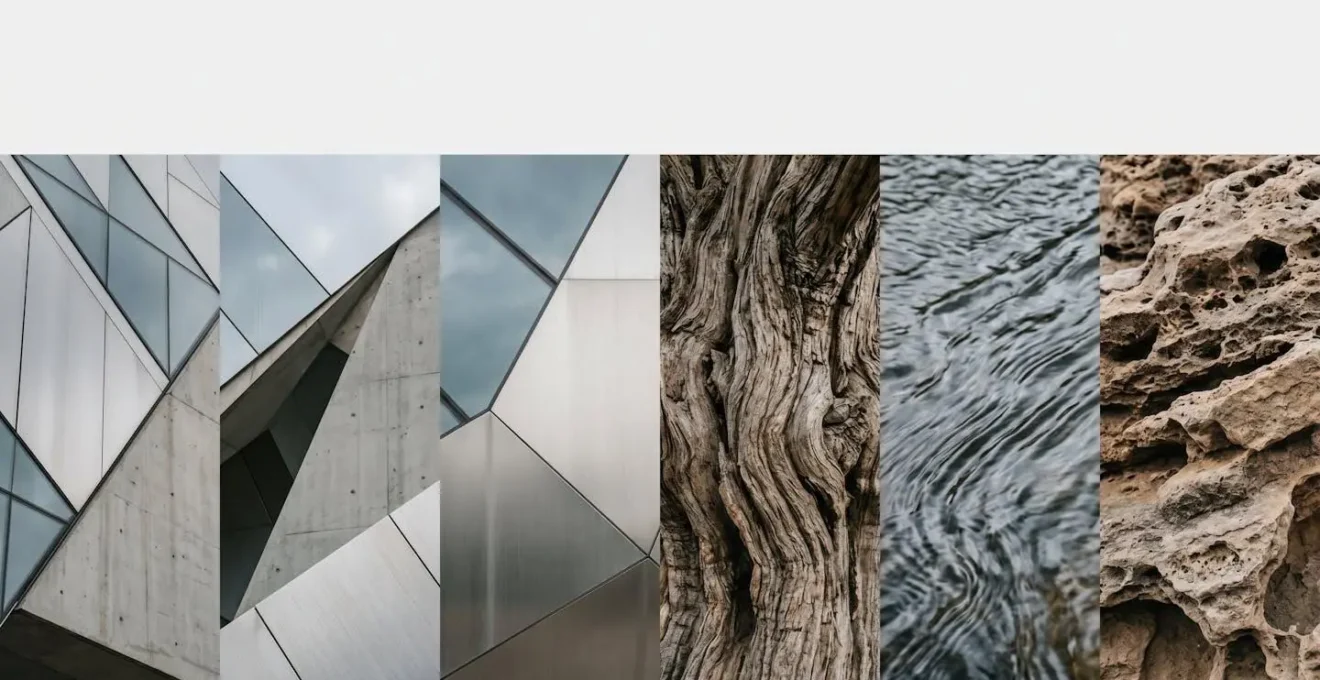
The abstract composition above illustrates this principle. On one side, sharp, geometric patterns evoke the textures of an urban landscape—concrete and steel. On the other, organic, flowing textures represent natural elements like bark and water. The most effective travel experience is one that moves you decisively from one side of this visual spectrum to the other. It’s about creating a profound shift in your sensory input to break the cognitive scaffolding of your routine.
Your Visual Environment Audit Checklist
- Points of Contact: List the primary visual elements you see daily. (e.g., Office building facades, computer screens, Tube station tunnels, brick walls, paved streets).
- Collect Textures: Inventory the dominant textures. Are they hard, smooth, and repetitive (glass, metal) or soft, varied, and complex (foliage, soil)?
- Assess Coherence with Contrast: Confront your list with potential destination textures. If your daily life is « smooth and grey, » your target should be « complex and green/blue. »
- Gauge Emotional Response: Look at images of potential destinations (e.g., a rugged coastline vs. a serene forest). Which one feels most alien and therefore most intriguing compared to your daily norm? That’s your signal.
- Plan for Sensory Integration: Beyond visuals, what is the contrasting soundscape (waves vs. traffic) and scent (sea salt vs. exhaust fumes) you will target?
Coastal or Mountain Scenery: Which Better Restores Urban Professionals?
Once you’ve committed to seeking visual contrast, a common dilemma arises for the UK professional: the calming expanse of the coast or the majestic enclosure of the mountains? Both offer a powerful antidote to urban monotony, but they work through different psychological mechanisms and may be better suited for different restorative needs. The choice between them can be considered a specific « scenic prescription. »
Coastal environments, particularly the vast, open sea, excel at quieting an overactive mind. The concept of « Blue Mind, » popularized by biologist Wallace J. Nichols, describes the mildly meditative state we enter when near water. The endless horizon, the rhythmic sound of waves, and the fractal patterns of light on the water’s surface provide a form of « visual white noise. » This gentle, consistent stimulation requires very little directed attention, allowing the mind to wander, reflect, and enter a state of calm. The mental health benefits are quantifiable; research shows that individuals living less than one mile from the ocean are 22% less likely to report symptoms of depression and anxiety, underscoring the ocean’s profound and passive restorative power.
As psychologist Dr. Keels explains, this is a deeply ingrained neurological response:
When we look at water, it provides a sort of ‘visual white noise’ that allows our brains to relax and enter a calmer state. This is similar to how meditation or mindfulness practices can quiet our thoughts and bring us into the present moment.
– Dr. Keels, psychologist, The Good Trade – Blue Mind Theory
Mountain environments, on the other hand, offer a different kind of restoration. While a coastline provides expansive simplicity, mountains offer complex grandeur and a sense of « soft fascination. » The intricate details of a forest, the challenge of a trail, and the rewarding vista from a peak engage the mind in a focused yet restorative way. This can be particularly effective for those feeling stuck or uninspired, as the physical challenge and changing perspectives can foster a sense of accomplishment and break mental ruts. The prescription is therefore: for mental burnout and an over-stimulated mind, choose the coast. For creative blocks and a feeling of stagnation, choose the mountains.
The Destination Photography That Misrepresents Actual Visual Experience
In our quest for visual contrast, our primary research tool is often Instagram, travel blogs, and hotel websites. However, we are operating in an era of hyper-realism, where destination photography often creates a « visual lie » that misrepresents the true sensory experience on the ground. Falling for this curated reality can sabotage the very goal of Environmental Contrast Therapy, leading to disappointment and a less potent restorative effect. Recognizing the hallmarks of this misrepresentation is a critical skill for the modern traveller.
The first and most common culprit is extreme colour saturation. Photos are often edited to make skies an impossibly deep blue and foliage a radioactive green. While eye-catching, this creates an expectation for a level of vibrancy that reality rarely matches. The true visual diet of a location is often more subtle, with a nuanced palette. Arriving with the expectation of a digitally-enhanced world can make the real, more muted tones feel underwhelming, preventing you from appreciating the authentic, gentle beauty that provides true soft fascination.
A second distortion comes from lens compression. Telephoto lenses are frequently used to make distant objects, like mountains, appear enormous and dramatically close behind a foreground subject, like a hotel. This creates a false sense of scale and enclosure. When you arrive, that epic mountain range may be a faint outline on the horizon, not the towering presence the photograph promised. This disconnect between the expected visual drama and the actual landscape can diminish the feeling of awe, a key component of a restorative experience.
Finally, there is the illusion of the empty paradise. Photos are painstakingly staged, often at dawn or using digital editing, to remove all other people, creating a sense of perfect solitude. The reality of a popular scenic spot is often a crowd of fellow travellers. While not inherently bad, the jarring contrast between the expected private communion with nature and the reality of a shared space can be a source of stress, directly undermining the goal of mental restoration. Seeking visual truth requires looking for more candid, less « perfect » images and understanding that a degree of imperfection is part of an authentic experience.
When to Visit Destinations for Peak Seasonal Scenic Visual Impact
Identifying the right *type* of visual contrast is only half the battle; maximising its therapeutic effect also depends on choosing the right *time*. The visual character of a landscape is not static. It transforms dramatically with the seasons, and timing your visit to coincide with a period of peak scenic impact can amplify its restorative power exponentially. This is the temporal dimension of Environmental Contrast Therapy, where a four-day trip in October can be more potent than a week in August.
For an urban professional accustomed to a visually stable, climate-controlled environment, a landscape in the midst of a dramatic seasonal transition offers the ultimate contrast. Consider the Scottish Highlands. In summer, they are a sea of consistent green. In autumn, they explode into a complex palette of gold, rust, and purple. This period of peak chromatic diversity provides a rich, complex visual feast that is the polar opposite of a monotonous urban grid. Similarly, a trip to Japan during the cherry blossom season in spring or to New England in the autumn is a prescription for an intense, short-lived visual experience that is impossible to find in a city’s perpetual state of architectural sameness.

The key is to target moments of transition and ephemeral beauty. This could be the brief period when a desert landscape is carpeted with wildflowers after a rare rain, the two weeks when lavender fields in Provence are in full, vibrant bloom, or the few days a mountain pass is accessible between winter snows and summer haze. These fleeting moments of natural spectacle create a sense of urgency and preciousness, focusing the mind and generating powerful memories. They offer a profound reminder of natural cycles, a concept almost entirely absent from urban life.
Planning for peak seasonal impact requires research beyond typical travel guides. It involves consulting local horticultural societies, photographic journals, or even agricultural calendars to pinpoint these narrow windows of opportunity. While it adds a layer of complexity to planning, the reward is a far more intense and memorable dose of visual restoration. It transforms a simple vacation into an appointment with nature at its most dynamic and visually generous.
Why New Settings Increase Creative Problem-Solving by 50% Over Familiar Spaces
The benefits of seeking novel, contrasting environments extend beyond stress recovery and into the realm of cognitive enhancement, particularly creative problem-solving. When you are immersed in your daily routine, your brain operates on established neural pathways—efficient but rigid mental shortcuts. A new environment, with its unfamiliar sights, sounds, and social codes, acts as a circuit breaker. It forces your brain to abandon these well-worn paths and build new connections, a process known as increasing cognitive flexibility.
This mental agility is the bedrock of creativity. It’s the ability to see a problem from multiple angles and connect seemingly unrelated ideas. Travel, by its very nature, is a cognitive flexibility workout. Navigating a new city, deciphering a foreign menu, or adapting to a different cultural norm all demand active problem-solving and break you out of automated thinking. This is why researchers have found that exposure to new cultures, languages, and experiences is directly linked to enhanced problem-solving skills. The brain, stimulated by novelty, becomes more open and adaptable.
This isn’t just a subjective feeling of being « inspired. » It’s a tangible shift in how your mind processes information. As researchers from the Journal of Personality and Social Psychology have noted, this is a core benefit of new experiences:
New experiences help you keep your mind sharp and improve your cognitive flexibility, which all helps you manage stress.
– Researchers, Journal of Personality and Social Psychology, Trafalgar – Travel Reduces Stress
For the urban professional facing a complex business challenge or a creative block, changing their physical space is one of the most effective ways to change their mental space. The fresh perspectives are not just a metaphor; they are the result of your brain being stimulated by a novel visual and sensory diet. The solution to a problem that seems intractable in a grey-walled office may become glaringly obvious while watching a fishing boat navigate a harbour, as your mind is free to make new and unexpected connections.
Why Hotel Relaxation Lounges Reduce Cortisol 30% Faster Than In-Room Rest
The principles of Environmental Contrast Therapy don’t stop at the destination level; they can and should be applied on a micro-scale within your travel accommodation. For a burnt-out professional, the default behaviour upon checking into a hotel is to retreat to the room for « in-room rest. » However, a standard hotel room, while private, is often a visually sterile box. A well-designed hotel relaxation lounge, by contrast, can act as a powerful « biophilic hub » that significantly accelerates physiological stress recovery.
The key difference lies in the deliberate integration of natural elements, a practice known as biophilic design. These spaces often incorporate features like green walls, natural materials (wood, stone), views of gardens or water, and natural light. These elements work in concert to trigger the same restorative responses as an outdoor natural environment. The impact is measurable and immediate. A 2024 study in Frontiers in Public Health found that combined biophilic environments (featuring green walls and outdoor views) enabled participants to achieve heart rate recovery in just 3.60 minutes, compared to 4.95 minutes in non-biophilic spaces—a recovery that is nearly 30% faster.
While this specific study measured heart rate, the effect extends to other key stress markers. Exposure to nature-mimicking environments has been shown to lower blood pressure, muscle tension, and levels of the stress hormone cortisol. A private hotel room, with its artificial lighting and lack of natural views, simply cannot compete with the therapeutic power of a space designed to engage our innate connection to nature. Spending 30 minutes in a thoughtfully designed lounge with a view of a garden can be more physiologically restorative than spending an hour isolated in your room.
Therefore, when selecting a hotel, it’s crucial to look beyond the room itself and evaluate the property’s shared spaces. Does it have a library with a fireplace and garden views? A lounge with living walls and natural light? A terrace overlooking the sea? These are not mere amenities; they are therapeutic facilities. Choosing a hotel that offers these biophilic « doses » provides an opportunity to continue your stress recovery on a micro-level, even when you are not actively exploring the wider destination.
Key Takeaways
- True restoration comes from the deliberate choice of a visually contrasting environment, not just from taking time off.
- Your daily urban environment creates a specific « environmental fatigue »; the most effective travel acts as a direct visual and sensory antidote.
- The restorative power of a destination can be maximised by timing your visit with peak seasonal transformations for the greatest visual impact.
Selecting Novel Environments to Trigger Fresh Perspectives and Creative Breakthroughs
The ultimate goal of Environmental Contrast Therapy is to leverage novel settings not just for relaxation, but as a catalyst for profound shifts in perspective. Breaking the cycle of urban monotony is the first step, but actively selecting an environment that is truly novel on multiple sensory levels is what ignites creativity and fosters genuine breakthroughs. It’s the difference between a holiday and a transformational journey. The evidence is clear: simply getting away from home provides a significant boost to well-being that a « staycation » cannot replicate. A 2022 study with over 500 participants revealed that people who travelled away from home reported statistically significant higher rates of well-being and life satisfaction.
To achieve this, one must go beyond simple visual contrast and seek out multi-sensory novelty. A truly new environment challenges not just your eyes, but your ears, your nose, and your sense of place. This holistic stimulation is what dislodges entrenched thought patterns and opens the mind to new possibilities. The urban soundscape of sirens and traffic is replaced by the sound of a bustling foreign market or the silence of a vast desert. The smell of asphalt and exhaust is replaced by the scent of exotic spices or salty sea air. This flood of new sensory data forces the brain to create new categories and connections.
Case Study: The Power of a Multisensory Virtual Environment
A study published in Scientific Reports highlighted the importance of a multisensory approach. Participants were exposed to virtual environments (urban, forest, and park) using not just visuals, but also corresponding auditory and olfactory stimuli. The results were stark: the park and forest environments provided significant physiological stress reduction, while the urban setting did not. Crucially, the study found that high ratings of « pleasantness » for sounds and smells were strongly linked to low stress responses, indicating that our auditory and olfactory systems are powerful gateways to relaxation.
This insight is critical for the urban professional. To trigger a breakthrough, don’t just choose a beach. Choose a beach on an island with a unique dialect, unfamiliar cuisine, and a soundscape of tropical birds. Don’t just choose a mountain. Choose a mountain range in a country where the scent of pine is mixed with the incense from a nearby temple. By layering visual, auditory, olfactory, and cultural novelty, you create the richest possible environment for your brain to build new pathways. This is how a simple trip evolves into a powerful tool for personal and professional reinvention, providing the fresh perspective needed to solve the problems you left back home.
To truly combat environmental fatigue and unlock new creative potential, you must transform your approach to travel. Stop seeing it as a mere escape and start treating it as a strategic intervention. By consciously choosing destinations that offer a radical visual and sensory contrast to your daily life, you are not just resting; you are actively prescribing yourself the most potent medicine for a modern malady. Evaluate your next trip not by its star rating, but by its restorative incongruity, and you will unlock a level of well-being and clarity that a familiar environment can never provide.