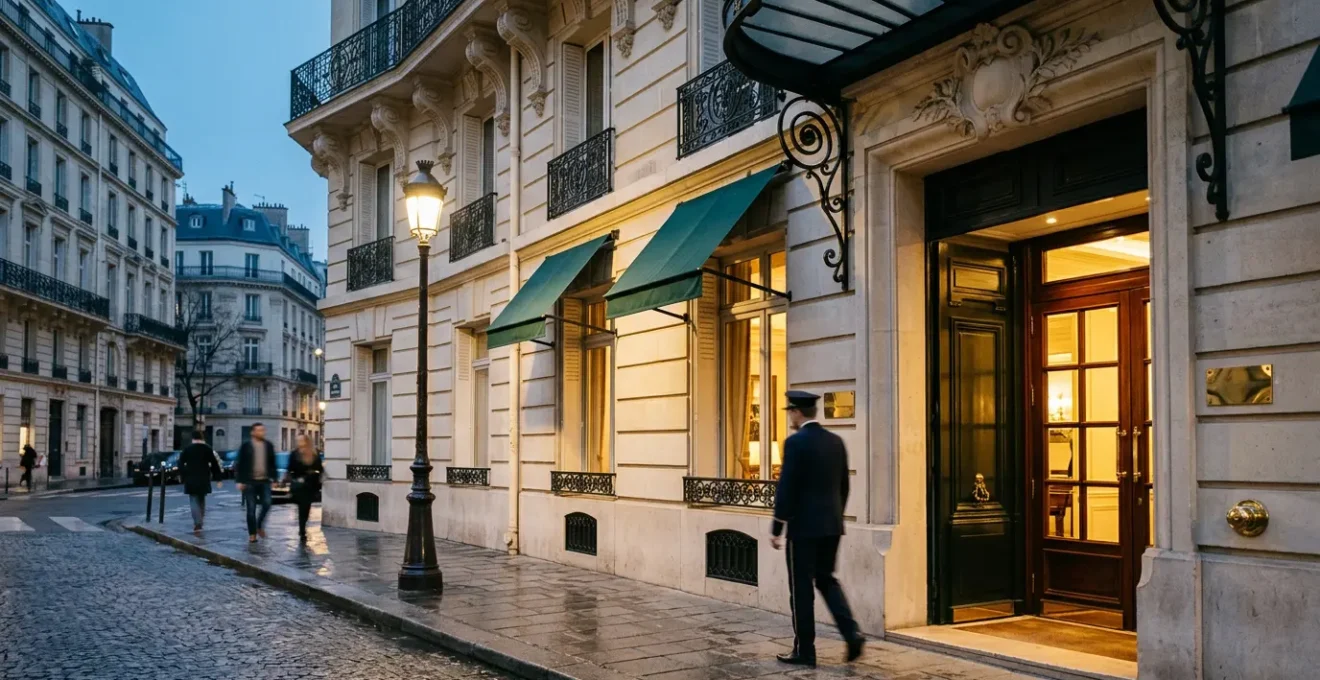
The romance of a classic Parisian hotel is only realised when its heritage charm is matched by verified modern functionality.
- True value lies in the justifiable location premium, offering unparalleled walkability and saving significant time and travel costs.
- Verify modernization by conducting ‘digital forensics’ on user photos and reviews for clues about power outlets, water pressure, and Wi-Fi speed.
Recommendation: Assess the ‘heritage-functionality ratio’ before booking to avoid the common trap of historic charm masking critical maintenance neglect.
For the discerning UK Francophile, the allure of a classic Parisian hotel is undeniable. It’s a fantasy woven from Haussmannian façades, wrought-iron balconies, and the promise of stepping into a living postcard. Properties like the Hotel Bedford, nestled in the 8th arrondissement, epitomize this dream. Yet, for every traveller enchanted by historic character, there’s a nagging question: does the 19th-century charm come at the cost of 21st-century comfort? The common advice—to simply check reviews or pick a central location—barely scratches the surface of this dilemma.
Many guides focus on aesthetics, praising antique furniture or period details, while ignoring the functional realities of a stay. They might warn that rooms are small but offer no strategy for mitigating the issue. This creates a significant risk: booking a dream that turns into a frustration of weak Wi-Fi, insufficient power outlets, and poor soundproofing. The true art of selecting a heritage hotel in Paris is not about finding the most charming property, but about finding the one that strikes the perfect, quantifiable balance between its historic narrative and its functional modernization.
But if the key isn’t just about location or looks, what is it? The answer lies in developing an evaluation framework. This guide moves beyond romantic notions to provide an expert methodology for assessing these properties. We will deconstruct the value of location, teach you how to perform ‘digital forensics’ to see past marketing photos, and weigh the pros and cons of iconic neighbourhoods. By the end, you will be equipped not just to choose a hotel, but to critically evaluate it, ensuring your Parisian experience is as seamless as it is beautiful.
This article provides a structured approach to making that choice, breaking down the key evaluation criteria. The following sections offer a comprehensive table of contents to guide your assessment.
Summary: Assessing Hotel Bedford Paris as a Case Study in Classic Parisian Hospitality
- Why Historic Paris Hotels Like Bedford Justify 50% Location Premiums
- How to Verify Heritage Paris Hotels Have Modernized Rooms Beyond Façades
- 8th Arrondissement or Le Marais: Which Better Serves First Paris Visits?
- The Heritage Paris Hotel Trap Where Charm Masks Maintenance Neglect
- When to Book Paris Heritage Hotels to Avoid Fashion Week 300% Surcharges
- Why Saint-Germain-des-Prés Beats Le Marais for First-Time Paris Visitors
- How to Identify Authentically Spanish Luxury Hotels Versus International Franchises
- Balancing Proximity to Parisian Landmarks With Reasonable Accommodation Rates
Why Historic Paris Hotels Like Bedford Justify 50% Location Premiums
The initial sticker shock of a centrally located heritage hotel can be jarring. It’s tempting to look towards the outer arrondissements for better value, but this often overlooks a crucial calculation: the Experience ROI. The premium paid for a hotel in the 1st, 6th, or 8th arrondissement is not just for a prestigious address; it’s a direct investment in time and convenience. The ability to walk to the Louvre, stroll through the Tuileries Garden after dinner, or return to your room between shopping and a show without a 30-minute Métro ride is a tangible luxury that reshapes the entire rhythm of a trip.
This location premium becomes even more pronounced during major city events. For example, the convergence of walkability to landmarks and immediate access to cultural happenings justifies the higher rates. During Paris Fashion Week, central districts like the 8th become the epicentre, with data showing occupancy reaching 86.3 percent and revenue per available room climbing significantly. This demand underscores the recognized value of proximity.
Ultimately, the premium is a trade-off. What you spend on the room, you save in transportation costs and, more importantly, in precious hours not spent navigating public transport. For a short, focused trip, this can mean the difference between a rushed, checklist-driven visit and an immersive, leisurely experience. The key is to see the higher rate not as an expense, but as a strategic purchase of the most valuable commodity on any holiday: time. The concentration of demand in these areas, especially during peak seasons, can lead to staggering prices, with preliminary data projecting an average daily rate of €514.05 in June 2025 for the market.
How to Verify Heritage Paris Hotels Have Modernized Rooms Beyond Façades
A beautiful Haussmannian façade and a lobby filled with antiques can create a powerful first impression, but they reveal nothing about the functional quality of the guest rooms. The most common pitfall for travellers is falling for the « heritage trap, » where charm effectively masks a lack of essential modern updates. To avoid this, you must become a digital detective, looking past the hotel’s professionally curated photos to uncover the reality of the guest experience. The goal is to assess the true ‘heritage-functionality ratio’ before you book.
Your investigation should focus on user-submitted content across multiple review platforms. Scrutinize candid guest photos for clues that professional photographers are paid to hide. Are there enough power outlets near the bed, or is there a single socket across the room? Can you spot the tell-tale frame of a double-glazed window, suggesting proper soundproofing against street noise? These small details are powerful indicators of a hotel’s commitment to functional modernization. Similarly, searching reviews for specific keywords like « water pressure, » « Wi-Fi speed, » and « air conditioning » provides unfiltered feedback on the amenities that matter most for a comfortable stay.
A hotel’s own digital presence is another clue. A fast, modern, and mobile-friendly website suggests an organization that invests in contemporary technology, which often translates to the in-room experience. Conversely, a clunky, outdated site can be a red flag. The most revealing evidence, however, often lies in photos of high-traffic common areas like elevators and hallways. These spaces are rarely featured in marketing materials, and their state of maintenance offers a transparent glimpse into the hotel’s true operational standards.
Your Action Plan: The Digital Detective’s Checklist for Hotel Evaluation
- Analyse User Photos: Scrutinise guest-submitted photos (not professional ones) for specific clues: number and placement of power outlets, and signs of double-glazed windows for soundproofing.
- Conduct Keyword Searches: Search within reviews on multiple platforms for critical terms like ‘water pressure,’ ‘Wi-Fi speed,’ ‘air conditioning,’ and ‘noise from street/hallway’.
- Assess Digital Presence: Evaluate the hotel’s website. A fast, modern, mobile-friendly site with recent updates indicates a broader investment in modernization.
- Inspect High-Traffic Areas: Check for guest photos of elevators and hallways. These reveal true maintenance standards often ignored in professional marketing.
- Look for Quality Assurance: Check if the hotel mentions compliance with LQA (Leading Quality Assurance) standards, which cover over 800 benchmarks for luxury hospitality.
8th Arrondissement or Le Marais: Which Better Serves First Paris Visits?
For first-time visitors, the choice of neighbourhood often boils down to two iconic but vastly different options: the stately 8th Arrondissement and the bohemian-chic Le Marais. There is no single « best » choice; the right one depends entirely on your travel personality and the desired rhythm of your trip. The 8th is defined by structured grandeur. Its wide, efficient avenues are perfect for the planner who has a destination-oriented itinerary of museums, landmarks, and luxury shopping along the Golden Triangle. It’s polished, monumental, and optimized for a high-impact, if somewhat corporate, stay.
Le Marais, spanning the 3rd and 4th arrondissements, offers the opposite: serendipitous discovery. Its winding medieval streets encourage a slower, more exploratory pace. It’s ideal for the wanderer who thrives on unpredictability, happy to stumble upon independent boutiques, hidden courtyards, and the vibrant energy of the Jewish Quarter. While the 8th tends to quiet down after business hours, Le Marais maintains a palpable energy well into the evening, with its dense network of restaurants and bars.
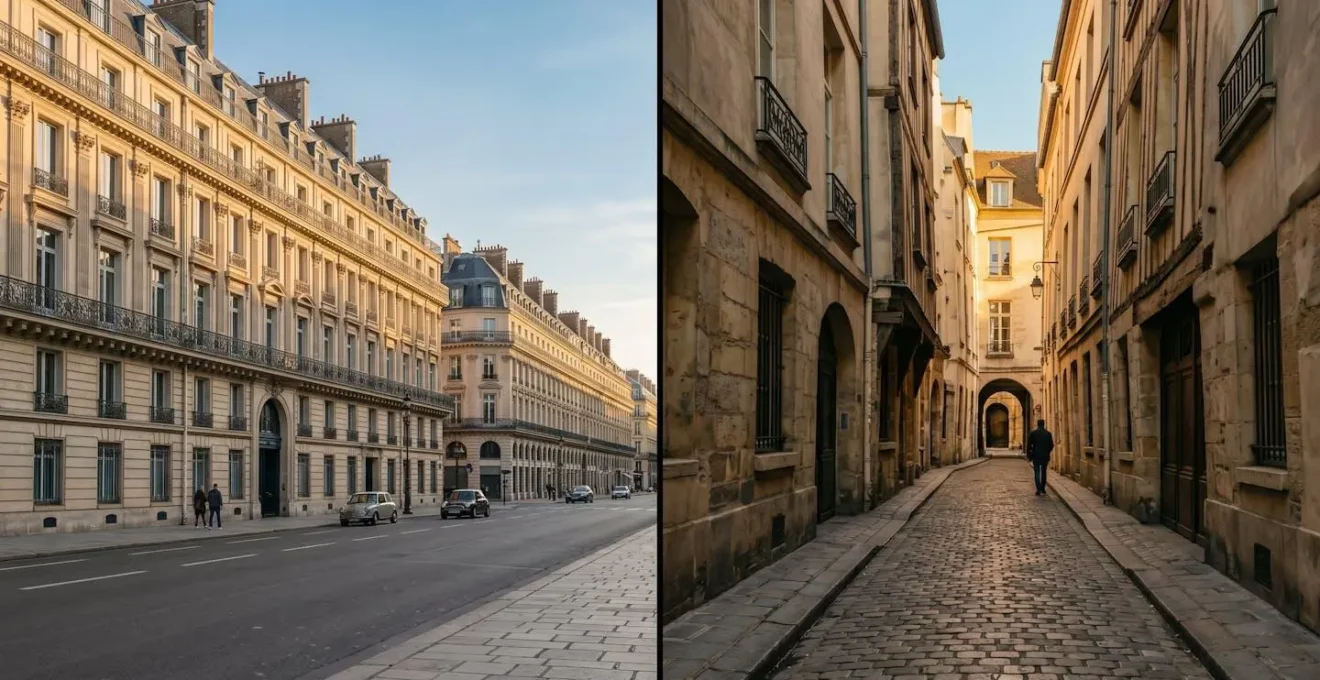
As the image above suggests, the architectural feel of each district dictates its experience. The open, symmetrical boulevards of the 8th facilitate efficient movement, while the intimate, narrow streets of Le Marais invite you to get lost. The following table breaks down the key differences to help you align your choice with your travel style.
| Criteria | 8th Arrondissement | Le Marais (3rd/4th) |
|---|---|---|
| Travel Personality | Structured Grandeur – Planner who enjoys monumental scale | Serendipitous Discovery – Wanderer thriving on unpredictability |
| Neighborhood Rhythm | Wide avenues for efficient, destination-oriented days | Winding medieval streets encouraging slower, exploratory pace |
| After 8 PM Atmosphere | Quieter, more corporate after business hours | Vibrant energy with restaurants and bars remaining active |
| Proximity Advantage | Champs-Élysées, Arc de Triomphe, luxury retail Golden Triangle | Medieval charm, independent boutiques, Jewish Quarter, Place des Vosges |
| Best For | Short polished stays, chauffeur use, shopping-focused trips | Neighborhood intensity, evening texture, authentic Parisian atmosphere |
| Metro Connectivity | Multiple lines, business-traveler optimized | Lines 1, 3, 5, 7, 8, 9, 11 at borders; central areas less connected |
The Heritage Paris Hotel Trap Where Charm Masks Maintenance Neglect
The greatest risk in booking a heritage hotel is the « charm trap, » where the romantic appeal of a historic building is used to excuse or obscure underlying maintenance issues. Peeling paint is framed as « patina, » worn-out furniture as « antique, » and rattling windows as « character. » A discerning traveller must learn to distinguish between genuine, well-preserved history and simple neglect. True luxury and quality are not found in the age of the decor, but in the meticulous care with which it is maintained. This principle of maintenance transparency is the ultimate indicator of a well-run establishment.
As a leading figure in the luxury industry once noted, the definition of luxury is multifaceted but always rooted in quality. This sentiment is particularly relevant when evaluating hotels that trade on their history. Angelo Bonati, a stalwart of luxury branding, offered a definition that serves as a perfect benchmark for hospitality evaluators:
Luxury is attention to detail, originality, exclusivity, and above all quality.
– Angelo Bonati, LQA Standards: How to Succeed in Luxury Hospitality
This « attention to detail » is precisely what separates a truly great heritage hotel from a tired one. It’s visible in the quality of the linens, the flawless operation of plumbing fixtures, and the absence of scuff marks in hallways. While many factors contribute, the quality of essentials like bedding can be a surprisingly strong signal; for instance, high-end European luxury hotel linen is strongly associated with softness and durability, reflecting an investment in guest comfort that often correlates with overall maintenance standards. When a hotel invests in these unseen details, it’s a strong sign that they are not cutting corners elsewhere. Ignoring these signals means you risk paying a premium for a fantasy that the hotel fails to deliver in reality.
When to Book Paris Heritage Hotels to Avoid Fashion Week 300% Surcharges
Choosing the right hotel is only half the battle; choosing the right time to book is paramount to securing a reasonable rate. Paris is a city of events, and marquee gatherings like Paris Fashion Week can cause hotel prices in prime arrondissements to skyrocket by as much as 300%. Navigating this volatile pricing landscape requires a strategic approach to timing, transforming the booking process from a simple transaction into a calculated decision. The goal is to sidestep the extreme demand peaks without sacrificing the quality of your stay.
The most powerful strategy is to book far in advance. Most Parisian hotels open their booking windows 365 days out, often with flexible, refundable rates. Locking in a good rate six to nine months ahead of your travel dates provides a crucial hedge against last-minute price surges. This also gives you the flexibility to cancel and rebook if a better deal appears. Equally important is being aware of the city’s event calendar. The major Fashion Weeks in late February/early March and late September/early October are the most notorious for price hikes, but other large-scale trade fairs like Maison & Objet or the Eurosatory defense expo can have a similar impact.
Targeting « shoulder dates »—arriving a day or two before an event begins or staying a day after it ends—can also yield significant savings. For leisure-focused hotels, there is often a mid-week value gap, with check-ins on a Tuesday or Wednesday being dramatically cheaper than on a Friday. Finally, a willingness to expand your map slightly to well-connected but less central neighbourhoods like Belleville or Saint-Ouen can provide an escape from the fiercest pricing pressures while still offering fast Métro access to the city center.
- Book at least six months ahead to lock in refundable rates and monitor for price drops.
- Avoid the key Fashion Week dates in late February/early March and late September/October when rates can triple.
- Target shoulder dates by arriving two days before or after major events for significant cost reductions.
- Be aware of major trade fairs beyond fashion, such as Maison & Objet, SIAL Paris, and Eurosatory.
- Exploit the mid-week value gap, as Tuesday or Wednesday check-ins are often cheaper for leisure hotels.
Why Saint-Germain-des-Prés Beats Le Marais for First-Time Paris Visitors
While Le Marais offers undeniable energy and charm, for many first-time luxury visitors, Saint-Germain-des-Prés on the Left Bank presents a more balanced and strategically sound choice. The argument for Saint-Germain is less about its own considerable attractions—the famous cafés, art galleries, and proximity to the Jardin du Luxembourg—and more about its superior positioning for experiencing all of Paris. It serves as a more practical and elegant home base, especially when considering the end-of-day logistics that can make or break a trip.
This perspective is championed by experienced city guides who prioritize the overall flow of a visit. As the specialists at Orange Donut Tours state, the choice for a first luxury stay is clear:
For a first luxury stay in Paris, I would book the Left Bank, and more specifically the north side of Place Saint-Sulpice, before I booked Le Marais or most of the 8th Arrondissement.
– Orange Donut Tours, Where to Stay in Paris for a Luxury First Visit
The reasoning behind this strong preference is rooted in a deep understanding of the tourist experience. It’s about solving what can be called the « last half-hour problem »—the slightly awkward journey back to your hotel after a long day of sightseeing or a late dinner. A base in Saint-Germain often makes these final trips smoother and shorter, avoiding an extra bridge crossing or a less direct Métro ride that can feel arduous when you’re tired. It elegantly balances access to both the Right Bank’s monumental sights and the Left Bank’s distinct atmosphere.
Case Study: Saint-Germain-des-Prés as an Optimal First-Visit Base
Saint-Germain-des-Prés excels for first luxury visits by adeptly solving the « last half-hour problem »—the tiring return journey after dinner or a museum day. A hotel near Saint-Sulpice ensures these endings are smoother. The neighborhood offers the Jardin du Luxembourg for peaceful decompression, while the combination of Le Bon Marché, luxury brands, and art galleries provides a more curated shopping experience than the denser boutique atmosphere of Le Marais. Furthermore, its rich intellectual and artistic narrative, as the historic home of Existentialism and literary cafés, provides a compelling story for first-time visitors to inhabit.
How to Identify Authentically Spanish Luxury Hotels Versus International Franchises
While the specifics of a title might point to identifying authentically Spanish hotels, the underlying principle is universal and critically important for a market like Paris: how does a traveller distinguish a truly authentic, locally-rooted luxury hotel from an international franchise that merely wears a Parisian costume? In a city saturated with global brands, finding a property that offers a genuine sense of place, rather than a standardized corporate experience, is a key part of the evaluation process for a discerning Francophile. This is about finding cultural integrity, not just a postcode.
The first indicator of authenticity is often in the ownership and management structure. Is the hotel part of a small, family-owned group with deep roots in the city, or is it one of hundreds in a global portfolio? Independent or small-collection hotels often have more freedom to cultivate a unique personality, from the art on the walls to the suppliers they use for their restaurant. They are more likely to reflect the specific character of their neighbourhood, rather than a brand-wide design template. An example is a hotel that features works by local artists from Saint-Germain or sources its pastries from a neighbourhood-favourite *boulangerie*.
Another key differentiator is the service culture. An authentic Parisian hotel often has long-serving staff—a concierge who has been with the property for decades, for instance—who possess an institutional memory and a deep, personal connection to the city. This contrasts with the often-transient, script-driven service of a large franchise. The level of personalization, the quality of the recommendations, and the warmth of the interactions can be profoundly different. Seeking out this authenticity is the final layer of a sophisticated hotel assessment, ensuring the experience is as culturally rich as it is comfortable.
Key Takeaways
- The price premium for central Parisian hotels is a direct investment in time and convenience, offering a superior « Experience ROI. »
- Verify modernization by scrutinizing user-submitted photos for details like power outlet placement and signs of double-glazed windows.
- Choose your arrondissement based on your travel personality: the 8th for structured grandeur, Le Marais for serendipitous discovery, and Saint-Germain for a balanced, strategic base.
Balancing Proximity to Parisian Landmarks With Reasonable Accommodation Rates
The ultimate goal for any savvy traveller is to find the sweet spot between prime location and a sustainable budget. While proximity to landmarks is a major advantage, it’s not an all-or-nothing proposition. The key is to think in terms of access rather than absolute adjacency. By employing a « one-arrondissement-over » strategy, you can often achieve dramatic rate reductions of 20-40% while remaining just a short walk or Métro ride away from the main attractions. This involves targeting neighbourhoods that border the prime tourist zones, such as the 15th near the 7th, or the 9th near the 8th.
This strategic thinking is more critical than ever, as accommodation costs continue to rise across all categories. For instance, even the economy sector has seen a 13% increase in average daily rates in Greater Paris, according to 2023 data. This makes intelligent compromises essential. Instead of prioritizing proximity to a single landmark, a better approach is to prioritize proximity to a major Métro hub like République or Montparnasse. This gives you efficient access to the entire city, making you more mobile than someone staying next to the Eiffel Tower who has to transfer lines to reach Le Marais or Montmartre.
This leads back to the concept of Experience ROI. A hotel that is €50 more expensive per night but saves you 90 minutes of travel time and €20 in daily transport fares is arguably the more economical and enjoyable choice. You must calculate the holistic value of your location. The often-overlooked 2nd arrondissement is a perfect example of this principle in action. It’s more compact and less formal than its neighbours, offering a delightful mix of covered passages and unique shops, but is frequently bypassed by tourists, resulting in better value just steps from the 1st.
- Target neighborhoods bordering prime zones (e.g., 9th near 8th) for 20-40% rate reductions.
- Prioritize major metro hubs (République, Montparnasse) over single-landmark proximity for city-wide access.
- Calculate your ‘Experience ROI’: a slightly pricier hotel might be more economical if it saves significant travel time and fares.
- Consider overlooked areas like the 2nd arrondissement for better value adjacent to prime locations.
Apply this evaluation framework to your next Paris trip planning. By moving beyond surface-level charm and critically assessing location, modernization, and authenticity, you can book with the confidence of an expert, ensuring your stay is as flawless as it is memorable.